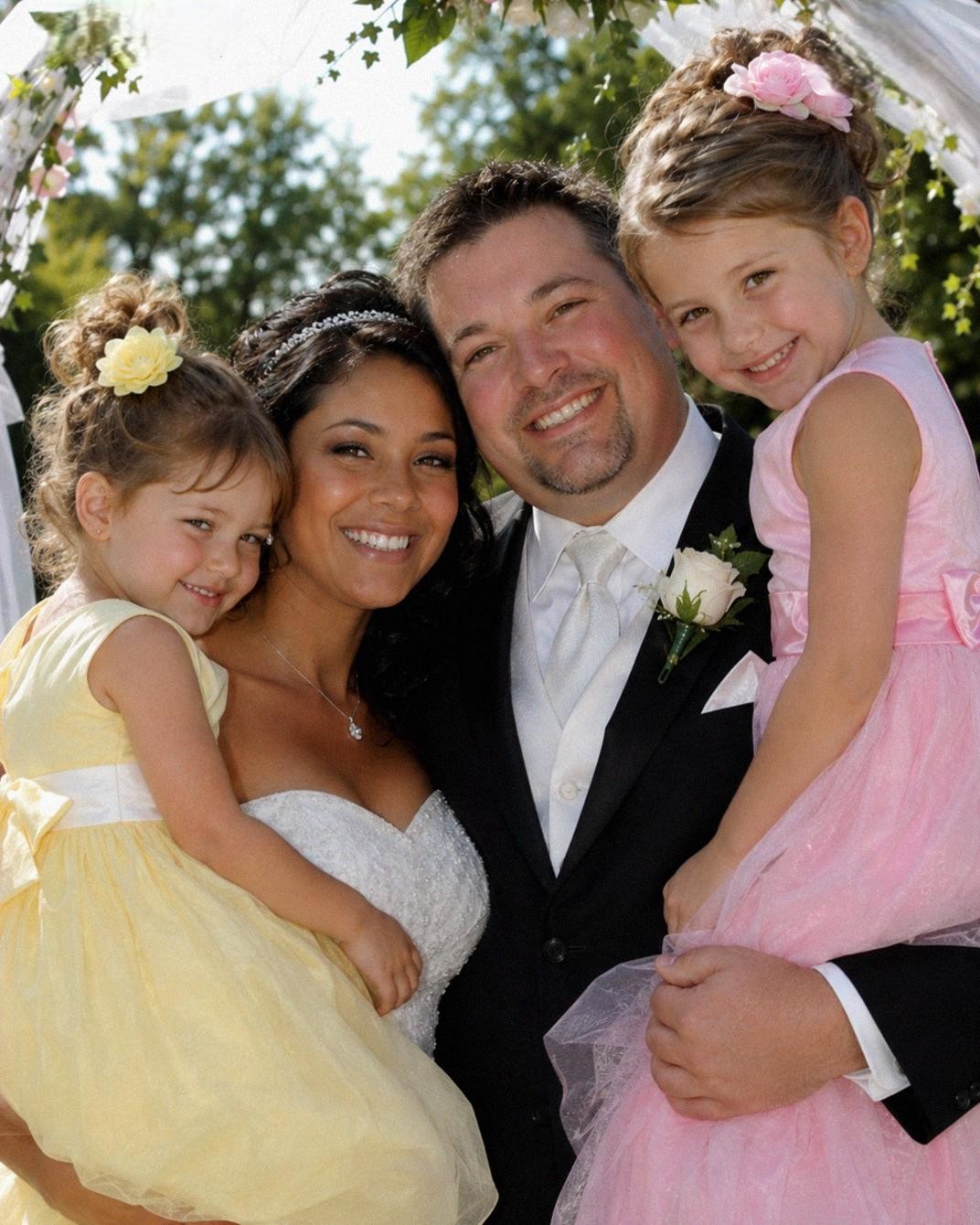
Because once I met the girls, I understood why he fought so hard to keep going. Grace was all bright eyes and sharp questions, like the world was a mystery she planned to solve personally. Emily was shy at first—half-hidden behind Daniel’s leg—until she decided I was safe and climbed into my lap with a book like it was the most natural thing in the world.
A year later, Daniel and I got married in a small lakeside ceremony with close family. Grace wore a flower crown and asked about the cake every ten minutes. Emily fell asleep before sunset. Daniel looked happy… but guarded, like he didn’t trust happiness to stick around.
After the wedding, I moved into his suburban home—big kitchen, wraparound porch, toys everywhere, family photos in the hallway.
And one detail that stood out immediately:
The basement door was always locked.
When I asked Daniel about it that first week, he barely looked up from the dishes. He said it was just storage—old tools, heavy boxes, random junk—and he kept it locked so the girls wouldn’t get hurt down there.
That sounded reasonable, so I let it go.
But over time, I noticed things that didn’t feel like “just storage.”
Grace would stand in the hallway staring at that door when she thought no one was watching. Emily would drift near it, then suddenly turn and hurry away like she’d remembered something scary.
One afternoon I found Grace sitting on the floor, eyes fixed on the doorknob like she was waiting for it to move.
When I asked what she was doing, she snapped out of it and ran to her room.
I told myself it was kid stuff. Grief does strange things to families. Still, it left a knot in my stomach I couldn’t untie.
The Day Everything Changed
It happened on a messy, ordinary afternoon.
The girls had mild spring colds, so I stayed home from work—runny noses, dramatic whining, the whole thing. By noon they’d “recovered” enough to sprint through the house playing hide-and-seek like nothing had ever been wrong.
I was at the stove warming chicken soup when Grace slipped into the kitchen and tugged on my sleeve—hard.
Her face was serious in a way that didn’t belong on a six-year-old.
“Do you want to meet my mom?” she asked.
I froze. I tried to keep my voice steady as I asked what she meant.
Grace frowned like I was the one being strange. “Do you want to see where she lives?”
Emily wandered in behind her, dragging a stuffed rabbit by one ear, and said softly, “Mommy’s downstairs.”
My heart started pounding so hard I could feel it in my throat.
Grace grabbed my hand and pulled me into the hallway with the excitement of showing me a surprise.
She led me straight to the basement door.
“Open it,” she said, like it was the simplest thing in the world.
I asked if their dad took them down there.
Grace nodded. “Sometimes. When he misses her.”
Every worst-case scenario I’d ever heard about flashed through my mind at once. The locked door. The secrecy. The girls acting like there was something alive down there.
I twisted the knob.
Locked.
My hands were shaking as I pulled out a couple of hairpins and worked at the lock—more instinct than logic, like my body had decided I needed the truth immediately.
Then—click.
The door opened.
What Was Behind the Locked Door
The smell hit first: damp air, mildew, something sour and stagnant.
I stepped down slowly, eyes adjusting to the dim light.
And then the fear drained out of me—replaced by something heavier.
It wasn’t a crime scene.
It was a shrine.
The basement had been arranged like a small living room: an old couch, a folded blanket, shelves full of photo albums. Framed pictures of Daniel’s late wife were everywhere—on tables, on shelves, leaning against boxes.
There were kids’ drawings taped up like decorations.
A tiny plastic tea set sat on a child-sized table. A knitted cardigan hung over a chair. Yellow rain boots rested against the wall like someone might step into them any minute.
An old TV and DVD player sat beside stacks of home videos labeled in neat handwriting: Zoo Trip. Grace Birthday.
The sour smell came from a leaking pipe dripping into a plastic bucket, leaving a dark stain creeping across the wall.
Grace beamed. “See? This is where Mommy lives.”
Emily hugged her rabbit and whispered that they watched Mommy on the TV while Daddy talked to her.
My throat tightened.
This wasn’t evil.
It was grief—untreated, locked away, and quietly teaching two little girls that death was something you could deny if you made the room convincing enough.
On a side table, a journal lay open. I didn’t want to pry, but one line caught my eye immediately:
“I wish you were here.”
Then we heard the front door open upstairs.
Daniel was home early.
The Confrontation
Grace bolted toward the stairs yelling, “Daddy! I showed her where Mommy lives!”
Footsteps stopped above us—then rushed fast, panicked.
Daniel appeared at the top of the stairs, face drained white as he saw the open door.
His voice shook when he demanded what I’d done.
Grace flinched at his tone, and something in me snapped into place. I stepped in front of the girls and told him not to speak to me like that.
He pressed his hands to his forehead and asked why the basement was open.
I told him the truth: “Because your daughter thinks her mother lives down here.”
Grace looked between us, trembling. “Did I do something wrong?”
Daniel’s anger collapsed instantly. He knelt and told her no—absolutely not.
I sent both girls upstairs to watch cartoons while we talked. They hesitated, sensing the tension, but finally went.
When the door shut behind them, I crossed my arms. “Explain.”
Daniel’s shoulders sagged. He admitted he’d meant to tell me about the basement—he just… didn’t.
He told me that after his wife died, everyone praised him for being “strong.” He packed lunches, worked long hours, kept the house running. And under all that, he never really dealt with what happened.
At first, he moved her things downstairs because he couldn’t throw them away.
Then when the girls missed her, he brought them down to look at photos and watch videos.
And somewhere along the way, he stopped correcting the fantasy—because it was easier than watching them hurt.
I pointed at the tea set, the boots, the cardigan. “Do you realize what you’ve built down here?”
He whispered, “Down here it feels like she’s still part of our life.”
My voice got quiet. “Then why marry me if you’re still living in the past?”
He said he loved me.
I asked if he loved me—or if he loved having someone help him carry a life he hadn’t let go of.
He looked away, and after a long pause, admitted it was both.
That truth hurt, but it was honest—and honesty was the first real breath we’d taken in that house in a long time.
I told him he didn’t have to erase his late wife. The girls deserved to remember her.
But they couldn’t grow up believing their mother was “downstairs,” waiting behind a lock.
We needed help. Real help.
Therapy. Grief counseling. A healthier way to honor her memory without trapping the entire family inside it.
Daniel covered his face and finally exhaled like someone who’d been holding in pain for years.
We agreed on two immediate changes: fix the leaking pipe and stop treating the basement like a secret world.
Telling the Girls the Truth
The next morning, Daniel sat Grace and Emily at the kitchen table with me nearby.
He held Grace’s hand and gently explained that Mommy didn’t live in the basement.
Grace argued that they saw her down there.
Daniel explained they saw pictures, videos, and belongings—things that helped them remember her—but that she wasn’t living in any room of the house because she had died.
Emily’s lip trembled. “Where is she now?”
Daniel, crying openly, told them she lived in their hearts, their memories, and the stories they’d keep telling.
Grace went quiet for a long time, then asked if they could still watch the home videos sometimes.
Daniel promised they could.
A week later, the leak was repaired. The basement door stayed unlocked. And a therapist’s number went up on the fridge where we’d all see it every day.
That locked door didn’t just hide a room—it hid grief that was shaping our family without permission.
Opening it hurt.
But it finally gave us a chance to heal in the open, where love and truth could exist in the same space.
If this story moved you, share your thoughts in the comments: How do you think families can honor someone they’ve lost without getting stuck in the pain? And if you’d like more real-life relationship and parenting stories like this, stick around and read the next one.