The Next Morning, the School Called—And the Principal Sounded Terrified
Monday morning, as I was getting ready for work, my phone rang. The caller ID showed the school.
It was the principal. Her voice was tight, urgent, and shaky in a way that instantly made my mind jump to every parent’s worst fear.
“Can you come in right now?” she asked. “Please. Immediately.”
I tried to get details, but she wouldn’t explain over the phone. She just repeated that I needed to come in.
I grabbed my keys and drove there with my heart pounding, imagining the worst: an injury, a fight, a serious rule violation—something that would change our lives in a single meeting.
But when I arrived, the scene outside the office was nothing like I expected.
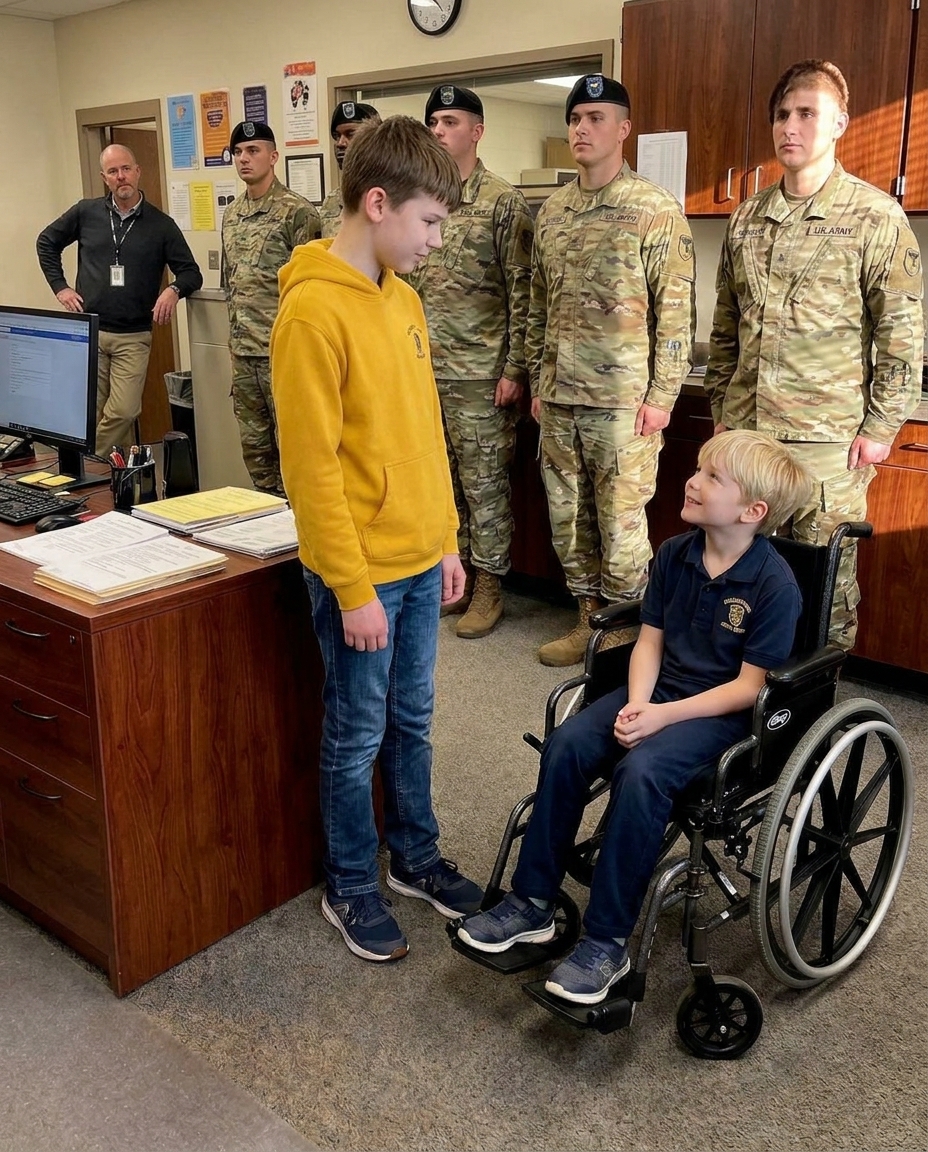
There were uniformed men standing near the administrative doors, quiet and serious. For a split second, I thought, What on earth did my kid do?
Then I stepped inside and realized this wasn’t about punishment.
This was about something else entirely.
Who Leo Is—and Why This Story Makes Sense When You Know Him
Leo has always been a gentle kid. Not shy exactly—just thoughtful. He listens more than he talks. He notices things other people miss.
Three years ago, we lost his father. Grief changes children in ways you can’t always see on the surface. For Leo, it made him quieter, yes—but it also made him deeply protective of anyone who seems left out or overlooked.
He can’t stand unfairness. He doesn’t always argue about it out loud, but you can see it in his face when something doesn’t sit right with him.
And a few days before the camping trip, something clearly didn’t.
“They Told Sam He Can’t Go.”
Leo came home from school frustrated in that controlled, tight way kids get when they’re trying not to cry.
He told me about his best friend, Sam.
Sam is bright, funny, and kind. He also uses a wheelchair due to a condition he’s had since birth. According to the teachers, the trail for the trip was “too rugged,” and the campsite wasn’t accessible—so Sam was told he couldn’t participate.
Leo didn’t throw a tantrum. He didn’t rant. He just said it quietly, like the words tasted wrong.
“It’s not fair,” he told me. “He’s my best friend.”
I remember thinking, How do you explain logistics to a child when all they can see is their friend being excluded?
I didn’t realize then that Leo wasn’t just upset.
He was already deciding what he was going to do.
What Really Happened on That Trail
The full story didn’t come from Leo that night. It came in pieces the next day—through the school, through other parents, and finally through Leo himself when he realized I wasn’t angry.
At some point during the trip, Leo refused to accept that Sam would miss the experience everyone else was getting. So he made a choice that no twelve-year-old should have to make—but he made it anyway.
He carried Sam.
Not for a few steps. Not for a photo moment. He carried him over steep inclines, rocky stretches, and narrow parts of the trail where even kids with good shoes were slipping.
Miles of hiking. Hours of strain. The kind of physical challenge that would test many adults.
And he did it because, in Leo’s mind, leaving Sam behind wasn’t an option.
He didn’t do it for attention. He didn’t do it to “go viral.” He did it because he couldn’t stand the idea that his best friend would be excluded from a memory that was supposed to belong to the whole class.
Why the School Was Panicking
When the supervising staff learned what happened, the reaction was complicated.
One teacher was furious. From their perspective, it was a serious safety risk and a direct violation of policy. And to be fair, I understand the fear that comes with liability and student safety—especially in the outdoors.
So when I got that urgent call, I assumed the school was preparing for disciplinary action.
I expected a lecture. A warning. Maybe even suspension.
That’s why the uniformed men outside the office rattled me so badly.
I thought they were there to make an example out of my child.
I was wrong.
The Men in Uniform Were There for a Different Reason
Inside the principal’s office, I learned the truth.
The men waiting weren’t there to punish Leo.
They were veterans—men who had served with Sam’s father.
Sam’s dad had been a soldier known for one thing above all: loyalty. The kind of person who made sure nobody in his unit was left behind. The kind of man other men still talk about years later, because his character left a mark.
When Sam’s mother heard what Leo did on the trail, the story reached people who understood exactly what that kind of loyalty means.
And they came to the school because they wanted Leo to know that what he did mattered.
A Patch, a Speech, and a Moment I’ll Never Forget
One of the veterans stepped forward and spoke to Leo with a level of respect that made the room go silent.
He thanked my son—not in a dramatic way, not with big speeches meant for applause—but with the steady seriousness of someone who knows the weight of words like courage, commitment, and brotherhood.
Then he handed Leo a military patch, a symbol of honor and loyalty.
Leo just stood there, stunned, holding it like he wasn’t sure he deserved it.
And then came the part that made my throat tighten:
The veterans had arranged a scholarship fund in Leo’s name to support his future education.
Not because they wanted attention. Not because they needed credit. But because they saw in my son the same spirit they remembered in Sam’s late father—the belief that you don’t abandon people you care about, even when it’s hard.
What I Realized as a Parent
On the drive home, I kept replaying it all.
Leo didn’t stop to calculate the risk the way an adult would. He didn’t weigh the social consequences. He didn’t think about awards or recognition.
He saw a friend being excluded, and he acted with pure, stubborn compassion.
That night, after the house got quiet, I walked past his bedroom and saw the patch resting on his desk under the lamp light.
And it hit me: the greatest thing a child can grow into isn’t a trophy, a perfect GPA, or a highlight reel.
It’s character—especially when doing the right thing is exhausting, inconvenient, and unpopular.
My son came home covered in mud and barely able to stand.
But he also came home having proven something many adults still struggle to learn:
Real strength looks like showing up for someone who can’t do it alone.
Closing CTA
If this story moved you, share what you would want your child—or your younger self—to do in Leo’s position. And if you enjoy real-life stories about parenting, resilience, and everyday courage, stick around and read the next one.