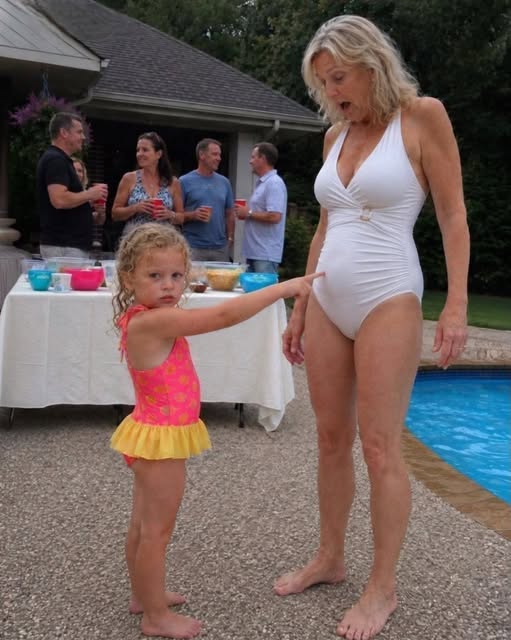
The Tattoo
Clara wrapped the towel around herself.
“I don’t know what kind of story you’ve created in your head.”
“In my head?”
My voice sharpened.
“My daughter just recognized my husband’s drawing on your body.”
Ariel stood between us.
“Daddy draws the happy sun.”
Glen knelt beside her.
“You’re right.”
The words seemed to travel through the entire yard.
My aunt stopped collecting plates.
My father sat up beneath the umbrella.
Someone turned off the music.
Glen looked at the tattoo.
“Before I met you, I volunteered at an arts center downtown.”
“I know that,” I said.
He had mentioned Saturday art classes and community murals.
But he had never mentioned Clara.
“There was a program for people recovering from surgery,” he continued. “Local artists helped them create artwork to cover or draw attention away from scars.”
Clara looked at him.
“The community room on Willow Street.”
Glen’s eyes widened.
“You remember?”
“Only pieces.”
She touched the lighthouse.
“I remember a young man with paint on his hands.”
My father looked from Clara to Glen.
“You two knew each other?”
“No,” Clara said quietly.
“Not really.”
Glen nodded.
“It was almost twenty years ago.”
Clara closed her eyes.
“I had just had surgery.”
Her hand moved toward the tattoo.
“I had a tumor removed. The scar was difficult for me to look at. Every time I saw it, I remembered everything I had been afraid of.”
My father stared at her.
“You never told me.”
“I told you I had surgery.”
“You said it was years ago.”
“It was.”
Clara looked away.
“I didn’t want to spend the rest of my life introducing myself through the worst thing that had ever happened to me.”
The yard had become completely still.
Glen looked at the lighthouse.
“I drew it because a lighthouse stands through bad weather without pretending the storm isn’t there.”
Clara’s voice softened.
“And the sun?”
Glen gave a faint smile.
“I used to draw that everywhere.”
Ariel leaned against him.
Clara looked down at the faded tattoo.
“Underneath it, he wrote two words.”
She lowered the towel slightly.
Beneath the lighthouse, almost hidden near the edge of the swimsuit, were faded letters.
Still Standing.
My father slowly sat down.
Suddenly, nobody was thinking about an affair.
Nobody was thinking about betrayal.
We were looking at something much older.
A moment between two strangers who had crossed paths before any of us knew each other.
The Story Behind the Lighthouse
Glen had been twenty-one.
Clara had been using her maiden name.
She had recently undergone surgery and was trying to find a way to feel comfortable in her own skin again.
Glen had been a young volunteer with paint on his hands and a habit of drawing the same cheerful sun on everything.
Then life moved on.
Clara eventually married my father.
Glen moved away, changed his appearance, and built an entirely different life.
Years later, I met him at a friend’s barbecue.
Neither of us had any idea that my future husband and my stepmother had once stood in the same community art room.
Until my three-year-old noticed one crooked little sun.
But I Had Another Question
The suspicion inside me began to fade.
But another question remained.
I looked at Clara.
“Then why have you always hated me?”
She flinched.
My father started to say my name.
Clara raised one hand.
“I never hated you, Helen.”
“You barely spoke to me for fifteen years.”
“I know.”
“You missed birthdays. You left dinners early. You acted like spending time with me was a burden.”
Clara looked toward the patio.
The guests were quietly guiding the children toward the other side of the yard, giving us the privacy of pretending they weren’t listening.
Finally, she sat down.
“I was afraid of you.”
I almost laughed.
“Of me?”
She nodded.
“I was afraid of what loving you might look like.”
I didn’t understand.
So she explained.
“Your mother had been gone for two years when I married your father. Her photographs were everywhere. Her recipes were still taped inside the cabinets. You wore one of her old sweaters even when it was too hot.”
I remembered that sweater.
Green wool.
Sleeves too long for my arms.
Clara continued.
“I thought if I tried too hard, you’d think I wanted to replace her.”
She paused.
“And if I did too little, you’d think I didn’t care.”
“So you did nothing.”
“I stayed too far away.”
Her answer wasn’t a defense.
It was an admission.
“I convinced myself that distance was respectful,” she said. “Then the years passed. And every attempt to get closer felt more awkward than the last.”
I thought about all the Christmas mornings.
Clara always wrapped my presents in brown paper because my mother had done that.
She made my mother’s cinnamon rolls but never took credit for the recipe.
She kept my childhood drawings framed in the hallway.
At my graduation, she stood at the edge of every photograph.
I had interpreted every step backward as rejection.
Maybe some of it had been fear.
Maybe I had been afraid too.
“You Kept It.”
Ariel climbed into Clara’s lap without asking.
Clara froze for a second.
Then she wrapped an arm around her.
“Does the lighthouse still work?” Ariel asked.
Clara blinked.
“It’s a tattoo, sweetheart.”
“No.”
Ariel shook her head.
“I mean the hope.”
Clara looked at me.
The question seemed to break through years of silence.
“Yes,” she said softly.
“I think it does.”
Ariel reached toward the faded tattoo.
“Can I touch it?”
Clara nodded.
Ariel placed one finger on the lighthouse.
“Daddy made it pretty.”
Clara laughed quietly, but tears filled her eyes.
“He did.”
Ariel traced the tiny sun.
“You kept it.”
Three simple words.
But they seemed to carry the weight of nearly twenty years.
The drawing.
The scar.
The memory.
The life that came afterward.
I looked at Clara differently.
Not as the woman who had entered my father’s life after my mother died.
Not as someone who had always seemed distant.
But as a woman who had once sat in a community center, afraid of her own reflection, asking someone to give her a reason to keep looking.
The Conversation We Should Have Had Years Ago
“I thought this tattoo was hiding something that would destroy our family,” I admitted.
Clara wiped beneath one eye.
“Instead, it was hiding the reason you survived long enough to become part of it.”
She covered my hand with hers.
“I’m sorry I made you feel unwanted.”
I swallowed.
“I’m sorry I never asked whether you were scared too.”
Across the patio, Ariel was drawing with sidewalk chalk.
A crooked lighthouse appeared between pink waves.
Inside it stood three smiling figures.
I called to her.
“Who are they?”
She looked up.
“Family!”
Clara’s fingers tightened around mine.
For years, we had stood on opposite sides of the same loss.
Each of us waiting for the other to cross the distance.
We had both misunderstood silence.
We had mistaken fear for rejection.
And we had allowed fifteen years to pass without asking the questions that might have changed everything.
It took a three-year-old, a faded tattoo, and one crooked little sun to finally show us what we had been missing.
The lighthouse hadn’t been hiding a secret that could tear our family apart.
It had been carrying a message all along.
Still standing.
And perhaps that was what family really meant.
Not that nothing ever breaks.
Not that nobody ever makes mistakes.
But that sometimes, after years of distance and misunderstanding, people can still choose to find their way back to one another.
The chalk drawing stayed on the patio until sunset softened its edges.
I didn’t take a photograph.
I didn’t need to.
Some memories stay because we preserve them.
Others stay because, at last, they explain everything that came before.