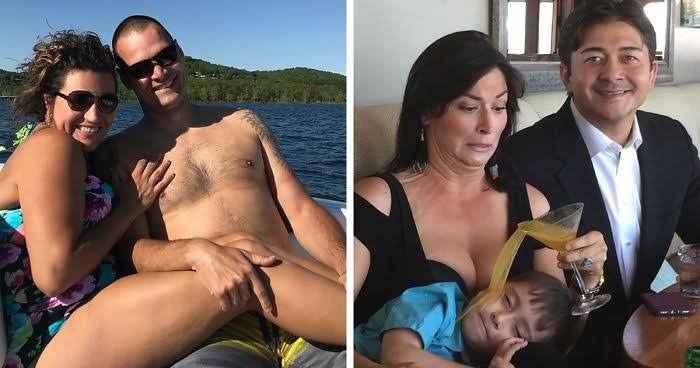
That tiny window is why so many perfectly timed photos feel rare. A seagull stealing an ice cream cone, a cat appearing to dance midair, a child’s head lining up with an adult’s body, or a wedding guest seemingly falling from the sky all depend on timing, angle, and luck working together.
The funniest examples usually are not carefully planned. They happen when ordinary scenes overlap in strange ways. A person stands in front of someone wearing a cap and suddenly appears to have a miniature hat. A pet sits in front of a television at the exact moment an onscreen character appears to bite it. A bubble floats across a dog’s face and, for one frame, makes the dog look trapped inside.
Nature creates some of the best versions of this effect. A honeybee close to the lens can look enormous compared with the background. A bird diving for a fish can become a blink-and-you-miss-it action shot. Even a penguin caught in an odd pose can resemble a visual glitch.
None of those images need special effects to work. They rely on alignment, motion, and the camera freezing a moment that the human eye might otherwise miss.
The Brain Science Behind the Double Take
Part of the appeal comes from how quickly the brain tries to make sense of images. Research in cognitive psychology and visual perception has long shown that people do not study every detail of a scene one object at a time. The brain makes fast assumptions based on shape, depth, contrast, and past experience.
Most of the time, that system is useful. It helps people recognize faces, read expressions, judge distance, and move through the world without stopping to analyze every object in view.
Perfectly timed photos interfere with that process. When two bodies overlap, the brain may briefly assign the wrong head to the wrong person. When an object lines up with the sun, it may seem larger or more important than it is. When an animal moves through the frame at just the right moment, the mind may create a funny hybrid creature before the truth becomes clear.
That moment of confusion is the hook. Viewers look once, misunderstand the image, then look again. When the real explanation clicks, the payoff feels satisfying.
It is the same reason optical illusions travel so well online. People enjoy solving the visual puzzle, and they often want to send it to someone else to see whether that person gets fooled too.
The Bigger Picture
Perfectly timed images have become even more interesting in the age of smartphones, editing apps, and artificial intelligence. Viewers are more skeptical now because so many pictures can be altered quickly or generated from scratch.
That skepticism is understandable, but it also makes authentic accidental photos more valuable. A well-timed shot reminds people that reality can still produce moments that look edited, even when they are not.
For photographers, the lesson is simple: expensive camera gear can help, but timing matters just as much. A smartphone in the right hands, pointed in the right direction at the right instant, can capture something more memorable than a perfectly planned shoot.
For social media platforms, these images are built for engagement. They invite comments, shares, screenshots, and repeat views because people want to figure out what is happening. A good double-take photo does not explain itself immediately; it rewards attention.
That is why images of flying dogs, shark wedding kisses, owl photobombs, tiny bubble dogs, and strange animal perspectives keep resurfacing. They are quick to understand, safe to share, and easy to enjoy across languages and platforms.
More than anything, perfectly timed photos are a reminder that the world is full of visual surprises. Sometimes the funniest image is not created by editing software, lighting tricks, or a professional studio. Sometimes it is just a random moment, caught before it disappears.
And the next time a photo makes no sense at first glance, it may be worth looking twice before deciding what you are seeing.