The Bedroom Wasn’t What She Expected
Inside, everything looked almost unnaturally clean.
The floor was spotless. The counters were clear. The furniture was perfectly arranged.
Yet instead of making Clara feel relieved, the neatness made the apartment seem strangely empty.
It didn’t look like a home where people had been living normally.
It looked like someone had been trying very hard to make it appear that way.
“Julian?” she called softly.
No answer.
She walked down the hallway, still holding the grocery bags.
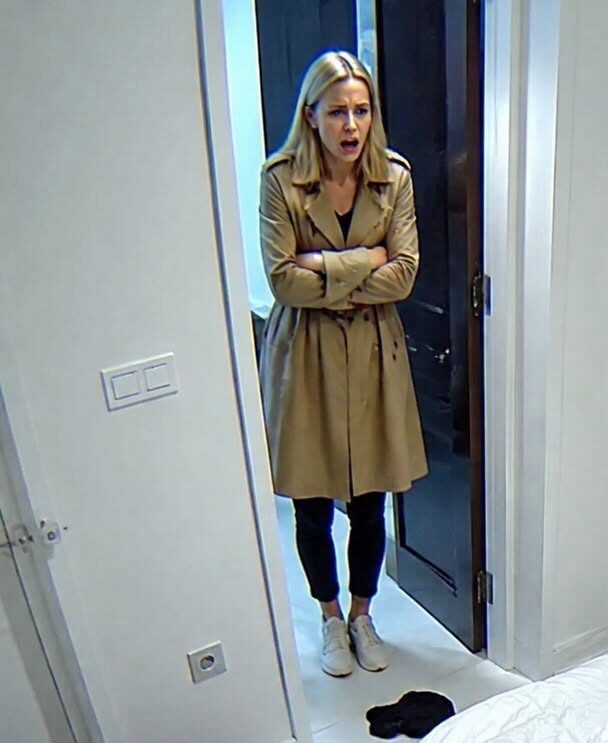
Then she reached the bedroom.
And froze.
Julian was asleep.
Beside him was Leo.
The boy was curled close to his father, breathing quietly beneath the blankets.
For several seconds, Clara couldn’t move.
Her mind immediately began filling in the gaps.
Then she noticed the clothes on the floor.
And the shoes.
A woman’s shoes.
They weren’t hers.
Her heart dropped.
The warm dinner she had planned suddenly seemed ridiculous.
She stared at the unfamiliar pair, searching for an explanation that made sense.
There wasn’t one.
“Julian?”
He stirred.
His eyes opened.
Then he saw Clara standing in the doorway.
What happened next surprised her.
He didn’t jump out of bed.
He didn’t start making excuses.
He simply stared at her with an exhausted expression, as though he had been carrying something heavy for a very long time.
“You’re home early,” he said.
Those four words hit harder than any explanation could have.
Clara looked at him.
Then at Leo.
Then back at the shoes.
The Truth About the Shoes
She walked into the kitchen and placed the groceries on the counter.
The meat was already beginning to soften inside its wrapping. The vegetables looked tired beneath the harsh apartment light.
Clara picked up the shoes.
“Who do these belong to?”
Julian appeared in the doorway.
He looked at them for several seconds.
“Your sister.”
Clara went completely still.
Her sister had been gone for five years.
“What?”
“I found them in the storage unit,” Julian said quietly. “I brought them home while you were away.”
Clara looked down at the worn shoes.
The explanation should have relieved her.
Instead, it left her with an entirely different kind of sadness.
Julian told her he had been struggling with the emptiness of the apartment.
He hadn’t brought the shoes home to deceive her.
He had brought them home because they reminded him of a time when the family felt complete.
He missed the noise.
The conversations.
The ordinary chaos of having people constantly coming and going.
He missed the feeling that the apartment belonged to a family instead of simply being a place where two people were trying to get through difficult days.
Then Clara asked the question that mattered most.
“What about Leo?”
Julian’s expression changed.
Their son hadn’t been sleeping properly since Clara left.
The nightmares had returned.
They were connected to the accident—the memories neither parent wanted to revisit but neither could completely escape.
Some nights, Leo woke terrified and shaking.
He would walk into Julian’s room and ask if he could stay.
And Julian always said yes.
Not because it was easy.
Because Leo needed somewhere to feel safe.
Clara suddenly understood.
The betrayal she had feared wasn’t there.
But something else was.
Something deeper.
Something she hadn’t seen.
The Part of Her Family She Had Missed
Leo appeared in the hallway, wrapped in a blanket.
His eyes were red from exhaustion.
He didn’t look guilty.
He didn’t look frightened of being caught.
He simply looked tired.
And in that moment, Clara realized how much she had missed.
While she had spent four months working, planning, earning money, and imagining the moment she would return home, Julian and Leo had been dealing with something she hadn’t fully understood.
They hadn’t been waiting for life to resume.
They had been trying to survive the life they were already living.
The spotless apartment suddenly made sense.
It wasn’t evidence that everything had been fine.
It was evidence that everything had stopped being normal.
When people are struggling, sometimes they don’t create a mess.
Sometimes they clean everything they can control because the things they cannot control are too painful to face.
Clara looked at the groceries on the counter.
She had brought them as an act of love.
Now they reminded her of how much she didn’t know about her own family.
She had imagined that one dinner could restore everything.
But four months had changed them.
And perhaps it had changed her too.
Some Families Break Quietly
Not every family crisis begins with an argument.
Some begin with missed calls.
Some with long workdays.
Some with conversations that are repeatedly postponed because there will always be time tomorrow.
And sometimes, people become so focused on providing for the family that they don’t realize the family needs their presence more than anything else.
Clara finally understood that coming home wasn’t the same as returning to the life she had left.
That life no longer existed exactly as she remembered it.
“I can’t stay here tonight,” she said.
Julian didn’t stop her.
Clara didn’t ask Leo to explain anything.
She picked up the grocery bags and walked out.
She wasn’t sure why she took them.
Maybe because leaving them behind felt like leaving behind the last piece of the homecoming she had imagined.
Three blocks away, Clara parked her car.
She turned off the engine.
For several minutes, she simply sat there.
The city continued moving around her.
People walked along the sidewalks.
Cars passed.
Lights changed.
The world carried on as though nothing had happened.
On the passenger seat, the food she had bought for dinner remained untouched.
Then her phone lit up.
A message from Julian appeared on the screen.
“The door is unlocked. It always was.”
Clara read the message once.
Then she deleted it.
She started the car.
But she didn’t drive to a hotel.
And she didn’t turn back toward the apartment.
For the first time that night, she allowed herself to sit with the truth.
Whatever happened next, she couldn’t rebuild her family by pretending nothing had changed.
She would have to listen.
She would have to understand.
And perhaps most importantly, she would have to admit that being physically present in a family and being emotionally present in it are not always the same thing.
Some homecomings don’t take us back to the past.
Sometimes, they show us everything that has been changing quietly while we were away.
And once we see it, we can’t pretend we didn’t.