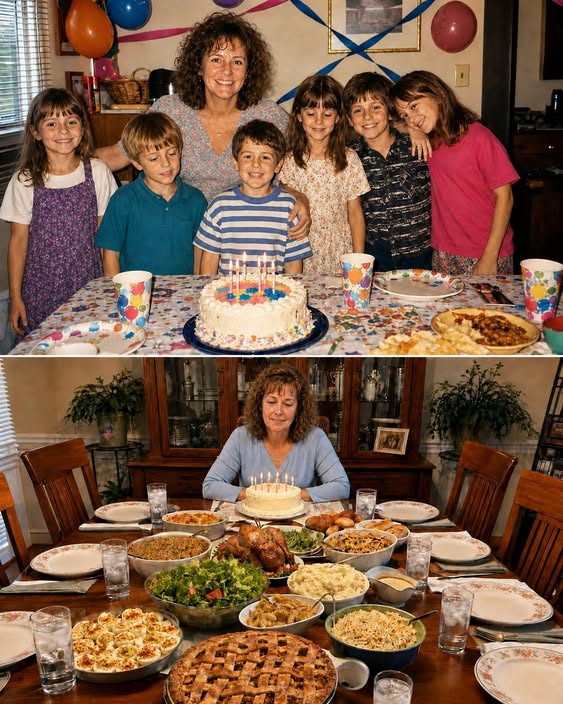
A Birthday Dinner That Started With Hope
For years, her home had been full of noise. She and her husband had welcomed six children over the course of a decade: Mark, Jason, Caleb, Grant, Sarah, and Eliza.
There had been cartoons playing in the background, school bags dropped by the door, muddy shoes, birthday decorations, homework spread across the table, laughter, complaints, and endless requests for food.
Back then, she sometimes wished for quiet.
Then life changed. Her husband left after deciding he wanted a different life, and she became the steady parent who stayed. She attended meetings at school, stretched paychecks, sat beside sick beds, managed teenage heartbreak, handled arguments, and kept the family moving forward.
That was why this birthday mattered so much. She did not want an expensive gift. She did not need a trip or a grand gesture. She only wanted one evening with all six children at the same table.
So she cooked their favorite dishes, brought out the good plates, and prepared the house the way mothers often do when they are hoping everyone notices the love behind the effort.
By late afternoon, she was checking the window. By early evening, she had sent a message to the family group: dinner was ready whenever they arrived, and they should drive safely.
No one came.
By nine o’clock, she was sitting alone at the head of the table, surrounded by untouched place settings. The thought that hurt most was not that her birthday had gone wrong. It was the fear that she had become someone her children loved, but no longer made time for.
The Knock That Changed the Night
Then came a knock at the front door.
It was not the familiar knock of one of her children. When she opened the door, a young police officer stood beneath the porch light.
He handed her a folded note with her name written on it.
The message was from Grant, the child who had always been the most unpredictable. He was funny, impulsive, determined, and known for finding surprising ways to do things.
The note told her not to call anyone, not to ask questions, and to listen to the officer. She was to get in the car.
Confused and alarmed, she looked back at the dining room one more time. Six empty chairs still surrounded the table.
Then she stepped outside.
A few minutes later, the police cruiser pulled into the parking lot of a familiar community building. She knew the place well. Over the years, she had sat there for school performances, basketball games, awards ceremonies, and community events connected to one child or another.
That night, the parking lot was unusually full.
Inside, she quickly realized this was not an emergency. It was a surprise party.
A banner stretched across the wall. Her children were there. The room was decorated. The celebration had been planned for her all along.
Relief came first. Then emotion. Then questions.
Mark began trying to explain. Sarah said they had been decorating since the afternoon. Grant had been the one responsible for getting their mother to the party, and everyone had assumed he had handled it.
But Grant had not arrived at her house at the expected time.
That was when headlights swept across the windows.
Grant walked in wearing a uniform, with a badge catching the light on his chest.
Before anyone could get too angry, he wished his mother a happy birthday.
She was stunned. He had sent a police officer to her house, allowed her to think something terrible might have happened, and arranged for her to arrive in a cruiser.
Grant admitted he had not thought the plan through.
Then he revealed the reason for the uniform. He had been training for months and had not told the family because he wanted to be sure he could finish. He had become a police officer.
Her anger softened into pride.
Grant explained that he had been afraid of disappointing everyone. His mother reminded him that she had never needed perfection from him. She only wanted honesty, effort, and the chance to stand beside him.
The Bigger Picture
The celebration eventually found its way back to joy. Laughter returned to the room. Grant sat beside his mother in uniform. Jason laughed loudly, Sarah helped Eliza fix her hair for a photo, and Caleb went back for more cake.
But the evening left behind an important reminder.
Surprises can be meaningful, but communication still matters. A simple message can keep someone from feeling forgotten. If plans change, if someone is running late, or if a surprise requires silence, families still need to think about the person waiting on the other side.
For this mother, the painful hours at home did not disappear. She had truly believed, for a while, that her children had chosen everything else over her.
But when she looked around the table later that night, all six of them were there.
They sang “Happy Birthday” loudly, off-key, and out of sync. It was the same kind of noise that had once filled her home years earlier, the kind she had sometimes wished would quiet down.
Now, she understood its value differently.
The night had not gone according to plan. The dinner at home had gone cold. The surprise had gone wrong before it went right. Still, the ending gave her what she had wanted from the beginning: her children together, close enough to touch, laugh with, forgive, and love.
As everyone urged her to make a wish, she looked around at the six familiar faces and realized she did not need to ask for a bigger house, more money, or a different life.
What she wanted was already sitting around the table.
Sometimes a family celebration is less about perfect timing and more about remembering who is waiting for you to show up.