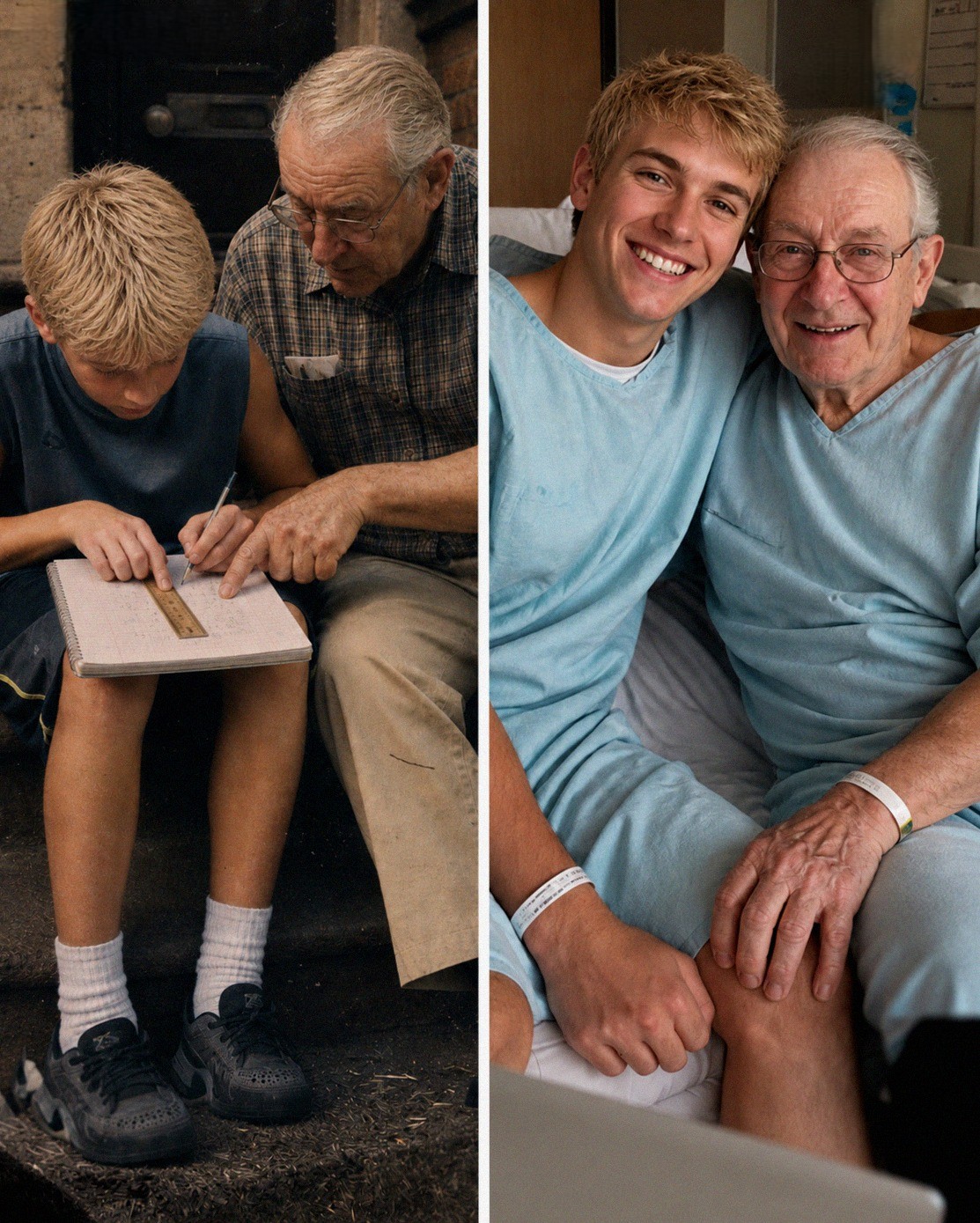
Mason glanced up and asked a simple question: “Do you like math?”
Lucas didn’t answer right away. It wasn’t that he disliked math—it was worse. Math felt like a locked door he could never open, no matter how hard he tried. Teachers had marked his worksheets with red ink and impatience. Classmates moved ahead. Lucas stayed stuck, embarrassed and quiet.
Mason patted the bench beside him.
And instead of launching into complicated formulas, he started with something Lucas could understand: a circle drawn in the dirt and a conversation about chocolate pie. Fractions became slices. Percentages became real life. Mistakes became normal.
That bench turned into an outdoor classroom.
Week after week, Mason helped Lucas rebuild what school had broken—confidence. He didn’t shame him for getting answers wrong. He didn’t rush. He explained, listened, and tried again. And slowly, the boy who once froze at basic problems started solving them with steady hands.
More than math, Mason taught Lucas something bigger:
“Don’t let anyone convince you you’re not smart.”
Those words didn’t just motivate Lucas. They anchored him.
Then, without warning, the lessons ended. Lucas’s family moved away suddenly, leaving no goodbye—just an empty space on the bench that Mason kept returning to, day after day, as if the boy might appear again.
Eleven Years Later: A Hospital Room and an Unpaid Medical Bill
Time passed. Seasons changed. The neighborhood stayed hard. Mason grew older and weaker, and eventually, his body began to fail him.
Now the setting wasn’t a park bench—it was a crowded city hospital. Fluorescent lights. Antiseptic air. Machines that beeped like reminders that time is never guaranteed.
Mason lay in a shared ward, staring at the ceiling, listening to doctors speak in careful tones. The treatment he needed was expensive. His savings were gone. There was no family sitting beside him, no financial safety net, no “miracle” waiting at the door.
He had lived quietly. He expected to leave the same way.
Then a new patient was rolled into the bed next to him—someone clearly well-off, the kind of person nurses treated with extra urgency. Even in a hospital gown, the man carried himself like a professional used to making decisions that moved money and people.
They were strangers for only a moment.
Because the younger man turned, looked at Mason, and froze.
His eyes searched Mason’s face like he was solving an old equation. And then, with a voice tight with emotion, he asked:
“Do you still like math?”
In that instant, eleven years collapsed into a single heartbeat.
The man wasn’t a stranger.
He was Lucas.
The Boy With the Taped Backpack Became a High-Profile Engineer
Lucas wasn’t the struggling kid from the neighborhood anymore. He was now a successful engineer—someone who had built a high-income career and a thriving company by doing what Mason once taught him: staying calm, thinking clearly, and refusing to believe the problem was impossible.
He told Mason the truth: those afternoons on the bench didn’t fade with time. Lucas carried them into every exam, every job interview, every late-night project, every high-stakes meeting.
And that blue notebook?
Lucas had kept it.
Not as a souvenir, but as proof that someone once saw potential in him when the world only saw struggle.
But as the conversation stretched into the night, Mason’s relief gave way to honesty. He admitted what he hadn’t said out loud to anyone:
He couldn’t afford the treatment.
He was running out of time.
Lucas went quiet—not with helplessness, but with focus. The same focus Mason remembered from the day Lucas finally understood fractions.
Only now, Lucas was solving a different kind of problem.
The Next Morning, the Hospital Staff Couldn’t Believe What Happened
Mason woke up and noticed the bed beside him was empty.
A nurse came in looking shocked, like she’d just witnessed something rare in a place full of bad news. She handed Mason a small cloth bag.
Inside were three things:
- the faded blue notebook,
- a bank card,
- and a letter.
Lucas had paid for everything.
The full medical treatment—covered. Not partially. Not “we’ll see what we can do.” Completely handled, so Mason could receive the best care available.
In the letter, Lucas explained what Mason never knew: the move had been sudden. Lucas hadn’t been allowed to return to say goodbye. But he never forgot. And he never stopped searching for the man who changed his life with patience, kindness, and a few simple lessons in the dirt.
This wasn’t charity.
This was gratitude—finally delivered.
Recovery, Redemption, and a Legacy That Actually Matters
Mason’s treatment was difficult, but he wasn’t alone anymore. Lucas visited daily. Sometimes he even brought technical drawings and project notes, asking Mason to “check his math,” a small joke that meant more than either of them said out loud.
In that hospital room, Mason realized something that people spend their whole lives chasing:
Legacy isn’t always loud.
It isn’t always awards, headlines, or a perfect bank account. Sometimes it’s a quiet moment where you choose patience instead of frustration. A moment where you see someone not for where they are, but for who they can become.
Mason had once drawn a circle in the dust to explain a simple idea to a scared kid.
And that circle expanded—wide enough to save his life.
A New Beginning, Written in the Same Blue Notebook
Mason eventually left the hospital, walking out with Lucas by his side. He kept the blue notebook, but he added one final message on its last page—a reminder meant for anyone who might ever feel invisible, behind, or forgotten:
A good lesson doesn’t end when the page turns. It echoes—until it finds its way back.
Because kindness is the one investment that never stops paying dividends. And sometimes, the child you help today becomes the person who saves you tomorrow.
Closing CTA
If this story moved you, share it with someone who needs hope today—and tell us in the comments: who was the person that believed in you when you didn’t believe in yourself?