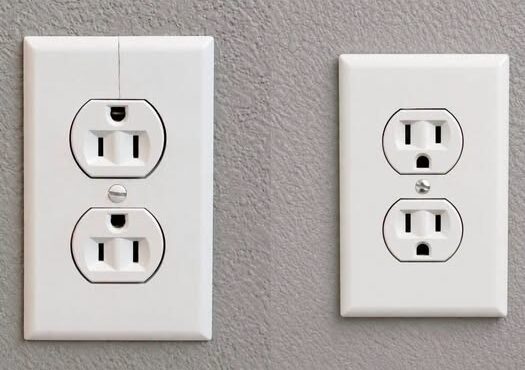
But here’s the important detail: an upside-down outlet is not a guaranteed sign that it’s switch-controlled.
There is no universal rule in the National Electrical Code requiring switched outlets to be installed this way. Electrical practices can vary by region, electrician, building age, and personal preference.
In some homes, an inverted receptacle may simply reflect a safety or installation preference. In others, it could be the result of a previous renovation. Sometimes, it may have no special meaning at all.
There’s another detail that makes these outlets even more interesting.
Many switched receptacles are “split” so that only one half is controlled by the wall switch. The other half remains powered continuously. That allows you to plug a lamp into the switched section while keeping a clock, charger, router, or another device connected to the always-on portion.
So how can you tell what you’re dealing with?
The simplest approach is to plug a lamp into the outlet and try the nearby wall switches. Test each half of the receptacle separately if the outlet is designed that way.
If the lamp turns on and off with a particular switch, you’ve found the connection.
Of course, electrical work should always be approached carefully. If an outlet appears damaged, loose, warm, or otherwise abnormal, don’t attempt to repair it yourself unless you’re qualified to do so. A licensed electrician can inspect the wiring and determine exactly how the circuit is configured.
The next time you see an outlet installed upside down, don’t assume someone made a mistake.
It might be a clue.
Or it might be nothing more than an unusual installation choice.
Either way, the real answer isn’t found by looking at the outlet’s orientation alone. It’s found by understanding how the outlet and the switches work together.
Have you ever discovered a switched outlet in your home? Tell us what you found in the comments—and share this with someone who’s always wondered why certain outlets look “backward.”