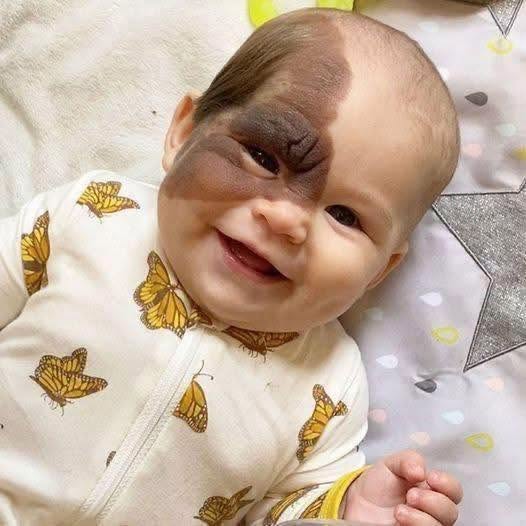
When Celine Casey first held her daughter, Vienna Brookshaw, in April 2021, she saw a healthy baby girl. She also saw something that would soon lead her family into a difficult and emotional decision: a visible birthmark between Vienna’s eyebrows.
Vienna was born with a congenital melanocytic nevus, often shortened to CMN. It is a rare type of birthmark linked to a cluster of pigment-producing cells. In Vienna’s case, doctors did not consider it an immediate medical danger, but its position on her face made her mother think carefully about the years ahead.
Casey’s concern was not that her daughter needed to look different to be loved. She made clear that Vienna was cherished exactly as she was. But like many parents, she worried about how other people might react once Vienna got older, especially at school, where children can sometimes be singled out for visible differences.
A Medical Decision With Emotional Weight
Because the birthmark was not considered medically necessary to remove, Casey’s request for treatment through the National Health Service was declined. The procedure was treated as cosmetic, not essential healthcare.