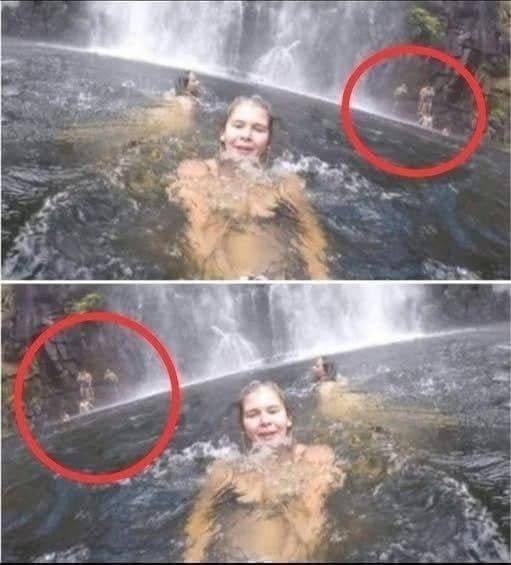
To prevent mental overload, your mind uses shortcuts—often called selective attention. Instead of processing every detail in a scene, your brain prioritizes what seems most important: the main subject, the brightest area, the human face, the obvious action. Everything else gets pushed into the background.
This isn’t laziness or low intelligence. It’s a built-in efficiency system. If your brain treated every shadow, reflection, and corner of the frame as equally important, daily life would feel exhausting and slow.
In other words: you don’t see everything—you see what your brain believes you need to see.
The Moment a Photo Turns Into a Puzzle
Everything changes the second you suspect there’s something hidden.
That one suggestion—“Look closer”—activates a different mode of thinking. You start scanning edges. You zoom in. You check reflections in windows, odd shapes in the background, and shadows that don’t quite match.
The image stops being “content” and becomes a challenge. And once your brain accepts there’s a solution, it doesn’t want to quit until it finds it.
This is why these posts are so addictive: they create a loop of curiosity and tension. The longer you search, the more invested you become, even if the hidden detail is tiny.
The Real Reward: Dopamine and the “Aha” Moment
When you finally spot the hidden object or unexpected detail, you get that instant rush of satisfaction—the classic “aha” moment.
That feeling isn’t random. It’s chemistry.
Your brain releases a small hit of dopamine, the same motivation-and-reward chemical tied to learning, achievement, and problem-solving. It’s one reason people love riddles, brain teasers, and optical illusions—and why “hidden reality” photos spread so quickly online.
The secret isn’t always impressive. But the experience of finding it makes you feel sharp, capable, and alert. That’s the hook.
What Viral “Look Again” Photos Say About Modern Attention Span
Most digital platforms are built for speed. Short videos, quick captions, endless scrolling—everything pushes you toward the next thing before you’ve fully processed the last.
Over time, we get trained into shallow viewing: noticing the obvious and skipping the rest.
Hidden-detail photos interrupt that pattern. They force something rare in today’s online world: slow attention. They demand patience, focus, and a willingness to look twice—skills many of us don’t get to practice often anymore.
Why the Comments Section Becomes the Main Event
In most cases, the “secret” was visible from the start. It was always there—your brain just filtered it out.
That’s why the comments explode.
People split into two groups: those who found it and those who can’t unsee it once it’s pointed out. Some users give the answer immediately. Others drop hints like:
- “Check the shadow.”
- “Look at the reflection.”
- “Zoom in near the corner.”
And for a moment, thousands of strangers are doing something surprisingly positive online: collaborating, playing, and sharing a harmless win.
The Bigger Lesson: What Else Are You Missing?
These images aren’t just internet entertainment. They’re a reminder that perception is selective.
If you can miss something obvious in a still photo, it raises a bigger question: what details are you missing in everyday life because you’re moving too fast?
A change in someone’s tone. A small warning sign. A subtle opportunity. A detail that changes the whole story.
Sometimes, you don’t need a new perspective—you just need an extra second of attention.
Final Thought
The hidden “reality” in these ordinary photos was never truly hidden. It was simply waiting for you to slow down enough to notice it.
Want more mind-bending perception and psychology breakdowns like this? Drop a comment with the last “hidden detail” photo that fooled you—and tell us how long it took you to spot it.