Not because Ethan was hiding, exactly. He just didn’t care to explain himself to people who only respected status. Meanwhile, I was still chasing my parents’ approval in the way grown children sometimes do—silently, painfully, and longer than we want to admit.
The Subtle Insults That Added Up
At every family gathering, the comments came dressed as polite curiosity.
“So, Ethan… how’s the consulting work going?” my father would ask with a smile that didn’t reach his eyes. “Still staying busy?”
Ethan would nod, answer calmly, and squeeze my hand under the table—his quiet way of telling me not to take the bait.
He never corrected them. He never mentioned the board meetings, the international deals, or the aviation and aerospace company he’d built into a serious global operation. He believed real leadership didn’t need an audience.
Whenever I wanted to defend him, he’d say the same thing: “There’ll be a right time.”
I didn’t realize the “right time” would arrive as a medical emergency.
Eight Months Pregnant—and Suddenly Everything Went Wrong
I was eight months pregnant when Ethan left for what I told my parents was a “routine business trip.” The truth was bigger: he was finalizing a high-stakes international contract—one of those complex, multi-country negotiations that can make or break an entire year.
Since he’d be gone, I stayed at my parents’ house, thinking the familiar environment would help as my due date approached.
Then, on a Tuesday afternoon, the pain started.
At first it was a dull ache. Within minutes, it turned sharp, rhythmic, and intense—nothing like the mild discomfort people casually joke about. I knew something wasn’t right. My breathing changed. My body felt like it was racing ahead of the timeline.
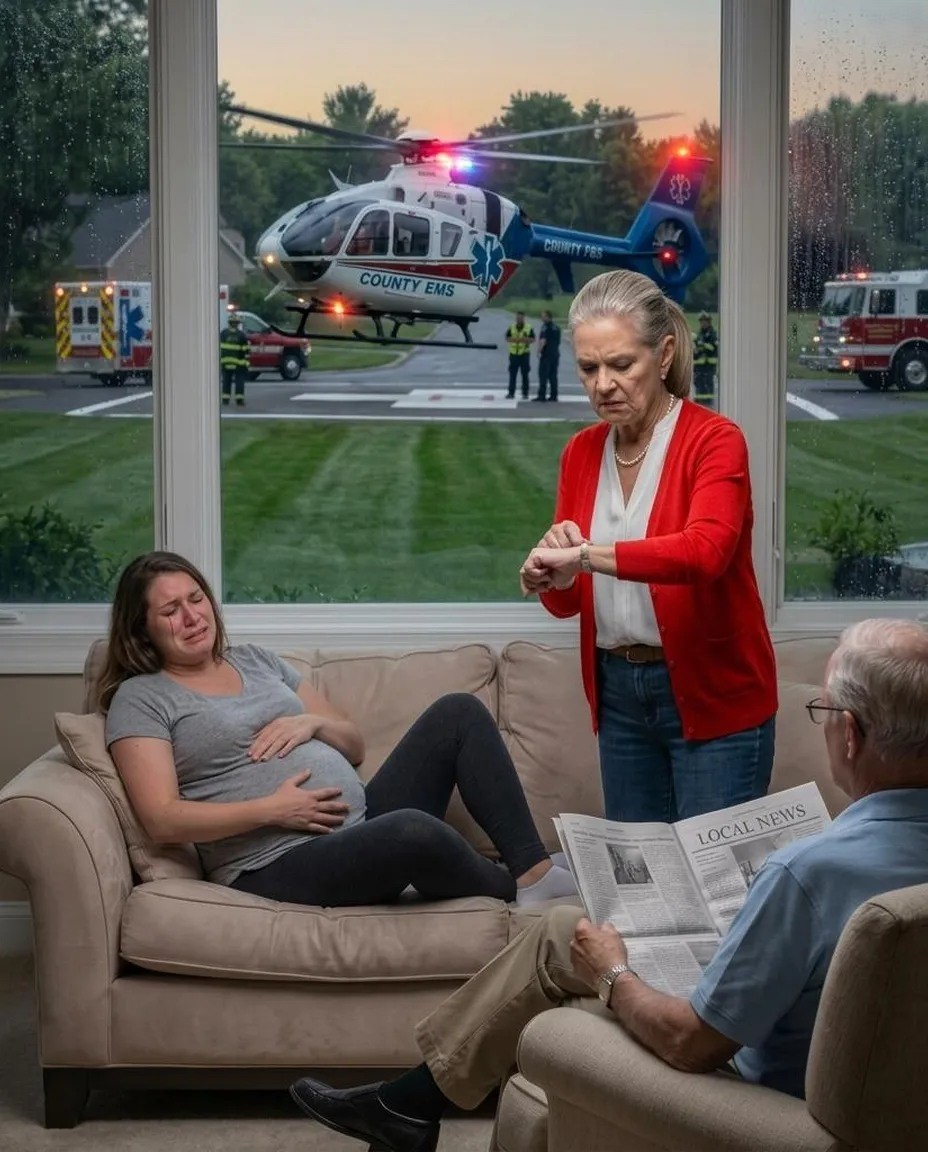
I walked into the living room, where my parents were discussing an upcoming country club event, and told them I needed to go to the hospital—immediately.
My mother barely looked up.
“It’s probably Braxton Hicks,” she said, flipping a page in her magazine. “Try to relax. Don’t be dramatic.”
My father waved me off because he was “in the middle of something.”
In that moment, I learned something that still stings to remember: in a house full of expensive furniture and framed family photos, I had never felt more alone.
The One Call That Changed Everything
I grabbed my phone and called Ethan.
I didn’t have to explain much. He heard my voice shake. He heard my breathing. The timing between my words told him everything.
He didn’t panic. He didn’t waste time.
He said, calmly and firmly: “I’m coming. Stay exactly where you are.”
And then—minutes later—the air itself seemed to vibrate.
The Helicopter in the Backyard
At first, it was a distant hum. Then it grew into a deep, powerful roar that rattled windows and shook the cabinets. My parents froze, confused, and rushed toward the back of the house.
Outside, descending into their perfectly manicured backyard, was a medical transport helicopter—modern, high-tech, and unmistakably official. It flattened their prized landscaping, blasted dust across the patio, and silenced every ounce of their skepticism in a single landing.
The doors opened.
A team of flight medics moved fast, professional and focused, like they’d rehearsed this exact moment.
And behind them was Ethan—still in his travel jacket, looking exhausted, but carrying a kind of calm authority that made the entire room feel smaller.
He had rerouted one of his own emergency response units the second he realized I was in danger. He didn’t come to impress anyone. He came to protect his wife and child.
What Ethan Said to My Father
As the medics prepared me for transport, Ethan finally looked at my parents.
He didn’t raise his voice. He didn’t brag. He didn’t “put them in their place” with a speech.
He said one sentence—quietly—but it landed like a verdict:
“She asked you for help. She told you she was in pain. And you treated her like an inconvenience. That will never happen again.”
My father didn’t have a comeback. For once, money and status didn’t offer him any power.
The Hospital, the Fear, and the Man Who Never Let Go
The flight was a blur of lights, medical equipment, and the steady beep of monitors. I remember gripping Ethan’s hand and trying to stay grounded through each contraction.
He stayed beside me the entire time—steady, present, focused. When I felt panic rising, he brought me back with his voice and his grip, like an anchor in a storm.
Hours later, our son was born healthy, safe, and loud—exactly the kind of cry you pray to hear.
Respect Looks Different When It’s Earned
The next day, my parents came to the hospital. They looked different—quieter, shaken, careful with their words. My mother tried to apologize, but I didn’t feel the need for a dramatic moment.
I had clarity now.
Respect isn’t something you purchase with a luxury car or a flashy job title. Love isn’t proven with public performance. The people who truly value you are the ones who show up when it costs them something—time, comfort, pride, sleep, convenience.
I looked at Ethan sitting beside my bed—tired, unpolished, fully present—and realized the truth I should’ve defended all along:
I hadn’t married an ordinary man. I’d married a strong one.
And I was done shrinking my life to fit inside my parents’ shallow definition of success.
If this story hit home for you, share what you would’ve done in that moment—would you have forgiven them, or drawn a hard line? Drop your thoughts in the comments and subscribe for more real-life stories about family, marriage, and the moments that change everything.