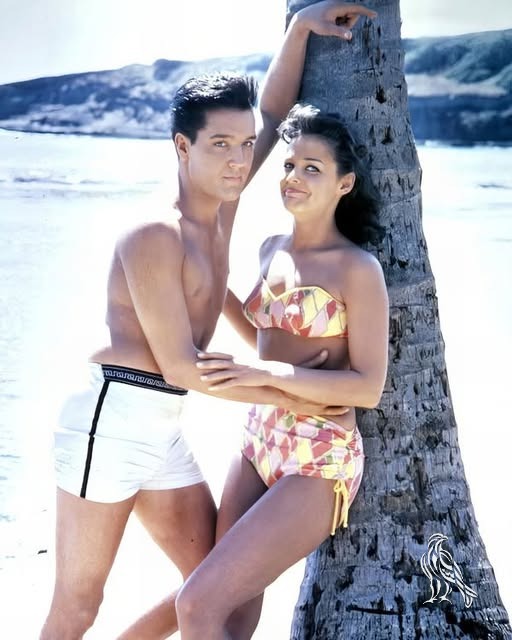
Colonel Tom Parker quickly understood the commercial power of that formula. In Blue Hawaii, Elvis played Chad Gates, a soldier returning home after military service. Unlike some earlier screen roles, Chad was not written as a professional singer. Still, the movie found plenty of reasons for him to sing, whether on the beach, near the water, or in the middle of a lighthearted romantic scene.
That lack of strict realism became part of the film’s charm. Viewers did not seem to mind that the songs appeared whenever the movie needed a musical lift. They came for Elvis, and the film delivered.
The soundtrack became one of the most important parts of the movie’s legacy. Can’t Help Falling in Love rose to No. 2 on the Billboard charts and remains one of Presley’s most recognizable recordings. Even people who have never watched the film often know the song immediately.
On-Screen Sunshine, Off-Screen Frustration
For all its popularity, Blue Hawaii was not a flawless production. One detail often noticed by careful viewers comes during the airport arrival scene. When Chad steps off the plane, real Elvis fans can be heard screaming in the background. Local crowds had gathered near the production, and their excitement made its way into the finished audio.
The film also contains several continuity mistakes. In the driving sequence set to Almost Always True, the positions of Maile’s hands on the steering wheel shift between cuts, while Elvis’s arm also changes position. In another scene, Ellie appears to switch sides in the back seat of a convertible, apparently to suit a better camera angle.
One of the more amusing details involves Elvis playing a small ukulele. Chad strums energetically, but viewers have pointed out that his fingers do not appear to match the chord changes heard in the music.
Some of the more revealing stories happened away from the camera. Juliet Prowse, who had starred with Elvis in G.I. Blues, was originally expected to appear opposite him again. According to accounts from the production, she made costly demands that included having the studio fly in her personal makeup artist and private secretary. Paramount declined, and Joan Blackman was cast instead.
Blackman and Elvis created a strong screen pairing. She later said they had immediate chemistry. Elvis reportedly wanted her to appear in more of his films and even imagined marrying her one day, but Blackman wanted her career to stand on her acting work rather than a romance with a superstar.
Yet the cheerful image of the film did not fully match Elvis’s own feelings. Paramount publicity director Anne Fulchino later recalled that he seemed embarrassed and frustrated during production. Elvis believed he was capable of more serious dramatic acting, but he felt boxed in by the lightweight musical comedies being chosen for him.
That tension became a recurring theme in his Hollywood years. The movies were often profitable, and the soundtracks sold well, but Elvis’s ambitions as an actor did not always match the projects built around his star power.
The Hawaii Connection That Stayed With Him
Even during a difficult shoot, Elvis found ways to enjoy himself and entertain the people around him. One behind-the-scenes prank involved Elvis and his girlfriend Anita Wood convincing crew members that he had stopped breathing. The panic ended when Elvis sat up laughing.
He also took golf lessons from champion golfer Gary Player. Player later joked that Elvis’s swing looked like “a cow giving birth to barbed wire,” a line Elvis reportedly took in good humor.
The production also left behind a piece of Elvis history. A bright red MGA roadster used during filming caught his attention, and he bought it for his own collection. The car remains at Graceland.
Hawaii itself became deeply linked to Elvis’s public image and personal story. He filmed more than one movie there, and several Blue Hawaii locations are still of interest to fans and travelers. Sites connected to the movie include the overlook at Tantalus Drive and the Coco Palms Resort, which was used for the film’s wedding sequence and the performance of Hawaiian Wedding Song.
Coco Palms was badly damaged by Hurricane Iniki in 1992, but its history still attracts attention from old Hollywood fans and Hawaii visitors interested in film tourism. For travelers, locations tied to classic movies can add another layer to planning, from hotel choices to guided tours and transportation costs.
The film even included a detail from Elvis’s real military service. The tank division patch worn by Chad Gates matched the U.S. Army division Elvis served with in Germany.
There is also a bittersweet final connection. Hawaii was Elvis Presley’s last vacation destination in 1977, just months before his death. For fans, that makes the islands more than a beautiful backdrop. They became part of the closing chapter of his life.
Blue Hawaii endures because it offers two stories at once: the carefree fantasy audiences loved, and the more human story of a star who wanted more than Hollywood was willing to give him.