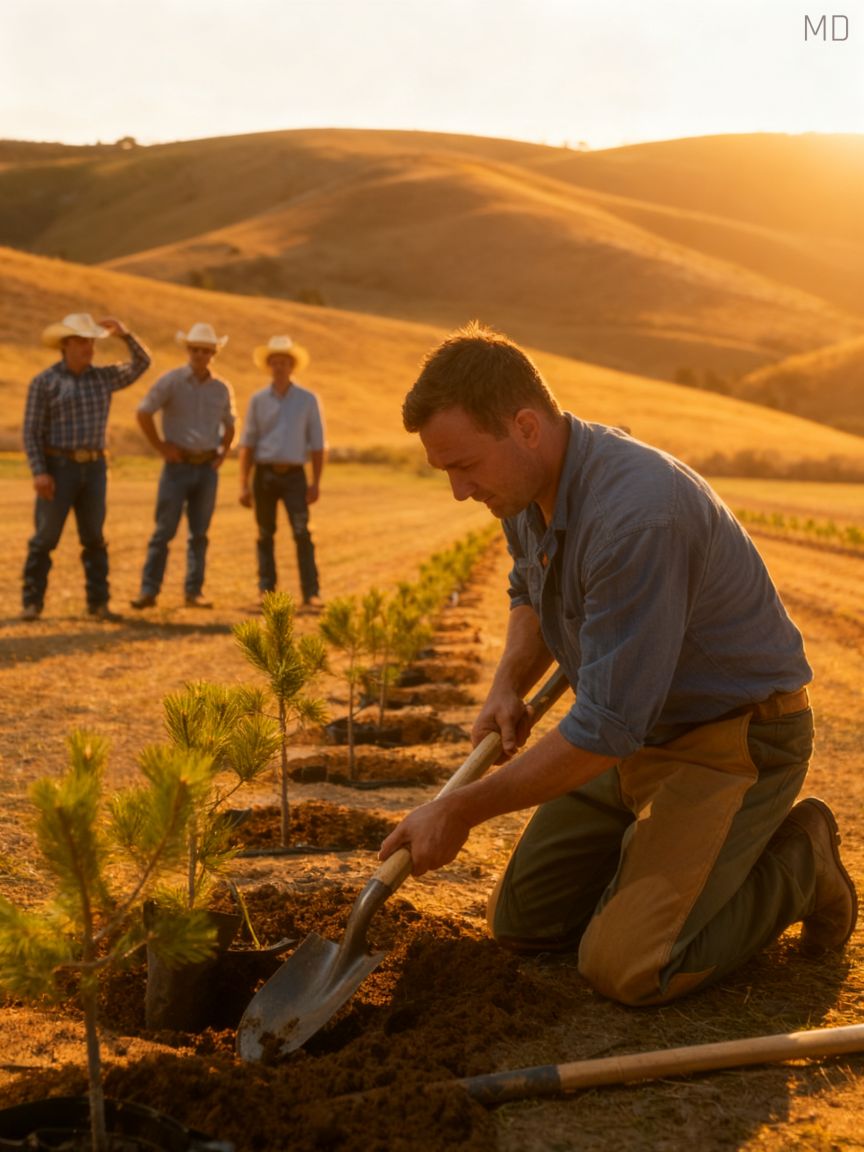
To the folks at the feed store, it looked like surrender. A rancher “growing a forest” in cattle country? That was comedy. The nickname Whitaker’s Forest spread fast, usually said with a smirk. Buck Harlan, the loudest critic in town, made sure the joke stayed alive.
But Tom didn’t argue. He didn’t campaign for approval. He simply kept planting.
Emily helped, even when school felt like a daily test of patience. At home, the pressure wasn’t just social—it was financial. To keep the project going, Tom sold off part of his herd, delayed repairs, and worked exhausting night shifts for extra income. Some evenings, Emily wondered out loud if they were trading their present for a future that might never come.
Tom’s answer stayed the same, steady as a fence post: “Preparation always looks foolish… until the day it saves you.”
When the Land Started Whispering Back
Years passed. The seedlings became young trees. The young trees thickened into a living wall. The jokes didn’t stop quickly, but something else began changing—quietly, under the surface.
Behind the growing windbreak, the grass held its color longer. Moisture lingered. The ground stayed calmer during hard gusts. Tom could see what others missed: the ranch wasn’t just surviving—it was rebuilding its strength.
He wasn’t chasing quick results. He was investing in long-term land management—the kind that doesn’t show up in a single season’s profits, but can determine whether a ranch exists ten years later.
The Drought That Broke the County
Then came 1988.
It started with a dry spring and turned into a summer that seemed to burn everything it touched. Pastures across the county faded into brittle stalks. Wells dropped. Cattle thinned. The ground cracked like old paint.
And then the wind arrived—hot, dry, violent—pushing a dust storm so thick the sky darkened into an ugly bruise. It was the kind of storm that doesn’t just damage property; it erases hope.
All across Miller’s Bend, ranchers watched their land get stripped bare.
But on the Whitaker place, something different happened.
Those forty acres of pine—once mocked as a waste—stood tall and dense. They slowed the wind. They trapped what little humidity remained. They shaded the ground, reduced evaporation, and created a pocket of protection where grass and cattle had a fighting chance.
The Whitaker north pasture became a refuge while the rest of the county took losses that would take years to recover from.
He Didn’t Say “I Told You So.” He Did Something Better.
Buck Harlan’s ranch was hit hard. Wind damage tore at his equipment and fencing. His herd scattered and panicked, desperate for water and shelter.
People expected Tom to enjoy the moment—to finally collect the respect he’d been denied.
Instead, Tom hitched his water tank to his tractor and started hauling water across the fence line.
He worked through the worst of it, helping Buck secure fences and keep cattle alive—saving the very man who had mocked him the loudest.
That single act changed Miller’s Bend faster than the trees ever did.
The laughter faded. Curiosity replaced it. And soon the questions weren’t insults—they were practical: How many rows? What spacing? Which species? How long before a windbreak pays off? What’s the best approach for pasture restoration and drought resilience?
Tom didn’t posture. He shared what he’d learned—his notes, his research, his results. The Whitaker ranch became a real-world classroom for farmers who suddenly realized that “old ways” aren’t always the safest ways.
A Town Rebuilt by Simple, Smart Conservation
In the years that followed, tree lines began appearing across the county. Windbreaks went up along fields and pastures. More landowners adopted regenerative agriculture ideas without even calling it that—just practical steps to keep soil in place, protect water, and stabilize production.
Miller’s Bend didn’t become immune to hard years. But it became tougher. More prepared. More united.
And Rachel Whitaker’s memory lived on in the sound of pine needles moving in the wind—proof that love for land can outlast loss.
A Quiet Legacy
Much later, Emily—grown now, with children of her own—sat beside her father on the porch and looked out at the tall pines standing like sentinels over the ranch.
She finally understood what Tom had really done.
He didn’t just plant trees. He planted time. He planted protection. He planted a future that required years of being misunderstood.
And Tom, watching cattle graze in the calm behind that green wall, knew the best reward wasn’t being proven right. It was knowing that when the next brutal season arrived—as it always does on the Plains—the land would be ready.
If this story made you think differently about resilience, smart risk, or land stewardship, share your thoughts in the comments—and tell us: what’s one “unpopular” decision you’ve seen pay off in the long run?