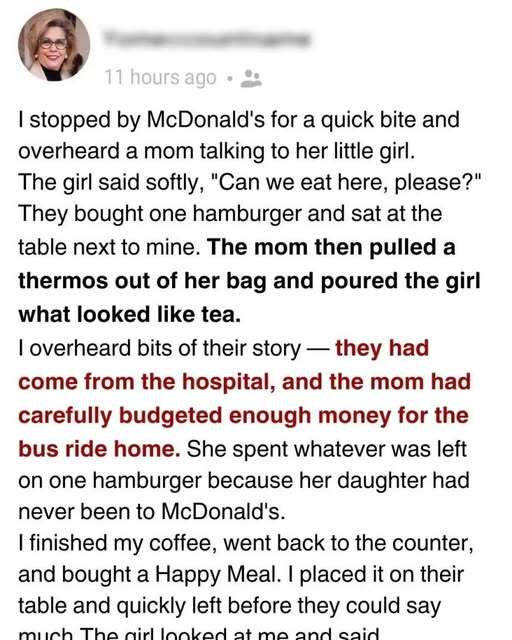
I found myself watching them with a growing sense of perspective. My own “tiring day” began to feel increasingly insignificant compared to the quiet dignity they displayed. As they reached the front of the line, I was close enough to hear the soft, careful cadence of their interaction. The mother spoke to the cashier with a firm, polite voice, ordering only a single cheeseburger and a small order of fries. It was a meager meal, clearly intended to be shared or perhaps given entirely to the child. The little girl tugged gently at her mother’s sleeve, her voice a hopeful whisper that carried through the air. She asked for a Happy Meal, her eyes fixed on the display of plastic toys that sat encased in glass by the register. It was the request of any child, but the silence that followed from the mother was heavy with the reality of a budget pushed to its absolute limit.
The mother knelt down, bringing herself level with her daughter’s eye line. Her expression was a complex map of love and regret. She told the girl that they would have to wait until next time, that today was just for the food. The disappointment on the child’s face was momentary, a fleeting shadow that was quickly replaced by a heartbreaking maturity. She didn’t pout or cry. Instead, she leaned into her mother, squeezing her hand with a strength that seemed to say she understood. She offered comfort where she should have been receiving it. It was a display of emotional intelligence and bond that felt too profound for a McDonald’s at the edge of town.
I stood there with my own tray in hand, but the appetite I had arrived with had vanished, replaced by a stirring in my chest that demanded action. I looked at the cashier, a young woman who had clearly witnessed the same exchange. Our eyes met for a brief second, a silent acknowledgment of the scene that had just unfolded. Without overthinking it, I stepped back toward the counter. I leaned in and asked the cashier to add a Happy Meal to their order—the one with the toy the girl had been eyeing. I reached for my wallet, insisting that the addition remain anonymous. I didn’t want a thank you, and I didn’t want to make them feel like a charity case. I simply wanted that little girl to have the toy and for that mother to have one less “no” to say that day. The cashier nodded, her own expression softening into a genuine smile as she punched the keys on the register.
I retreated to a corner booth, positioning myself behind a plastic partition where I could see them without being seen. When their order number was finally called, the mother walked up to the counter, her brow furrowed in confusion as she looked at the tray. Tucked neatly beside the modest cheeseburger was the bright, iconic red box of a Happy Meal. The little girl let out a gasp that was audible across the dining room. Her hands flew to her face, her eyes dancing with a joy so pure it felt like it could light up the entire block. She reached for the box as if it were a treasure chest, pulling out the small plastic figure with the kind of reverence usually reserved for fine art.
The mother stood frozen for a moment. She looked at the cashier, then began to scan the room, her eyes searching for the source of this unexpected windfall. I buried my head in my phone, focusing intensely on a blank screen, my heart hammering against my ribs. I saw her shoulders drop, not out of defeat, but out of a massive, visible release of tension. The confusion in her eyes gave way to a weary, beautiful smile. She didn’t find me, but she found the grace in the moment. She sat down across from her daughter and watched as the girl dove into the meal, her giggles punctuating the air between bites of nuggets and fries. For those thirty minutes, the world outside—the thin coats, the scuffed shoes, and the cold wind—didn’t exist. There was only the warmth of the restaurant and the thrill of a plastic toy.Telephone repair services
As I cleaned up my own table and prepared to leave, I realized that the exhaustion I had felt earlier had been replaced by a strange, buoyant energy. We often convince ourselves that to make a difference, we need to perform grand, sweeping gestures or donate vast sums of money. We wait for the “right” time to be generous, ignoring the thousands of tiny windows of opportunity that open and close every single day. That evening, the price of a Happy Meal had bought something far more valuable than food. It had bought a moment of reprieve for a tired mother and a core memory of magic for a child who likely faced more “nos” than “yeses” in her daily life.
I stepped out into the night air, and for the first time all day, the cold didn’t feel quite so sharp. I walked to my car, the neon yellow sign of the arches glowing in my rearview mirror, reflecting on the fact that kindness is a circular force. I had intended to help them, but in reality, they had helped me. They reminded me that human connection is the only thing that truly balances the scales in a world that can often feel indifferent. Sometimes, the most profound stories aren’t found in books or movies, but in the quiet corners of a fast-food restaurant, where a small red box and a hidden gesture can change the entire trajectory of someone’s night. As I drove home, I carried that image of the little girl’s smile with me, a reminder that while we cannot fix every problem, we can always choose to add a little light to the shadows.