The Fast Way to See the Answer
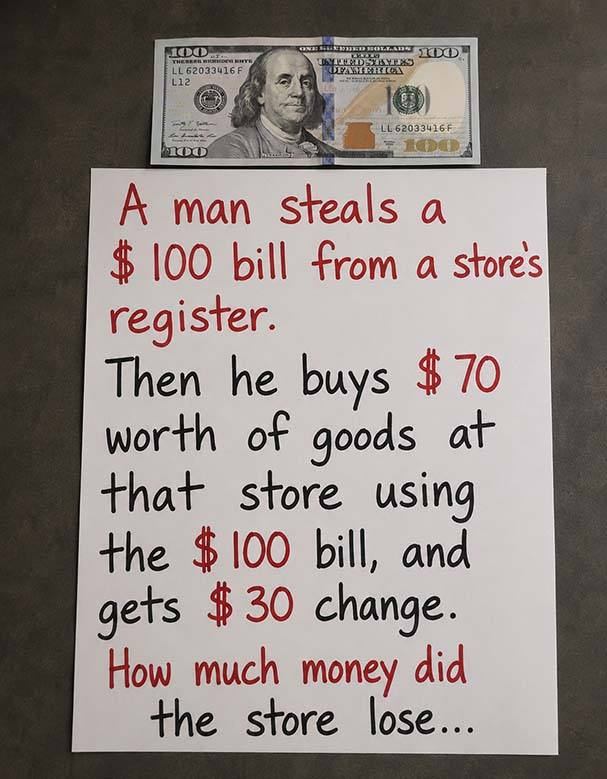
Instead of getting tangled in the “stolen bill” detail, picture a cleaner version:
Imagine the man walks in and takes $70 worth of products plus $30 in cash—and gives the store nothing.
That’s it. That’s the whole outcome.
The store is out:
- $70 in inventory (products)
- $30 in cash (change)
Total loss: $100.
Why the $100 Bill Doesn’t Increase the Final Loss
The wording tricks people because it feels like the store loses $100 twice—once when it’s stolen, and again when it’s used as payment.
But here’s the key detail:
That same $100 bill ends up back in the register.
So it cannot be counted as missing at the end of the day. The store doesn’t finish the day “down” that bill—it finishes the day down the value of what was handed out.
Step-by-Step Breakdown (No Fancy Math)
- Step 1: The store loses $100 cash when the bill is stolen.
- Step 2: The bill returns when the thief uses it to pay—so the register is no longer missing that specific $100.
- Step 3: The store gives away $70 in goods and $30 in cash change.
$70 + $30 = $100 total loss.
The Final Answer
The store lost exactly $100.
This puzzle doesn’t test how well you calculate—it tests whether you can track what’s actually gone at the end: cash and inventory.
Enjoy puzzles like this? Share your answer (and your reasoning) in the comments—and send this to a friend who loves a good logic challenge.