The Visitor Who Didn’t Look Like Staff
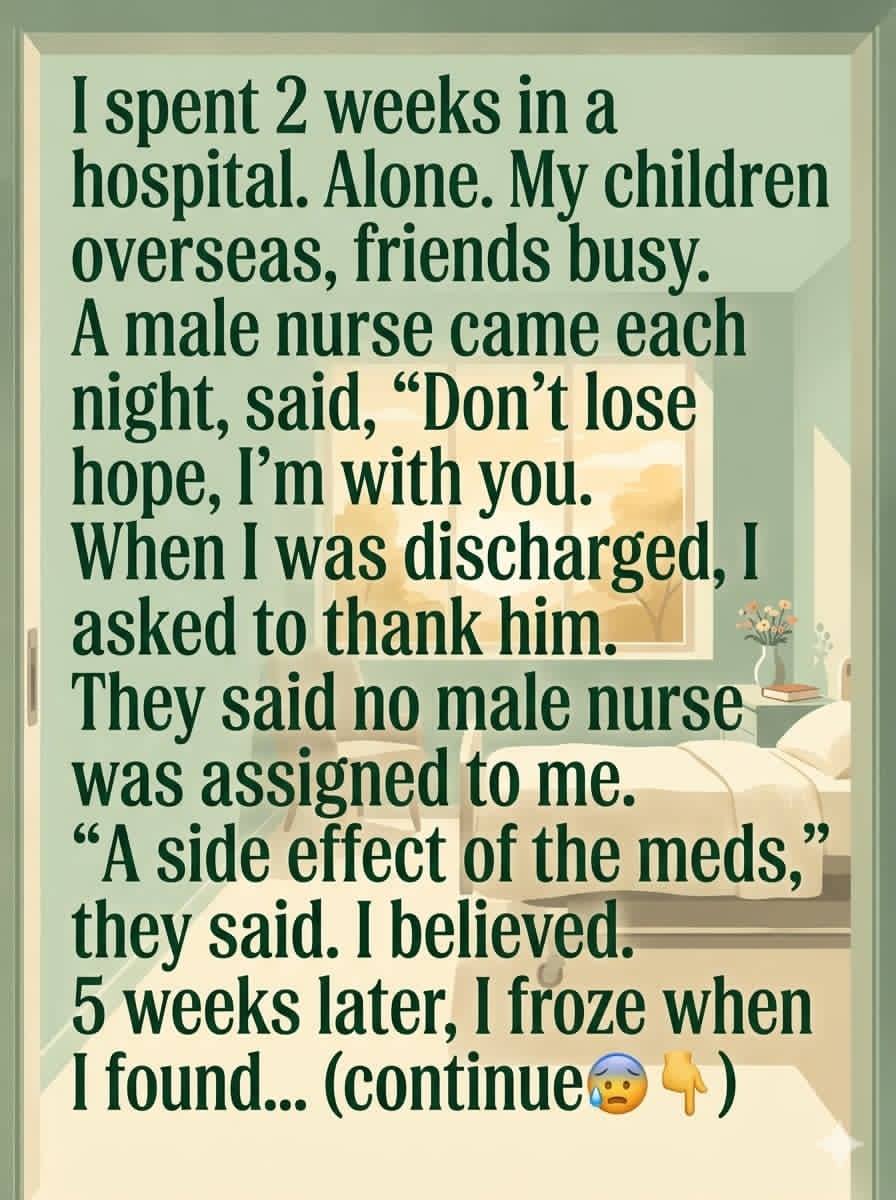
One night, long after visiting hours, her door opened.
She expected a nurse doing rounds or an aide adjusting equipment. Instead, a man stepped in—calm, unhurried, and unfamiliar. He wasn’t wearing scrubs or a lab coat. He didn’t carry a clipboard. He didn’t act like someone rushing between patients.
He simply pulled up a chair and sat beside her bed as if he belonged there.
What stood out most wasn’t what he did—it was how the room felt with him in it. The tension eased. Her breathing slowed. The panic that had been building for days finally loosened its grip.
No Questions About Insurance—Just Conversation
He didn’t ask her to rate her pain. He didn’t mention test results. He didn’t talk like a clinician.
Instead, he spoke gently about ordinary life outside the hospital—trees moving in the wind, morning light, the comfort of small routines. Then he listened. Really listened.
She told him the things she hadn’t been able to say out loud to anyone else: how scared she was, how alone she felt, how she worried she wouldn’t be strong enough to recover fully. He didn’t interrupt or judge. He just stayed present, steady and reassuring, until the night didn’t feel so heavy anymore.
After that, she slept better than she had in days.
The Staff Said He Wasn’t There
As her condition improved and discharge got closer, she mentioned the visitor to her primary nurse. She wanted to make sure he was thanked. She assumed he was part of patient support services, or maybe a late-night volunteer.
The nurse’s reaction stopped her cold.
There were no male nurses assigned to that floor during those nights. No volunteers were scheduled after hours. And the hospital’s security rules didn’t allow unauthorized visitors overnight.
Staff checked logs. They asked around. Nothing matched her description. Officially, no one like that had been there.
Clinical Explanations That Didn’t Fit
The medical team offered possibilities: medication side effects, sleep deprivation, stress-related hallucinations. On paper, those explanations sounded tidy—like a problem solved.
But to her, it didn’t feel like a dream or a distorted memory. It felt specific. Grounded. Real.
Still, once she went home, doubt started to creep in. Maybe her mind had created comfort when she needed it most. Maybe she’d imagined the whole thing.
She tried to let it go.
The Note Hidden in Her Robe Pocket
Days later, while unpacking her hospital bag, she reached into the pocket of the robe she’d worn during her stay. The robe had been folded and untouched since she left the hospital.
Her fingers found a small, hand-folded piece of paper.
Inside was a message written in neat, steady handwriting:
“Don’t lose hope. You’re stronger than you think.”
No signature. No date. No hospital branding. Just eight words that landed exactly where her fear still lived.
And suddenly, the mystery wasn’t fading—it was deepening.
If He Wasn’t Real…How Did the Note Get There?
She lived alone. No one had unpacked her things. No one had access to that robe pocket after she left the ward. Yet the note was there—physical, undeniable, and impossible to explain with a quick shrug.
If the visitor was a staff member, why didn’t anyone recognize him? Why didn’t the schedule show him? If he was an intruder, how did he bypass security and cameras? And if he was only a hallucination, how did he leave behind something she could hold in her hand?
She never found a name. No one came forward. The hospital had no record.
Maybe the Answer Isn’t “Who”—It’s “Why”
Eventually, she stopped trying to win an argument with logic. She stopped chasing proof that would satisfy skeptics. Instead, she held on to what the experience gave her: the strength to endure the worst nights and keep moving forward.
Whether the visitor was a forgotten volunteer, a rare security failure, a coincidence no one could trace, or something far more mysterious, the outcome was the same—she received compassion at the exact moment she was running out of it.
And that changed her.
When You’re at Your Lowest, Kindness Can Still Find You
Hospitals rely on science, and science saves lives. But stories like this remind us that not everything meaningful fits neatly into a report or a camera angle.
Sometimes what carries a person through recovery isn’t only treatment—it’s a moment of human connection, a steady presence, a simple message that says, you can make it.
For this woman, that late-night visitor—known or unknown—became proof that even in the darkest hours, hope can still slip quietly through the door.
What do you think happened here? Share your theory in the comments, and if you’ve ever experienced something unexplainable in a hospital or caregiving setting, tell your story—someone reading may need that hope today.