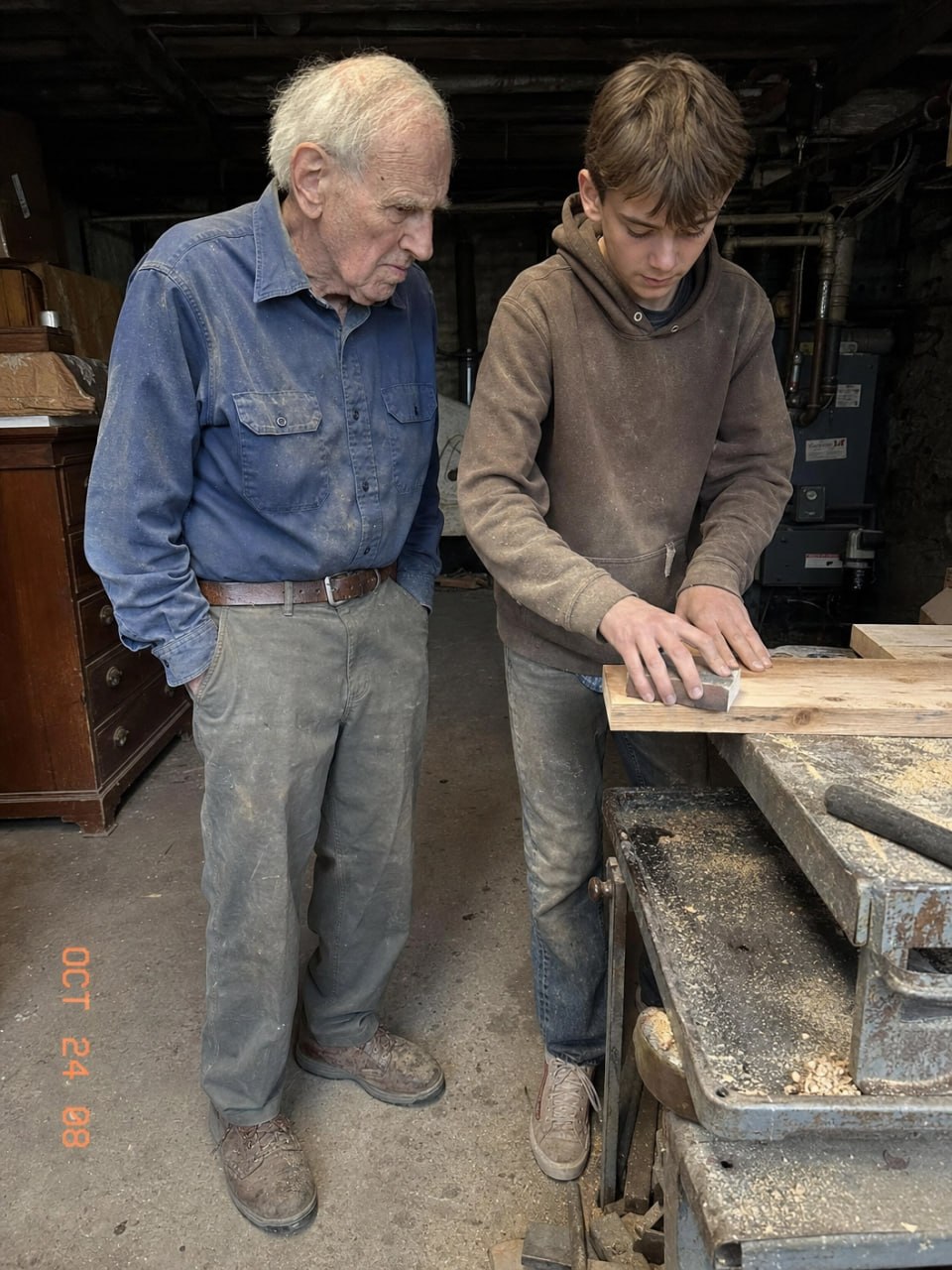
I’m Arthur. Back then I was seventy, the head custodian at a worn-out public middle school in Ohio. My knees complained every time I moved. My hands were rough from decades of wax, grease, and scrubbing floors most people never noticed.
I wasn’t a counselor. I didn’t have a fancy degree in child behavior or adolescent psychology. But I recognized pain when it tried to pass itself off as arrogance.
I dropped a thick sheet of heavy-grit sandpaper onto his lap. Dust lifted into the air between us like a warning.
“What is this?” Leo snapped, brushing at his pricey sneakers like the basement itself was beneath him. “You can’t make me do manual labor. I’ll call my mom.”
I kept my voice even. “Your mom is working a second shift so you can wear those shoes. She’s tired. She doesn’t have time to rescue you from the consequences of your own choices.”
That hit harder than any punishment the office could give him.
The defiance in his eyes flickered—just for a moment—into something closer to guilt. I pointed at a row of old wooden desks I’d pulled from the dumpster: carved up, gouged, covered in graffiti and years of disrespect.
“Start sanding,” I said. “Don’t stop until you can run your hand over it without catching a splinter.”
A Basement Detention That Turned Into a Life Skill
For twenty minutes, the boiler room was filled with the sound of anger: rough sanding, heavy breathing, sharp sighs. Leo worked like someone trying to prove he shouldn’t have to be there.
Then he stopped and threw his hands up. “This is stupid. The school district has money. Why don’t they buy new desks? Why are we fixing trash?”
I set my own sanding block down and wiped my forehead. “We’re not doing this to save the district money,” I told him.
I ran my palm over the smooth section I’d finished. “We do it so the next kid who sits here knows somebody cared enough to give them a solid place to learn. Respect isn’t something you’re handed. It’s something you build—piece by piece.”
Leo stared at the desk. Then his voice dropped, quiet enough that it didn’t sound like him anymore.
“Nobody cares about me,” he said. “Not my teachers. Not my dad. He left. Just my mom… and she’s never home.”
There it was. The real problem wasn’t “bad behavior.” It was abandonment, disappointment, and a kid who didn’t know where to put it.
I didn’t give him pity. Pity is cheap and temporary.
I gave him purpose.
“I care,” I said. “And right now, I need you to care about the kid who’s going to use that desk next year. Now get back to work.”
He did. And this time his strokes weren’t violent or careless. They were steady. Intentional.
When detention ended, he didn’t sprint for the door like most kids would. He stayed behind, running his fingertips across the smooth wood like he couldn’t believe he’d done it.
“Can I come back tomorrow?” he asked, staring at the floor instead of my face. “To finish it?”
I kept my smile to myself. “Only if you leave the attitude upstairs.”
How Mentorship Changes a Kid’s Future
That’s how it started—an unlikely friendship with almost sixty years between us.
Leo began showing up every Tuesday and Thursday. Not because he was in trouble, but because he wanted to be there. At first, we didn’t talk much. Just two people working side by side, sanding down rough edges—on old furniture and on a young life.
Eventually, the quiet turned into conversation.
He told me he was struggling in math, so we worked through homework between projects. I taught him how to use a level, how to glue joints so they didn’t split, how to stain wood so the grain came alive. He taught me something too: kids aren’t “lost,” even when it looks like they are. Many of them are simply desperate for structure, consistency, and someone who won’t give up on them.
By the time he finished eighth grade, he stood taller. He looked adults in the eye. On his last day before high school, he shook my hand—firm, calloused, and proud.
Then life moved on.
I retired at seventy-five. The school got renovated. The old wooden desks were replaced with cheap plastic ones. The boiler room was turned into a space for equipment and cables.
I moved into a small bungalow at the edge of town. My wife was gone. The days were quiet in a way that sometimes felt heavy. And I’ll admit it—more than once I wondered if my working life had mattered at all.
A Letter Years Later That Answered Everything
At eighty-five, I got my answer.
The mail carrier slid a thick envelope through my slot. The return address was from a town three states away. My hands weren’t as steady as they used to be, but I opened it carefully.
Inside was a handwritten letter and a photograph.
The photo showed a tall man in a busy workshop, surrounded by teenagers wearing safety goggles. In the center was a restored dining table—beautiful, solid, and new again.
I knew that jawline. That posture.
It was Leo.
His letter explained he’d become a high school shop teacher, running an after-school woodworking program for at-risk students. They rescued damaged furniture, restored it, and donated it to families moving out of homeless shelters and into transitional housing.
He wrote, plainly, that I hadn’t just fixed desks.
I’d helped fix him.
I sat in my living room and cried the way old men do when they finally let themselves.
The Gift That Brought the Past Back to Life
Not long after, there was a knock at my door. The mail carrier stood there holding a long wooden box wrapped in brown paper and tied with simple string—too big for the slot.
Inside was a shelf made from a smooth oak plank, stained a warm honey brown. In the corner were carved initials: L.R.
And beneath the finish—faint but still there—was the ghost of an old scratched star, the kind bored students carved into desks decades ago.
It was a piece of the very first desk Leo had ever finished.
Repurposed. Restored. Useful again.
Just like him.
When a Program—and a Teen—Were About to Be Written Off
That evening, the phone rang.
It was Leo. His voice was deeper, but it was unmistakably him. We talked like no time had passed—until he got quiet and told me why he’d really called.
His program was on the verge of being shut down.
A fifteen-year-old student named Jaden—angry, defensive, and carrying more than he could explain—had lost his temper and shoved a half-finished cabinet. A window broke. Nobody was hurt, but it was enough.
Some parents panicked. An influential donor pushed for a “cleaner” alternative: replace the woodshop with a pristine digital lab.
Leo feared the board would throw Jaden away the way so many adults throw kids away—especially the messy ones. He asked me to write a letter.
Then, even more softly, he asked if I’d come to the meeting.
Why Accountability and Compassion Must Go Together
Six days later, my niece Clara drove me three states to Mill Creek.
Leo was waiting outside the vocational wing when we arrived. He wrapped his arms around my shoulders and held on like he’d been carrying something heavy for a long time.
Inside the shop, a dozen teenagers stood around pretending they didn’t care. I recognized the posture immediately—arms crossed, eyes guarded, emotions locked behind sarcasm.
One girl, Maya, wore that armor especially well.
In the middle of the room sat their project: a scarred maple dining table meant for a mother moving into transitional housing. The principal, Ms. Harlan, explained the situation. She wasn’t cruel—just exhausted, juggling budgets, safety concerns, and public pressure.
The students muttered about adults giving up on them. I stepped forward and tapped the cracked table with my cane.
“Who broke this table?” I asked.
A boy said, “Nobody. It came like that.”
“Exactly,” I said. “A lot of life is being handed damage you didn’t cause—and deciding whether you’re too proud to repair it.”
I sat down beside Maya and asked for sandpaper.
For two hours, the shop breathed again. The kids worked. Maya sanded like she was fighting the wood.
“You’re attacking,” I told her gently. “Attacking leaves marks. Sanding removes them.”
She slowed down. Then she started talking—about Jaden, about how he quietly got his little brother ready every morning, about how the rumors never include the parts that explain the pain.
She asked if they were supposed to pretend Jaden didn’t do anything wrong.
“No,” I said. “Mercy without accountability is just another kind of neglect. If you care about him, you don’t excuse him. You make him face it—and you stay close enough that facing it doesn’t destroy him.”
Maya went still. Then she whispered, barely audible through the sawdust:
“My dad left when I was eight.”
I kept sanding, steady and slow. “Mine drank too much,” I said.
And in that moment, the room shifted—because the kids finally understood something adults rarely show them:
You can be honest about what broke you and still choose to build something better.
Closing Thought
Some people think second chances are earned with perfect behavior. I’ve learned they’re usually earned with honest work—done slowly, with guidance, and with someone nearby who refuses to give up when you get loud, messy, or afraid.
If this story moved you, share your thoughts in the comments: Have you ever had someone step in at the right moment and change your path—or have you been that person for someone else?