Graham insisted I should “take the high road.” He framed it as a mature, classy move—proof that we were happy and unbothered. Against my better judgment, I agreed.
I didn’t realize the woman in the back row—wearing a wide-brim hat and a bold red dress—wasn’t there to cause drama.
She was there to stop a disaster.
The Reception Stopped Cold
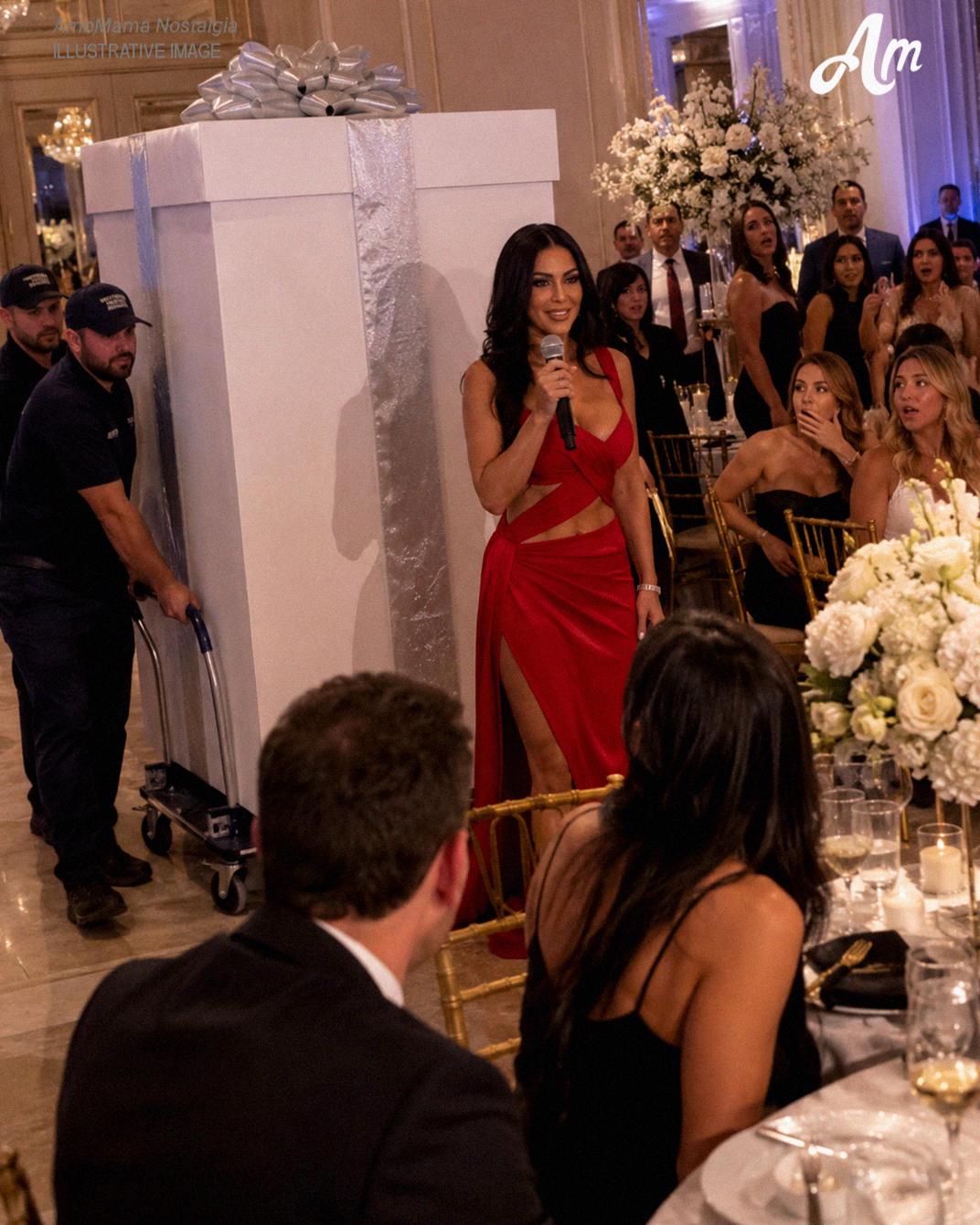
The reception was all champagne flutes, polite laughter, and staged happiness—until the music cut out. A sharp screech of microphone feedback sliced through the room. Monica had walked to the DJ booth and taken the mic.
Silence hit like a wall.
I felt Graham’s hand clamp around my waist, tight enough to hurt. Monica announced she’d brought a wedding gift I needed to open immediately.
Before anyone could react, the banquet doors swung open and two men rolled in a massive white box wrapped in a silver ribbon. It was tall, heavy-looking, and strangely ominous—like it didn’t belong at a celebration.
“Don’t Open It”—And That’s Exactly Why I Did
As I stepped toward the box, Graham’s calm mask started to slip. He begged me not to open it, claiming Monica was “mentally unwell” and trying to ruin our day.
Helen snapped too—suddenly shrieking insults, calling Monica names, acting like the victim in a scene she clearly wanted to control.
But their panic didn’t reassure me.
It warned me.
I pulled the ribbon. The sides of the box dropped away.
Inside were towering foam boards covered with enlarged screenshots—messages between Graham and Helen. Not vague hints. Not misunderstandings. A detailed plan.
A plan to take my money.
The Texts Were a Blueprint for Financial Fraud
In black and white, Helen asked if Graham had “secured” my savings yet. Graham replied that once the marriage was official, my accounts would be “theirs.”
People gasped as I read it out loud. My hands went cold.
Monica stepped forward and handed me a manila envelope. Inside were printed bank alerts showing a pending transfer of $40,000 scheduled for the next business day.
Then the final detail clicked into place: Graham had already accessed my account.
He knew my routines. He knew my passwords were protected by two-factor authentication. And he’d found a way around it—by intercepting a verification code while “borrowing” my phone for something harmless, then convincing me the security alert was a scam.
It wasn’t romance. It was identity theft dressed up as love.
The Charming Fiancé Turned Into a Predator
When I confronted him, Graham didn’t stay apologetic for long. His expression hardened. His tone changed. The man I thought I knew disappeared, replaced by someone cold and calculating.
He claimed he was “reimbursing himself” for the expensive wedding, blaming high-interest credit cards and financial stress. But Monica didn’t let him rewrite the story.
She told the truth: the wedding wasn’t a celebration—it was a setup. A legal doorway to drain my savings and patch over their debts.
And Helen? She stopped pretending entirely. She actually implied I owed them—like my savings were a membership fee for joining their family.
The “Diamond Heirloom” Was Fake Too
Then Monica pointed at the necklace around my neck.
Helen started shouting about how valuable it was—how ungrateful I was being. Monica calmly delivered the last blow: she’d seen a synced message that morning confirming the pendant wasn’t a real diamond at all.
It was cubic zirconia.
The real family diamond had been pawned years earlier to cover bills and property taxes.
I unclasped the necklace. Then I slid off my engagement ring.
Without saying much, I dropped both into Graham’s champagne glass. The splash was louder than the room.
I told him to keep them—he might need whatever he could sell to pay for the wedding he never should’ve tried to afford.
Then I walked out. No screaming. No bargaining. No “fixing it.”
Just freedom.
How I Protected My Bank Account and Built a Legal Case
Within minutes, I called my bank’s fraud department and froze everything. Because the marriage license hadn’t been signed, my attorney explained I could report it as an unauthorized login and attempted theft—cleaner, faster, and far more serious than a messy divorce dispute.
Even better: the entire confrontation had been recorded. Guests filmed it from every angle. The messages were displayed publicly. And Graham and Helen said enough—out loud—to help my lawyer build a strong case.
Four months later, the legal process is still unfolding, but the facts are on my side.
The Truth About Monica
When Monica and I finally met for coffee, she didn’t act smug. She didn’t act vengeful. She looked tired—like someone who knew exactly what it feels like to be targeted by the same people.
She told me they’d tried to bankrupt her during her marriage, too. She didn’t want another woman trapped in the same cycle.
The “unstable ex-wife” was never unstable.
She was the only person in the room brave enough to tell the truth.
What I Lost—and What I Gained
I didn’t get the fairy-tale wedding. I didn’t get the photos I expected to hang on the wall. But I kept something far more valuable:
- My financial security
- My independence
- My future
- The self-respect to walk away
Now, when I think about that red dress in the back row, I don’t see scandal. I see a warning flare—one that saved me before the trap closed.
Because escaping a monster isn’t a tragedy.
It’s a victory.
CTA: If this story hit close to home, share it with someone who’s dating, engaged, or rebuilding after a toxic relationship—and tell me in the comments: what’s one financial “red flag” you think more people should watch for before marriage?