

Why Some $20 Bills Get Attention
Modern U.S. currency is produced in enormous quantities, and the printing process involves multiple stages.
Occasionally, genuine production errors can occur. These may include significant misalignments, missing or misplaced printing elements, unusual ink problems, or other abnormalities that can be verified as part of the manufacturing process.
Minor smudges, folds, stains, or marks caused after a bill leaves the printing facility generally aren’t considered valuable printing errors.
That’s an important distinction for anyone hoping to identify a collectible note.
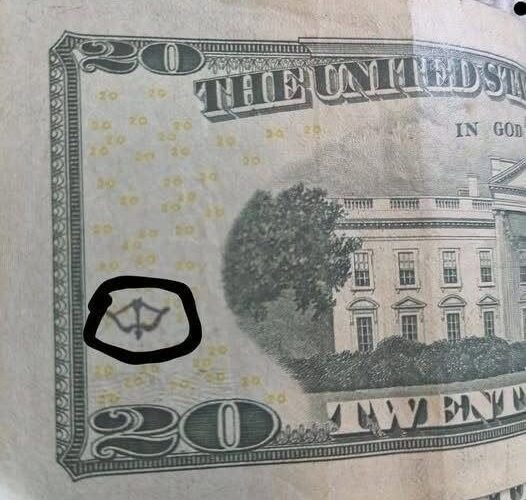
What About a Strange Mark Near the White House?
Some $20 bills may appear to have unusual shapes, marks, or details around the artwork featuring the White House.
Before assuming that such a feature is an error, it’s worth comparing the bill with another $20 note from the same series.
A detail that looks unusual at first may actually be a normal part of the design, a security feature, or simply the result of the way the artwork appears under different lighting or magnification.
A particular mark by itself does not automatically make a $20 bill rare.
What Collectors Usually Examine
If you discover a $20 bill that looks unusual, there are several details worth checking.
1. The Serial Number
Collectors may pay attention to unusual serial-number patterns, including certain repeating or otherwise distinctive sequences.
However, desirability varies considerably depending on the specific pattern and the collector market.
2. Printing Errors
A genuine printing error can sometimes increase a banknote’s collector interest.
The significance depends on what went wrong, how clearly the error can be identified, and whether it occurred during production rather than afterward.
3. Condition
The physical condition of a banknote can also matter.
A crisp, well-preserved note may attract more collector interest than a heavily worn example of the same type.
4. Series and Design
Different series of $20 bills can have different features and collector interest.
Checking the series designation and comparing the note with reliable references can help determine whether anything unusual is actually present.
Don’t Assume Every Odd-Looking Bill Is Valuable
Online posts can make unusual currency discoveries sound more dramatic than they really are.
A stain, crease, ink mark, or printing variation isn’t necessarily rare. Likewise, claims that an ordinary-looking $20 bill is automatically worth hundreds or thousands of dollars should be treated cautiously unless supported by reliable evidence.
If you believe you have a genuine printing error, consider having the note examined by a reputable currency dealer or professional grading service before making any decisions.
Take a Closer Look Before Spending It
Finding an unusual banknote can be fun, especially for people interested in currency collecting.
So if a $20 bill catches your attention because something about it looks different, don’t immediately assume you’ve discovered a fortune—and don’t dismiss it either.
Compare it with another bill, examine the serial number and design carefully, and look for evidence that the unusual feature originated during production.
Sometimes the interesting part isn’t the mark itself, but discovering exactly why it is there.