

The lawyer, Arthur, didn’t answer immediately.
Instead, he pulled a chair closer.
“Before I tell you anything, Nora, I need you to understand something.”
“What?”
“Julian never wanted you to feel obligated to him.”
I frowned.
“Obligated?”
Arthur nodded.
“He knew that accepting this backpack might raise questions. He also knew you might be angry when you discovered what was inside.”
I looked down at my hands.
“I don’t understand.”
“You will.”
He stood and walked toward the door.
Then he stopped.
“There’s one more thing.”
I looked up.
“Julian asked me to tell you not to open the small blue envelope until you’ve read everything else.”
He left before I could ask why.
I sat alone in the room where Julian had spent his final days.
The hospital seemed strangely normal.
People walked through the hallway.
A cart rolled past.
Someone laughed quietly at the nurses’ station.
Yet my world felt completely different.
I placed the backpack on the empty chair.
Then I opened it.
The First Clue
Inside were several envelopes.
Each one had a date written on it.
There was also a small notebook, a photograph, and a set of keys.
I picked up the photograph first.
It showed a much younger Julian standing beside a woman I didn’t recognize.
They were standing in front of a small brick house.
On the back, Julian had written:
“The promise began here.”
I turned the photograph over again.
Who was the woman?
And what promise was he talking about?
I opened the notebook.
The first page contained only one sentence.
“Nora deserves the truth, but not all at once.”
My stomach tightened.
Why me?
Why had Julian chosen me?
We had barely known each other.
I turned the page.
There were dozens of names.
Some had dates beside them.
Others had short notes.
“Found work.”
“Returned home.”
“Reconnected with daughter.”
“Never answered.”
I didn’t understand what I was looking at.
Then I saw a name that made my breath catch.
My mother’s.
My Mother Was in the Notebook
I stared at the page.
There it was.
Evelyn Carter.
My mother’s full name.
Beside it was a date from twelve years earlier.
The date my mother had moved away for several months when I was a teenager.
I remembered that period.
At least, I thought I did.
She had told me she needed time to care for an old friend.
She never explained much more.
I turned the page.
There was another note.
“She came back because she believed Nora needed her.”
My hands began to tremble.
Julian knew my mother.
That couldn’t be a coincidence.
I grabbed the photograph again.
The woman beside Julian wasn’t a stranger anymore.
I recognized her.
It took only a few seconds.
The photograph was old, but the smile was unmistakable.
It was my mother.
A Past I Never Knew
I sat back in the chair.
For years, I had believed my mother’s life before I was born was something she simply didn’t like discussing.
Now I was holding proof that Julian had been part of it.
But why?
And why had he waited until the end of his life to tell me?
I opened the first dated envelope.
Inside was a letter.
The handwriting was Julian’s.
“Your mother once helped me when I had nowhere else to turn.”
I read the sentence twice.
The letter explained that Julian had gone through a difficult period many years earlier.
He had lost his business.
His marriage had ended.
He had become increasingly isolated.
My mother had met him through a community program.
She didn’t rescue him with money.
She simply listened.
According to Julian, that small kindness changed the direction of his life.
He eventually rebuilt his career.
But he never forgot her.
Then came the part that left me speechless.
My mother had asked him to make her a promise.
The Promise
Julian had promised that if he ever found himself in a position to help someone who felt alone, he would.
Not because he owed my mother.
Because she had taught him that sometimes the smallest act of kindness can change someone’s entire day.
He kept that promise for decades.
The names in his notebook belonged to people he had quietly helped.
A former coworker.
A neighbor.
A teenager he had helped find a scholarship.
An elderly man who had needed transportation to medical appointments.
A woman trying to rebuild her life after losing her job.
Julian hadn’t wanted recognition.
He had simply kept helping.
And then, years later, he met me.
Why He Chose Me
I turned to the final pages.
There was a note written only a few days before we married.
“When Nora sits with patients, she thinks she’s helping them survive their loneliness. She doesn’t realize they’re helping her survive hers.”
I stopped reading.
Tears blurred the page.
Julian had noticed.
He had noticed that I wasn’t volunteering only for the patients.
I had been running from my grief.
My mother was gone, and sitting beside strangers who were afraid of being alone had somehow made me feel less alone myself.
Julian understood that before I did.
Then I found another sentence.
“She reminds me of Evelyn—not because she looks like her, but because she stays.”
I closed my eyes.
For the first time, I understood why he had asked me to marry him.
It wasn’t because he believed we were some great romantic story.
It wasn’t because he expected me to become his lifelong partner.
He simply didn’t want the last days of his life to be empty.
And somehow, he knew I understood what that loneliness felt like.
The Keys
I returned to the backpack.
Three keys were attached to a small metal ring.
One was labeled Office.
Another said Storage.
The third had no label.
Underneath them was a note.
“The third key is yours to use only if you want to know the whole story.”
I almost laughed.
Even from beyond the grave, Julian was making me choose.
I called Arthur.
He answered immediately.
“Did you find the keys?”
“Yes.”
“Then you know.”
“I know that my mother knew Julian.”
There was silence.
“How long have you known?”
“Years.”
“Why didn’t you tell me?”
“Because Julian asked me not to.”
I felt anger rising.
“Everyone keeps saying Julian asked for things. What about what I wanted?”
Arthur sighed.
“You’re right.”
His voice softened.
“I’m sorry.”
“Where does the third key lead?”
Arthur hesitated.
“An old community center.”
“What’s there?”
“Something Julian built.”
The Locked Room
The following morning, I drove across town.
The address led me to a modest brick building on a quiet street.
The sign above the entrance read:
THE OPEN DOOR COMMUNITY HOUSE
I had never heard of it.
A woman at the front desk recognized Julian’s name immediately.
“You must be Nora.”
I froze.
“How do you know me?”
She smiled sadly.
“Julian told us you might come someday.”
She handed me an envelope.
I didn’t open it.
“What’s this place?”
She looked around.
“It’s where Julian spent the last twenty years helping people.”
Inside were classrooms, a small library, a kitchen, and several offices.
There were no photographs of Julian.
No giant plaque.
Nothing that suggested the building belonged to him.
It looked ordinary.
But it was full of people.
A teenager studying in the library.
Two older women preparing food.
A man filling out a job application.
A volunteer sorting donated clothing.
Julian had built something that continued working without him.
That was when I understood.
The backpack wasn’t an inheritance.
It was an invitation.
The Blue Envelope
That evening, I finally opened the blue envelope.
Inside was one sheet of paper.
Only a few lines.
“Nora,
If you’re reading this, I’ve already gone. I’m sorry I couldn’t explain everything while I was alive. I was afraid that if I told you too much, you’d think our marriage was planned or that I had chosen you because of your mother.
Neither is true.
I chose you because you sat beside strangers when you didn’t have to.
You stayed when leaving would have been easier.
That is rare.
Don’t spend your life taking care of people because you’re afraid to lose them. Take care of yourself, too.
And please don’t turn my life into a debt you have to repay.
Live yours.
—Julian
I read the letter three times.
Then I cried.
Not because I had lost him.
Not only because of that.
I cried because, for the first time since my mother died, someone had given me permission to stop living inside my grief.
Six Months Later
I didn’t become the director of Julian’s organization.
I didn’t sell everything he left behind.
I didn’t try to become him.
Instead, I started volunteering there one afternoon a week.
Then two.
Eventually, I helped create a small program for hospital patients who had few visitors.
It wasn’t named after Julian.
It wasn’t named after my mother.
We simply called it The Visiting Program.
People came in, sat with patients, read books, played cards, or talked.
Sometimes they said nothing at all.
I learned that presence could be enough.
On the anniversary of Julian’s death, I returned to the hospital chapel.
I wore the same yellow sweater.
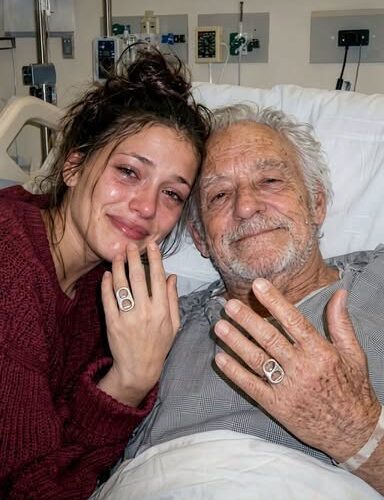
I still had the soda-can pull tab.
It wasn’t a wedding ring anymore.
It was a reminder.
A reminder that seven days can matter.
That strangers can change each other’s lives.
That grief can eventually become something other than pain.
The chaplain who had married us was there.
He smiled when he saw me.
“How have you been?”
I thought about it.
“Different.”
He nodded.
“That’s probably a good thing.”
I looked at the little pull tab in my palm.
“I used to think Julian came into my life because he needed me.”
“And now?”
“Now I think we needed each other.”
The chaplain smiled.
“That sounds more complicated.”
“It is.”
I laughed softly.
“But it’s also true.”
The Truth Julian Left Behind
Julian had been right about one thing.
He wasn’t who I thought he was.
He had been more complicated.
He had made mistakes.
He had secrets.
He had regrets.
But he had also spent years trying to turn one person’s kindness into something that could reach other people.
And in the end, he had unknowingly done the same thing for me.
He had given me a reason to keep moving.
I never expected to marry a stranger.
I certainly never expected that marriage to last only seven days.
And I never expected a green backpack to reveal a connection between the dying man beside me and the mother I had spent years mourning.
But life rarely gives us the explanations we expect.
Sometimes they arrive late.
Sometimes they arrive in a letter.
Sometimes they arrive in the form of a stranger who asks you to stay.
And sometimes, the truth isn’t that someone entered your life to change it forever.
Sometimes they simply arrive at the exact moment when you need to remember that your life is still yours.
Julian’s final gift wasn’t money, a house, or a secret inheritance.
It was the reminder that being there for someone can change both of you—and that eventually, you have to learn how to stay for yourself, too.