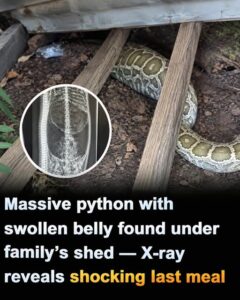
The answer would eventually come from an X-ray.
The X-Ray Reveals the Truth
After the python was safely removed, it was taken to the Monmouth County SPCA for examination.
Veterinary staff used imaging to determine what was inside the snake's distended abdomen.
The result was startling.
The X-ray revealed the unmistakable shape of a large opossum inside the python.
The snake had swallowed the animal whole.
For a python, that behavior is not unusual. Burmese pythons are ambush predators capable of consuming prey much larger than people might expect. They don't chew their food; instead, they use their jaws and flexible bodies to swallow prey whole.
That explains the bizarre appearance of the snake.
The enormous bulge wasn't a tumor or some mysterious growth.
It was its most recent meal.
From Backyard Predator to Animal-Control Case
Once the mystery was solved, the situation became more complicated.
The python wasn't native wildlife.
Burmese pythons are native to parts of South and Southeast Asia, not suburban New Jersey.
That raised an obvious question:
How did an eight-foot exotic snake end up living beneath a family's shed?
Authorities began looking into whether the animal had an owner and how it had escaped or been released.
Cases involving exotic animals can create difficult situations for both residents and wildlife officials. A large snake that escapes into a neighborhood can pose a potential danger to pets and native wildlife, while the animal itself can also be vulnerable to cold weather, starvation, traffic, or other hazards.
In this case, the python had apparently managed to survive long enough to find shelter beneath the shed and successfully hunt local wildlife.
Why the Discovery Was So Alarming
The most disturbing part for the family wasn't simply the snake's size.
It was where the snake had been living.
The animal was underneath a structure in a residential backyard.
 Up Next: Page 3 of 4
That meant it wasn't discovered in some remote wilderness area. It was...
The fact that the snake had already captured a sizable wild animal demonstrated that it was capable of surviving outside captivity.
Continue Reading