
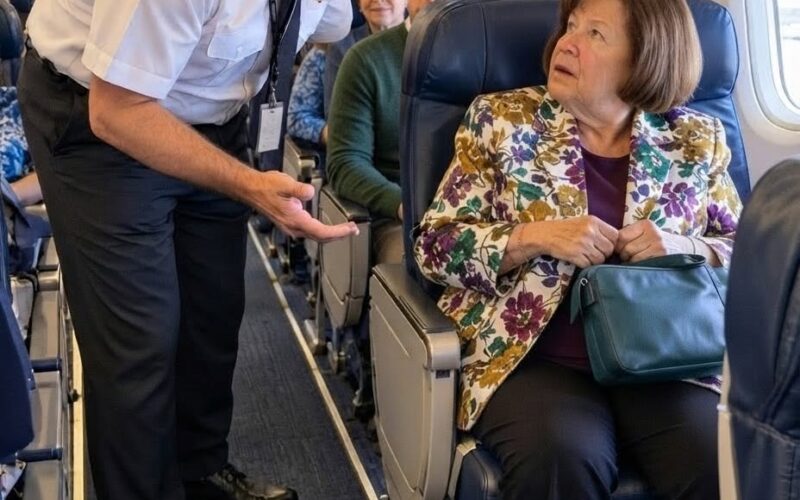

My grandmother said it so quietly that, for a moment, I thought I had misunderstood her.
We were standing at the gate at Boston Logan Airport. She held her boarding pass in one hand and pressed her worn brown leather purse against her chest with the other.
The gate agent looked at her ticket.
“Ma’am, you’re currently assigned to first class. Seat 3A.”
“I know,” Grandma said. “But I’d like 34A instead, if it’s available.”
The agent paused.
“It is. But if you voluntarily move to economy, there won’t be a refund for the fare difference.”
“That’s perfectly fine.”
I stared at my grandmother.
“Grandma, what are you doing?”
She didn’t answer.
The printer hummed. A new boarding pass appeared.
She took it, studied it for several seconds, and slipped it carefully into the side pocket of her purse.
I caught a glimpse of something yellowed and old inside.
“Grandma, that first-class ticket cost me a fortune.”
“I know, sweetheart.”
“Then why would you give it up?”
She reached for my hand.
“I’d rather sit in the back.”
That was all she would say.
And I should explain why that seat mattered so much.
My grandmother, Ruth Walsh, had recently turned eighty. She still lived alone in the small gray house in Dorchester where she had spent more than five decades.
She planted flowers every spring, did crossword puzzles in ink, and called me every Sunday evening to ask whether I was eating properly.
I was twenty-seven and working as a nurse at Massachusetts General Hospital. Between rent, student loans, and extra shifts, I didn’t have much money left over.
But almost a year earlier, I had asked Grandma what she wanted for her eightieth birthday.
I expected her to say dinner.
Instead, she put down her fork.
“I want to go to San Francisco.”
I stared at her.
“To visit your mother.”
My mother had lived in California since before I was born. I had grown up in Oakland before returning to Boston for nursing school. I stayed because Grandma was alone.
“You haven’t flown in decades,” I reminded her.
“Twenty-seven years.”
“You always said you were never getting on another airplane.”
“I changed my mind.”
Then she gave me an oddly specific request.
“March fourteenth. Flight 212. The morning flight.”
I searched for it that night.
The flight still existed.
So I started saving.
When the time came, I booked Grandma first class.
Seat 3A.
I wanted her to be comfortable. She was turning eighty, and she was facing something she had avoided for twenty-seven years.
I even booked myself into 3B so we could sit together.
And now, at the gate, she had voluntarily traded those seats for economy.
“You’re upset,” she said as we waited to board.
“I’m confused.”
She smiled.
“Because you worked so hard for those tickets.”
“Then why are you moving?”
She hesitated.
“Because sometimes comfort isn’t the most important thing.”
I wanted to argue.
But my grandmother almost never asked me for anything.
So I nodded.
“Okay.”
She squeezed my hand.
“Thank you.”
First class began boarding.
I took my seat in 3B.
Grandma disappeared toward the back of the plane.
As we climbed above Boston, I kept thinking about why she had stopped flying in the first place.
I knew only fragments about my grandfather.
His name was Frank Walsh.
He had worked as an aircraft mechanic at Logan Airport for thirty-four years. According to my mother, he could listen to an engine and recognize a problem before anyone else noticed it.
He died the day after I was born.
March 14, 1999.
I had always been told it was a heart attack.
Nothing more.
Whenever I asked questions, Grandma became quiet.
There was one photograph of him in her house. He was young, wearing a sailor’s uniform and laughing at something outside the frame.
And there were the silver wings.
A tiny, tarnished aviation pin had always been attached to Grandma’s purse.
When I was little, I once asked where it came from.
“Your grandfather gave it to me,” she said.
“Why?”
She thought for a moment.
“Because I was frightened, and he wanted me to remember that I could be brave.”
I didn’t understand what she meant.
Not until Flight 212.
Continue reading…