
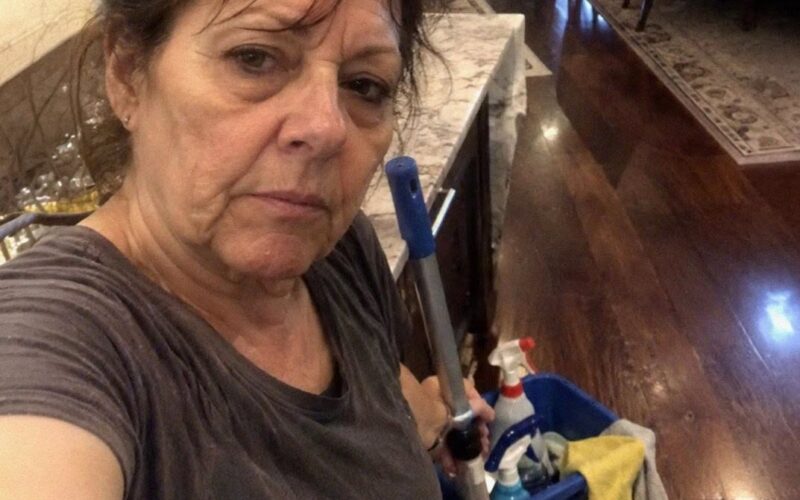

When I started working for her, my daughter, Willa, was nine. I’d recently separated from her father and was trying to fit enough cleaning jobs between school drop-off and pickup to keep us going.
Mrs. Whitaker had called after seeing one of my handwritten ads.
That Thursday appointment became the one job I could always count on.
Then, a few weeks ago, she told me she was moving closer to her daughter.
“I’m tired of having a whole upstairs I don’t use,” she said.
We laughed, but cleaning the house for the last time was harder than I expected. There were pale rectangles where the pictures had hung. Her kitchen calendar was gone. I kept reaching to move things that weren’t there anymore.
When I handed back her key, she closed my fingers around it.
“Not yet. Come back Saturday at eleven.”
“Do you need me to clean after the movers?”
“No. And leave your supplies at home.”
I must have looked confused because she added, “I’m asking you to visit, Carly.”
On Saturday, I showed up in jeans without bleach spots and a blouse I usually saved for school events. I brought cookies because arriving empty-handed felt strange.
Most of the furniture was gone, but she’d kept the kitchen table and two chairs. There were sandwiches on actual plates.
“Sit down,” she said. “I know you usually eat lunch in your car.”
I hadn’t realized she knew that.
We talked about the move and Willa’s senior year. When we finished eating, I automatically stacked our plates.
Mrs. Whitaker reached across the table and stopped me.
“Leave those. There’s something I wanted to show you.”
She stood slowly and walked toward the hallway.
I followed.
For a moment, I wondered if she was going to show me some hidden water stain, a loose floorboard, or perhaps something she had forgotten to pack.
Instead, she stopped in front of the small closet beneath the stairs.
I had cleaned that closet hundreds of times.
I knew the vacuum was usually kept there. I knew the spare light bulbs were on the top shelf. I knew the old Christmas decorations were packed into plastic tubs toward the back.
But there was something else.
A narrow wooden box sat on the floor.
I had never seen it before.
Mrs. Whitaker bent down and pulled it out.
“This is for you.”
I stared at her.
“For me?”
She nodded.
I crouched beside her.
The box was old, with scratches across the lid and a brass clasp that had gone dark with age.
“What’s inside?”
“You’ll have to open it.”
I lifted the clasp.
Inside was a stack of envelopes.
There must have been twenty or thirty of them.
Each one had a date written across the front.
I picked up the first.
October 14.
Another said:
December 2.
Another:
March 18.
I looked at her.
“What are these?”
“Things I wanted to say.”
My stomach tightened.
“To me?”
She smiled.
“Yes.”
I opened the first envelope.
Inside was a single sheet of paper.
The handwriting was neat and slightly slanted.
I read the first line.
Today Carly came in looking exhausted.
I looked up.
Mrs. Whitaker had turned toward the window.
“You wrote about me?”
“Not every week,” she said. “I wasn’t keeping a diary about you.”
I laughed nervously.
“Because that would be a little creepy.”
She laughed too.
Then she became quiet.
“I just started writing things down because I was afraid I’d forget them.”
I looked back at the letter.
The note wasn’t dramatic.
It described something I barely remembered.
Years earlier, I had arrived at the house late because Willa had been sick. I had apologized repeatedly and offered to stay later.
Mrs. Whitaker had apparently noticed that my hands were shaking.
I remembered the day.
I didn’t remember her noticing.
I opened another envelope.
This one was dated several years later.
It mentioned Willa’s middle-school graduation.
I remembered telling Mrs. Whitaker that I couldn’t afford a new dress for the ceremony.
Apparently, I’d said it while wiping fingerprints from the dining room chairs.
At the time, I’d thought she was barely listening.
But her letter said:
She talks about her daughter as though every problem in the world can be solved if she just works hard enough. I hope one day Carly realizes she doesn’t have to carry everything alone.
I stopped reading.
“Why didn’t you ever tell me this?”
Mrs. Whitaker looked down at her hands.
“Because I didn’t want you to think I was trying to become something I wasn’t.”
I didn’t know what she meant.
“You were my employer,” she continued. “You were working for me. I never wanted kindness to feel like charity.”
That sentence stayed with me.
She picked up another envelope.
“This one is from the winter your car broke down.”
I smiled.
“Oh, I remember that.”
“You walked three miles in the snow.”
“I had to get here.”
“You could have called.”
“I needed the money.”
She gave me a look.
“I know.”
I opened the letter.
She had written about seeing me arrive with wet shoes and red hands.
I remembered spending the first hour cleaning while trying not to shiver.
What I didn’t know was that after I left that afternoon, she had called a mechanic.
She had paid to have my car repaired.
I stared at her.
“You did that?”
She shrugged.
“You needed the car.”
“I thought the mechanic gave me a discount.”
“He did.”
I blinked.
“You paid the rest?”
She nodded.
I couldn’t speak for a few seconds.
“Why didn’t you tell me?”
“Because you would’ve argued.”
“That is absolutely true.”
She laughed.
Then she reached into the box again.
“There’s one more thing.”
She handed me a smaller envelope.
There was no date on it.
My name was written across the front.
Carly.
My heart began beating faster.
I opened it carefully.
Inside was a letter.
Dear Carly,
If you’re reading this, I have probably already moved.
I know you may be wondering why I asked you to come back without your supplies.
For eight years, you came through my front door carrying buckets, cloths, bottles, and bags. You made this house look cared for.
But somewhere along the way, I realized something.
You were caring for more than my house.
I swallowed.
The next paragraph was harder to read.
You were raising a daughter. You were rebuilding your life. You were working when you were tired. You showed up when things were difficult. And you rarely complained.
I don’t know if you ever understood how much I respected that.
I lowered the letter.
Mrs. Whitaker was watching me.
“I didn’t know,” I said.
“I know.”
She smiled sadly.
“That was partly why I wrote it down.”
I continued.
There is something else in the box.
I looked inside.
Under the letters was a small envelope from a bank.
My name was printed on it.
“What is this?”
“Open it.”
I did.
Inside was a letter from a financial institution and a statement showing an account.
My name was on it.
So was hers.
I looked at the balance.
I couldn’t understand what I was seeing.
“Mrs. Whitaker…”
“Before you panic, listen.”
I looked at her.
“For years, you gave me your time. I paid you for your work. That was fair. But every Thursday, you also gave me something I never put on an invoice.”
“What?”
“Company.”
She sat down.
“After my husband died, Thursdays were very quiet.”
I remembered that.
She had become quieter after her husband’s death.
I had assumed she simply didn’t like to talk about it.
“But you were always here,” she continued. “You’d vacuum. You’d complain about the kitchen drawer. You’d tell me something ridiculous Willa had done at school.”
I smiled.
“She once put a frog in her backpack.”
“I remember.”
“She forgot it was there.”
“I remember that too.”
We both laughed.
Then Mrs. Whitaker’s expression softened.
“Those Thursdays mattered to me.”
I looked at the statement again.
“What is this account?”
“A little something I set aside over the years.”
“For me?”
“For you.”
I shook my head immediately.
“No. I can’t take this.”
“You can.”
“I really can’t.”
“You really can.”
“This is too much.”
She leaned forward.
“Carly, I’m not giving you money because I think you need rescuing.”
I went quiet.
“I’m giving you something because I want you to have a chance to do something for yourself.”
I stared at her.
“What kind of chance?”
She smiled.
“Whatever you want.”
I looked at the account statement again.
For years, I had imagined getting ahead.
Not becoming rich.
Not owning some enormous house.
Just getting ahead.
A reliable car.
A little savings.
Maybe taking Willa on a trip.
Maybe paying for a class I’d always wanted to take.
Maybe, someday, working fewer hours.
But whenever those thoughts appeared, another bill seemed to arrive.
“Why now?” I asked.
She looked around the nearly empty house.
“Because I’m leaving.”
She paused.
“And because I finally learned something.”
“What?”
“Sometimes people wait until the very end to say what should have been said years earlier.”
I felt tears gathering in my eyes.
She reached across the table.
“I didn’t want to do that.”
We sat quietly for a moment.
Then she pointed toward the wooden box.
“There’s one more envelope.”
I looked inside.
There was a small white envelope tucked beneath the others.
This one wasn’t addressed to me.
It said:
For Willa.
I stared at it.
“What’s that?”
“Something I wanted to give her when she graduates.”
I opened it.
Inside was a handwritten note and a small key.
“The key is for what?”
“You’ll find out.”
I looked at her suspiciously.
“You’ve been keeping secrets from me for eight years.”
She laughed.
“Not secrets. Surprises.”
That distinction didn’t seem very convincing.
She explained that the key opened a small storage box at the local community center. Inside was a collection of books she had gathered over the years.
Not expensive books.
Just books she thought Willa might enjoy.
Some were about college.
Some were about careers.
Some were novels.
One was an old cookbook.
“She told me once she wanted to learn how to cook,” Mrs. Whitaker said.
“She still does.”
“Good.”
I folded the note carefully.
“She’ll love this.”
“I hope so.”
We stayed at the table for another hour.
We talked about things we’d never discussed during those eight years.
Her favorite childhood memory.
My biggest fear about Willa leaving home.
The job I secretly wanted to have someday.
The reason she had kept the kitchen table until the end.
Eventually, I asked her why she had never invited me to sit down before.
She smiled.
“I thought you were busy.”
“I was.”
“I didn’t want to interfere.”
“You were paying me to clean your house.”
“Yes.”
She smiled.
“But I never wanted you to think that was all you were to me.”
That sentence broke something open in me.
For eight years, I had thought of myself as the woman who came every Thursday.
The cleaner.
The person who knew where everything belonged.
The person who arrived with supplies and left with a check.
But sitting there, looking at the woman across from me, I realized that relationships don’t always announce themselves.
Sometimes they grow quietly.
Sometimes they hide inside routines.
Sometimes you don’t notice them until the routine ends.
Before I left, Mrs. Whitaker walked me to the door.
She handed me the key to the storage box.
Then she hugged me.
It wasn’t a quick, polite hug.
It was the kind where neither person rushes to let go.
“I’ll miss Thursdays,” she whispered.
“So will I.”
“You can still call.”
“I will.”
“And Carly?”
“Yes?”
“Come next time without your supplies.”
I laughed through my tears.
“I promise.”
Three months later, Willa graduated.
Mrs. Whitaker couldn’t attend because of the move, but she sent a card.
Inside was a short message.
To Willa,
Your mother taught me something over the years: showing up matters.
Whatever you decide to do with your life, keep showing up.
And remember that some of the most important people you’ll meet won’t always have impressive titles. Sometimes they’ll simply be the people who keep a promise, make a meal, open a door, or show up every Thursday.
Willa read it twice.
Then she looked at me.
“Mom?”
“Yeah?”
“How long have you known her?”
“Eight years.”
She smiled.
“No. I mean how long have you really known her?”
I thought about that.
Then I smiled back.
“Maybe only since Saturday.”
Because sometimes we think we know the people who pass through our lives every week.
We know their routines.
We know their schedules.
We know what they do for work.
But we don’t always know what they mean to each other.
And sometimes it takes an empty house, a wooden box, and one final invitation to sit down before we realize that a relationship was quietly growing there all along.
Mrs. Whitaker moved away.
I stopped cleaning her house.
But every few months, a postcard arrives.
And every time it does, I put down whatever I’m doing and read it before doing anything else.
Because after eight years of arriving at her house with cleaning supplies, I finally understood what she had wanted me to bring that last Saturday.
Nothing.
Just myself.
And, for once, enough time to sit down.