
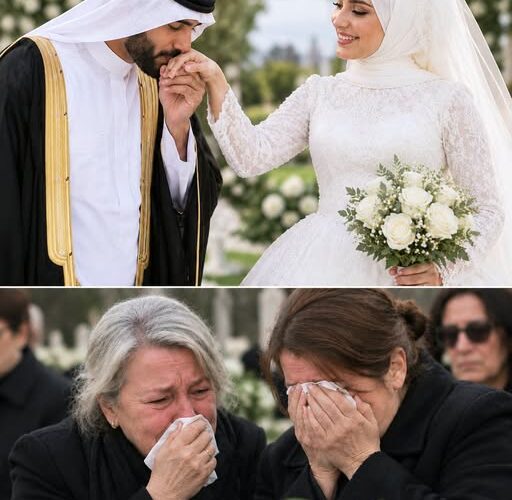

There was no arrogance in his eyes. No interest in the cameras, the expensive decorations, or the people watching them. When he looked at her, the world seemed to disappear.
That night, he whispered that the wedding was only the beginning.
They talked about the future.
About traveling together.
About a home they would build.
About children, perhaps.
About growing old.
They spoke with the certainty of people who believe tomorrow is promised.
Neither of them knew that tomorrow would arrive without him.
The following morning began quietly.
The honeymoon suite was still and peaceful. Pale sunlight slipped through the curtains, painting thin golden lines across the floor. The air conditioner hummed softly in the background.
She remembers waking and looking toward him.
At first, nothing seemed wrong.
Then she noticed how still he was.
She called his name.
No answer.
She touched his shoulder.
Nothing.
She took his hand.
It was cold.
In those first few seconds, her mind refused to understand what her hands were already telling her.
She called his name again, louder this time.
Then she began shouting for help.
The room that had been filled with laughter only hours before suddenly became a place of panic.
Doctors came.
Staff rushed in.
Phones rang.
People spoke quickly around her, using words she couldn’t understand.
She stood there frozen, still wearing traces of the happiness from the night before, watching strangers attempt to save the man who had just promised her forever.
And then came the moment she would remember for the rest of her life.
The moment everyone stopped trying.
The moment the room became unbearably quiet.
Rashid was gone.
Just like that.
No dramatic goodbye.
No final conversation.
No opportunity to tell him one last time that she loved him.
There was only silence.
She held his hand and begged him to come back.
She prayed.
She cried.
She refused to believe what the doctors were telling her.
How could a man who had been laughing beside her hours earlier suddenly be dead?
How could someone become a husband one night and a memory the next morning?
The questions had no answers.
In the hours that followed, she moved through the world as though she were underwater.
People came to speak with her.
There were documents to sign, questions to answer, arrangements to make.
She barely understood any of it.
She signed papers she could hardly read because her hands were shaking too badly.
She answered questions she couldn’t process.
She watched strangers move around the room while her mind remained trapped in the previous night.
She kept thinking about his smile.
His voice.
His hand in hers.
The promises they had made.
At one point, she looked at her wedding dress lying nearby.
Only hours earlier, it had represented the beginning of her new life.
Now it felt like a relic from someone else’s story.
She couldn’t bring herself to take it away.
For days, she struggled to accept what had happened.
There were moments when she would instinctively turn toward him to share something, only to remember that he wasn’t there.
She would wake in the morning expecting to hear his voice.
Then reality would return.
He was gone.
And she was alone.
People often assume that wealth makes tragedy easier.
But money could not buy her another morning with Rashid.
His luxurious home could not fill the silence.
His expensive cars could not drive her back to the night before.
His vast fortune could not purchase the one thing she wanted most—a few more minutes with the man she had just married.
In the weeks that followed, she discovered that grief does not always arrive as tears.
Sometimes it arrives as silence.
Sometimes it is sitting alone at a dinner table set for two.
Sometimes it is reaching for a phone to call someone who will never answer.
Sometimes it is hearing a song and suddenly remembering a conversation from years ago.
And sometimes grief is simply waking up and realizing, once again, that the person you love is no longer part of your tomorrow.
But slowly, painfully, she began to understand something.
Her story with Rashid had been short.
But that did not mean it had been meaningless.
Their time together had not been measured in decades.
It had been measured in moments.
And some moments can change a person’s entire life.
Years passed.
The sharpness of the grief softened, though it never disappeared completely.
She learned how to live with the empty space.
She learned how to laugh again without feeling guilty.
She learned that remembering someone does not mean refusing to move forward.
And she learned something else about the fortune Rashid had left behind.
It could either become a monument to everything she had lost—or it could become a way of continuing the kindness he had shown while he was alive.
She chose the second.
His home became her refuge, but she refused to allow his wealth to become merely a symbol of luxury.
Instead, she began supporting causes that mattered to them.
Scholarships were established in his name.
Donations were made to families who needed help.
Opportunities were created for young people who reminded her of the dreams Rashid once had.
His name slowly became connected not only with wealth, but with generosity.
She realized that perhaps this was one way she could keep a part of him alive.
Not by remaining trapped in the past.
But by allowing the love they shared to continue producing something good in the world.
Even years later, she keeps a photograph of Rashid beside her bed.
She doesn’t look at it every morning.
She doesn’t need to.
She knows exactly what it represents.
It isn’t a shrine to tragedy.
It is a reminder.
A reminder that she was loved.
A reminder that she loved someone deeply.
A reminder that, for one brief and extraordinary chapter of her life, two people believed they had found forever.
She sometimes wonders what their life would have looked like if he had survived.
She imagines the places they might have traveled.
The children they might have raised.
The arguments they might have had.
The ordinary mornings they might have shared.
Perhaps that is one of the hardest parts of losing someone suddenly—not only losing the person, but losing every future version of your life that might have existed with them.
There are no answers to those questions.
Only possibilities.
And perhaps that is what life teaches us in the most painful way.
We make plans as though tomorrow belongs to us.
We buy houses.
We plan weddings.
We make promises.
We talk about next year, next decade, retirement, old age.
We say, “We’ll do it someday.”
But life has never promised us someday.
It only gives us today.
That is why, years after Rashid’s death, she no longer measures love by how long it lasts.
She measures it by how deeply it is lived.
She remembers the laughter.
The conversations.
The tenderness.
The excitement of becoming a wife.
The feeling of holding his hand.
And yes, she remembers the devastating morning when that hand became cold.
But she refuses to let the final moment erase everything that came before it.
Because Rashid’s life did not begin with her, and it did not end with the day she lost him.
But their love became a chapter in both their stories.
A short chapter.
An unexpected chapter.
A heartbreaking chapter.
But a real one.
And perhaps that is the lesson she carries with her now.
Life is fragile.
Tomorrow is never guaranteed.
The people we love can leave us far sooner than we ever imagined.
So say what you mean.
Hold the hand a little longer.
Make the phone call.
Forgive when you can.
Tell someone you love them while you still have the chance.
Because sometimes, the greatest tragedy is not loving someone and losing them.
It is waiting too long to love them at all.
She lost her husband the morning after she became his wife.
She lost the future she had imagined.
She lost a thousand ordinary tomorrows that would never come.
But she did not lose the love itself.
That remained.
And years later, when she looks at his photograph beside her bed, she no longer asks why life took him so suddenly.
She simply whispers a quiet thank-you.
Thank you for finding me.
Thank you for loving me.
Thank you for the memories.
And thank you for reminding me that even the shortest moments can leave a lifetime behind.
Because some love stories are not measured by how many years two people are given.
They are measured by how much love they manage to place inside the time they have.