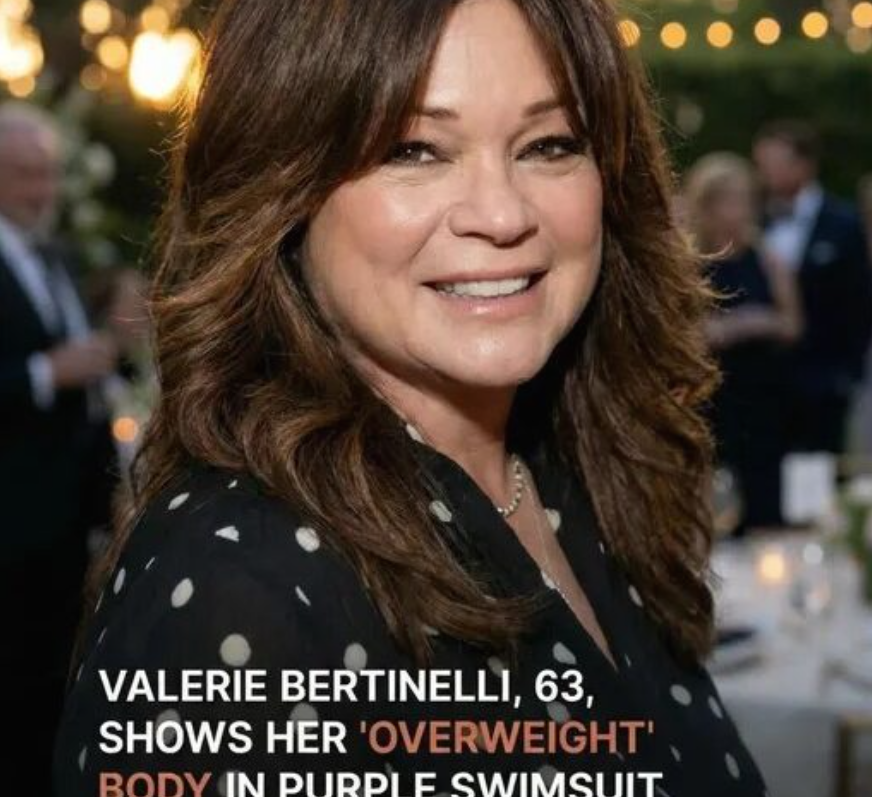
In today’s online world, perfection is practically treated like a requirement. Social media feeds are filled with edited photos, filtered faces, and carefully staged lifestyles that quietly pressure people—especially women—to believe they must look a certain way to be worthy of admiration. But on February 15, 2026, Valerie Bertinelli pushed back against that entire mindset with one simple post: a swimsuit throwback photo that was raw, real, and unapologetically human.
At 63 years old, the actress and beloved food personality didn’t just share an old memory. She sparked a larger conversation about body image, aging, and how deeply society trains women to judge themselves based on their shape. Her post wasn’t dramatic or loud, but it carried a powerful message: a woman’s value was never supposed to be measured by her waistline.
The image Bertinelli posted was taken nearly ten years ago—during a period when tabloids and critics frequently labeled her as “overweight.” Even worse, she admitted that she had also internalized those labels at the time. But looking back now, she doesn’t see what the media once claimed to see. Instead, she sees a woman who was alive, energetic, healthy, and living her life—yet still trapped in the exhausting belief that she wasn’t “good enough.”
Her reflection cuts straight to the heart of the issue: appearance-based judgments often hide the truth. They erase the reality of someone’s health, happiness, and strength, reducing them to a number or a headline. In Bertinelli’s case, the judgment wasn’t just coming from the outside world—it was echoing inside her own mind, shaping the way she saw herself for years.
For decades, Bertinelli was closely tied to the weight-loss industry, becoming a recognizable face in major campaigns during the era when diet culture dominated celebrity branding. She has openly spoken about how long she chased the idea that a specific number on the scale would bring peace, confidence, and happiness. But that chase came at a cost. It wasn’t only physically draining—it was mentally exhausting.
Over time, she realized she had spent far too many years distracted by self-criticism, missing moments of joy because she was busy battling her own reflection. Her honesty resonated with countless people because it reflects a struggle many silently carry: treating the body like a constant project instead of something meant to be lived in and appreciated.
A major turning point in her life came after the loss of her former husband, legendary guitarist Eddie Van Halen, who passed away in 2020. Grief has a way of stripping away illusions, and for Bertinelli, it reshaped her priorities completely. In the face of death and heartbreak, the scale suddenly seemed meaningless. The pursuit of “perfect” felt small compared to the reality of time, love, and what truly matters.
She has shared that mourning forced her to rethink how she was spending her energy. She began to understand that happiness doesn’t magically arrive when you reach a goal weight—it comes from presence, emotional stability, and gratitude for the life still in front of you.
What made her February 2026 post so impactful is that she didn’t present it as a “before and after” moment. There was no weight-loss storyline, no transformation narrative, no message suggesting she had “fixed” herself. Instead, she challenged the entire framework of how society talks about health. Her point was clear: wellness isn’t defined by how someone looks in a swimsuit. It’s defined by how they feel, how they function, and how they live.
Her current outlook focuses less on appearance and more on ability. She encourages people to think about what their bodies allow them to do—travel, move, laugh, hug the people they love, and experience life—rather than obsess over what space they take up in a photo.
The reaction online was immediate and emotional. Comment sections filled with messages from people who felt seen, understood, and even relieved. Many admitted they had looked back at old pictures of themselves and realized they were far kinder to their past selves than they were in the moment. Bertinelli’s post became a mirror for thousands of others, reminding them how often self-judgment steals happiness in real time.
Her vulnerability also highlighted a growing cultural shift: people are tired of the perfection industry. There is a rising hunger for authenticity, especially when it comes to aging. And Bertinelli, without even trying to become a spokesperson, has emerged as someone who represents that freedom. Her confidence at 63 sends a louder message than any trendy diet ever could.
Through her writing and public reflections in 2026, she appears more at peace than ever before. The harsh voice of “you’re not enough” has been replaced with something softer and healthier—self-respect. And that shift is what makes her story so meaningful. It’s not about weight. It’s about healing.
Her message is simple but powerful: we are often far too cruel to ourselves. The woman in that old photo was never unattractive, never unworthy, never “less than.” The only thing that changed is that now Bertinelli can finally see herself clearly.
She no longer waits for approval from the scale, the media, or strangers online. She has given herself permission to enjoy her life without conditions—and in doing so, she’s encouraged others to do the same.
Ultimately, Valerie Bertinelli’s moment of honesty has become more than a nostalgic post. It’s a reminder to meet ourselves with kindness, to respect the bodies that have carried us through life, and to reject the toxic belief that beauty is the price of being valued.
Her story stands as proof that the greatest transformation isn’t physical—it’s internal. And in a culture that profits from insecurity, choosing self-acceptance may be one of the most rebellious things a person can do.
The impact of her words will likely last far beyond a single post. She has helped shift the focus away from “how do I change my body?” and toward a far more meaningful question: “how do I appreciate the life I’m living right now?”
And in this stage of her journey, Valerie Bertinelli seems to have found her strongest role yet—not as an actress, not as a public figure, but simply as herself.