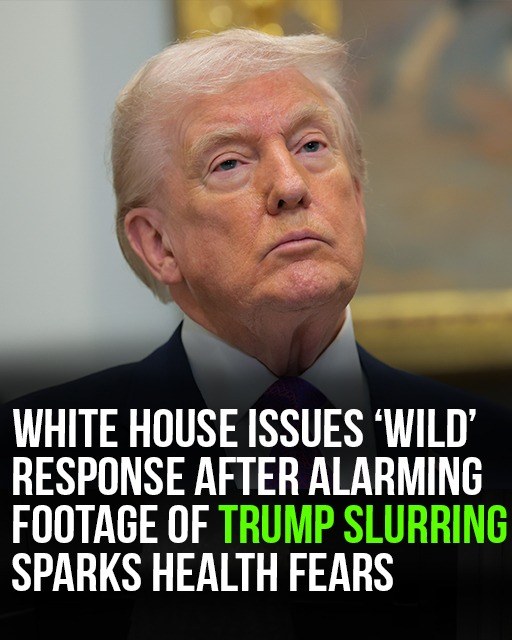
Another week has gone by, and once again, fresh speculation has surfaced about President Donald Trump’s health.
Whether these claims have any real foundation remains unclear, but in today’s nonstop media environment, even the smallest detail—a pause, a facial expression, a slight stumble, or a moment of tiredness—can quickly become the center of viral debate. Social media users, political commentators, and casual viewers alike often analyze every public appearance frame by frame, searching for anything that could be interpreted as a sign of decline.
Holding the office of President of the United States means living under constant observation. Every sentence is examined, every gesture is interpreted, and every public moment is scrutinized. And when the president is someone as polarizing and high-profile as Donald Trump—who has lived much of his life in front of cameras and thrives on attention—the spotlight becomes even more intense.
With Trump nearing 80 years old, it’s not surprising that conversations about his stamina and well-being have grown louder. Questions about physical endurance, mental sharpness, and the strain of a demanding schedule naturally arise when a leader reaches that stage of life.
Over the years, observers have pointed to various details that fuel these discussions: visible bruising on his hands, moments where he appears fatigued, and occasional instances where his speech seems uneven. None of these are proof of a serious condition on their own, but they have repeatedly been used as fuel for ongoing public speculation.
Recently, a particular appearance reignited the conversation. On Wednesday, February 11, President Trump delivered remarks at the White House during a “Champion of Coal” event, a ceremony intended to honor coal workers and highlight policies aimed at strengthening the coal industry.
During the gathering, Trump signed an executive order directing federal action related to coal-powered energy. The moment drew attention not only because of the policy announcement, but also because of the theatrical tone of the event. In a move that many found unusual, Trump was presented with a trophy in connection with the executive order signing—an element that quickly became a talking point online.
In his speech, Trump praised coal miners, portraying them as essential contributors to the nation’s strength and economic stability.
“I’m thrilled to welcome to the White House the men and women who light our cities,” he said, framing the miners as an overlooked but vital workforce. He continued by emphasizing their role in powering homes and fueling industry, describing them as the people who turn natural resources into prosperity.
While many supporters saw the speech as appreciative and patriotic, critics immediately focused on something else: Trump’s delivery.
A number of viewers claimed that parts of the speech sounded slurred or disjointed, prompting an immediate storm of online commentary. On X (formerly Twitter), users posted clips and excerpts, debating whether the president’s speech patterns were simply the result of fatigue—or something more serious.
Some reactions were framed as genuine concern. Others were sarcastic or openly mocking. One user compared the speech to early dementia symptoms they claimed to have seen in a relative. Another posted a dramatic comment suggesting Trump’s words sounded incoherent and questioned whether it could indicate a medical emergency. Others brushed it off as nothing significant.
As expected in the modern digital era, the moment spread rapidly. Short video clips circulated widely, accompanied by memes, analysis threads, and political commentary. Within hours, it had become one of the most discussed topics on multiple platforms.
Not everyone agreed on what the footage showed. Some observers argued that environmental factors—stress, exhaustion, room acoustics, or even dehydration—could easily explain brief speech irregularities. Others insisted it was a sign of deeper cognitive decline.
Soon after the speculation intensified, the White House issued a forceful response.
Davis Ingle, a spokesperson for the administration, provided a statement to The Daily Beast dismissing the rumors and defending the president’s energy and sharpness. The statement described Trump as unusually active and engaged, while also taking an aggressive swipe at the media outlet, using language that many considered unusually harsh and inflammatory for an official response.
The statement itself quickly became part of the controversy.
Some people viewed it as a bold dismissal of what they considered sensational reporting. Others argued it sounded defensive and avoided addressing legitimate public curiosity about the president’s condition.
Online reactions were immediate. Reddit users, in particular, expressed disbelief at the tone of the statement, with some questioning how anyone could interpret it as reassuring. Others responded with humor, shocked by how blunt the wording was.
The broader issue, however, goes beyond a single speech.
The presidency is physically and mentally demanding, and Trump’s schedule has long been described as intense—filled with rallies, travel, press events, and policy meetings. For someone approaching 80, occasional signs of exhaustion would not be unusual. But in a world where everything is filmed, replayed, and dissected, even a brief moment of tiredness can quickly turn into a viral narrative.
Additionally, Trump’s speaking style has always been heavily analyzed. Throughout his political career, critics and analysts have debated his rhetorical patterns, frequent repetition, and off-the-cuff phrasing. Because of that history, any unusual moment in his delivery tends to be magnified even further.
Outside political circles, medical experts have repeatedly emphasized that diagnosing someone from video clips is irresponsible. Speech changes can be caused by many factors, including stress, fatigue, medication effects, dehydration, or even a minor illness. Without verified medical information, any serious claim remains speculation rather than fact.
The February 11 event also highlighted Trump’s continued reliance on spectacle. Presenting a trophy during an executive order signing is not typical presidential tradition, but it aligns with the Trump era’s tendency to blend politics with performance. To critics, it looked like unnecessary theatrics. To supporters, it appeared as a symbolic celebration of action and commitment.
As the conversation expanded, it became clear that the controversy wasn’t only about the coal event. It reflected larger public anxiety about leadership, aging, and transparency.
In today’s media culture, presidents are no longer evaluated only through policy decisions or formal speeches. They are judged through constant observation, viral clips, and online reactions—often shaped by partisan interpretation.
Supporters continue to argue that Trump demonstrates remarkable energy for his age, pointing to his frequent travel and long public appearances as evidence that he remains capable of handling the job. Critics counter that public appearances are carefully controlled and may not reveal what’s happening behind the scenes, keeping the debate alive without any definitive resolution.
Ultimately, the February 11 White House appearance serves as another example of how quickly a single moment can spiral into a national conversation. A slight stumble in speech, a brief pause, or a mispronounced phrase can instantly become a headline, a meme, and a political argument.
For now, discussions surrounding Trump’s health remain exactly that—discussions. Without confirmed medical documentation, no conclusion can be stated with certainty.
What is undeniable, however, is the intensity of the spotlight. In modern America, presidential wellness is not only a personal matter—it is a public obsession, magnified by technology, politics, and a media system built to amplify every perceived anomaly.
The “Champion of Coal” speech may have been intended as a policy-focused ceremony, but it ultimately became something else: another flashpoint in the ongoing debate over Trump’s age, endurance, and how leadership is judged in the digital era.