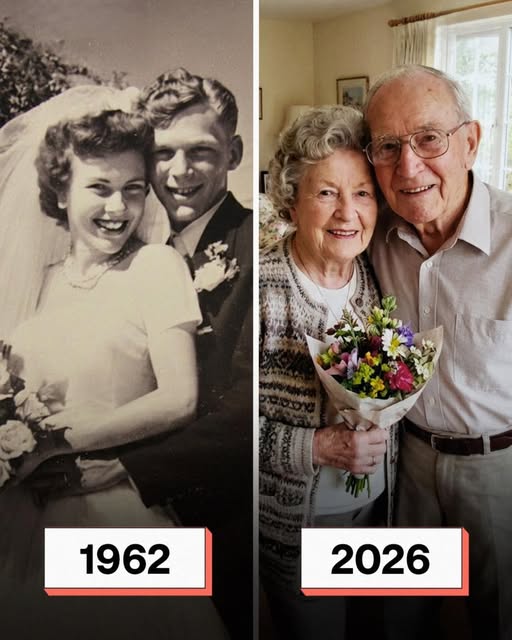
My name is Daisy. I’m 83 years old, and I’ve been a widow for four months now. Four months sounds small when you compare it to sixty-three years of marriage. It feels like nothing.
And yet it has felt endless.
The days have stretched out in front of me like an empty hallway, quiet and cold, as if the whole house is holding its breath. Robert asked me to marry him on Valentine’s Day, 1962.
We were only twenty. We lived in a tiny student apartment near campus, the kind where the walls were thin and the furniture never matched. The kitchen was shared with two other couples, and no matter how hard we cleaned, it always carried the smell of scorched toast and cheap coffee.
That night, Robert insisted on making dinner.
He cooked spaghetti with store-bought sauce and garlic bread that was burnt around the edges and undercooked in the middle. He placed a single candle into an empty soda bottle and kept apologizing like the meal was a disaster.
To me, it was perfect.
After we ate, he handed me a small bundle of roses he’d bought at a grocery store. They were wrapped in newspaper, probably to protect them from the cold February wind. Then he reached into his pocket and pulled out a plain silver ring.
He’d paid for it with two weeks of wages from washing dishes at the campus cafeteria.
His fingers trembled as he held it out.
“Daisy,” he said, forcing his voice to stay calm, “I don’t have much right now. But I will someday. And I want to build everything with you.”
I didn’t even let him finish.
I said yes immediately.
From that moment on, Valentine’s Day became sacred to him.
He never forgot it. Not once.
Some years, when money was tight and our children were young, he would pick wildflowers from the roadside and hand them to me like they were rare treasures. Other years, when life was easier and his business was doing well, roses would arrive at our door—long-stemmed, elegant, expensive.
One year, a sudden frost ruined the flowers he had planned to surprise me with. He showed up holding carnations instead, smiling like a boy caught doing something sweet.
“They’re tough,” he said. “Just like us.”
The year we lost our second baby, he didn’t bring roses.
He brought daisies.
That February is burned into my memory. Grief sat on my chest like stone. I could hardly get out of bed, hardly breathe without feeling the weight of what we’d lost. When he came home carrying that bundle of white daisies, I collapsed into him.
“Even when life hurts,” he whispered, holding me tight, “I’m still here.”
Those flowers were never just flowers.
They were his way of saying, year after year, I choose you again. Through every fight, every sleepless night with crying babies, every worry about bills, every illness, every funeral, every hard season—we always came back to each other. And he always showed up with something in his hands.
Robert passed away in the fall.
A heart attack. The doctor said it happened quickly.
Quick for him.
Not for me.
One moment we were standing in the kitchen, gently disagreeing about whether the garden tomatoes needed covering before the frost. The next, his hand gripped the counter and his face drained of color. By the time help arrived, everything had already changed.
After he died, the house became unbearably silent.
His slippers stayed beside the bed, still turned outward like he’d just stepped out of them. His coffee mug remained on its hook, stained inside with the familiar brown ring.
For weeks, I made two cups of tea every morning without thinking. Then I’d stop, frozen, and remember—there was only one of us now.
Grief isn’t always dramatic. Sometimes it’s just the refrigerator humming in a room that used to hold laughter. Sometimes it’s the sight of a jacket hanging by the door, waiting for someone who will never come back.
When Valentine’s Day began creeping closer, I felt something worse than sadness.
I felt fear.
February 14th had belonged to us for more than sixty years. I didn’t know how to face it alone.
That morning, I stayed in bed longer than I should have, staring at the ceiling like I could avoid the day by refusing to move. Eventually I forced myself up, pulled my cardigan tighter around my shoulders, and made tea.
I sat at the kitchen table, looking at Robert’s empty chair.
And then I heard a knock at the door.
It startled me. I wasn’t expecting anyone. My children had called the night before, saying they’d visit later in the week. I had no deliveries scheduled, no appointments.
Slowly, I walked to the front door and opened it.
No one was there.
Only a bouquet sitting on the welcome mat.
Roses.
Wrapped in brown paper, tied with twine.
Just like they had been in 1962.
For a second, I couldn’t breathe. The cold winter air hit my face, sharp and real, and my hands began to shake as I bent down to pick them up.
Tucked between the stems was an envelope.
Inside was a letter.
Robert’s handwriting.
And a key.
“My love,” it read, “if you’re holding this letter, it means I’m no longer beside you.”
My vision blurred instantly. I had to sit down, still holding the flowers in my lap.
“There is something I’ve kept from you for our entire marriage,” the letter continued. “I’m sorry. But I didn’t know how to tell you. This key belongs to an apartment. You need to go there.”
Something hidden?
The word hit me like ice.
My thoughts ran through the past—business trips that lasted a little too long, late nights at work, phone calls he stepped outside to take. Once, years ago, I had asked him if there was anything he wasn’t telling me.
He had kissed my forehead and said, “Nothing you need to worry about.”
Was there another woman?
Another life?
The idea made me sick.
After sixty-three years, could everything have been a lie?
But deep down, I also knew Robert. The man who never missed Valentine’s Day. The man who held me together when I was breaking.
Still, I needed answers.
I called a taxi. My fingers shook so badly I dialed wrong the first time. When the car arrived, the young driver tried to chat politely, but I barely heard him. I kept staring at the key in my hand, cold and heavy like a stone.
We drove to a neighborhood I’d never been to. Quiet streets. Brick buildings. Small gardens. Nothing about it looked dramatic or suspicious.
The address matched the one in Robert’s letter.
A green door.
I stood outside for what felt like forever before I finally climbed the steps. My heart pounded as I slid the key into the lock.
It turned easily.
The first thing I noticed was the smell.
Clean wood. Old paper. Something warm and dusty.
Then I saw it.
Music.
Sheet music everywhere.
I stepped inside and closed the door behind me. The apartment was small but bright, sunlight pouring through half-closed curtains. Along the walls were framed photographs—not of people, but of pianos and concert halls.
When I turned on the light, my breath caught.
In the center of the room stood a beautiful upright piano. Dark polished wood, clearly cared for with love. Shelves lined the walls, filled with music books, stacks of recordings, neatly labeled binders, and folders arranged with careful precision.
On the piano bench sat a pile of papers.
I picked up the top one.
“Clair de Lune.”
My favorite piece.
I had mentioned it once, decades ago, when we were newly married and I still played from time to time.
On the stand was “Moonlight Sonata.”
Another one I loved.
On a nearby table sat dozens of recordings, each marked in Robert’s handwriting:
“For Daisy – December 2018.”
“For Daisy – March 2020.”
“For Daisy – July 2022.”
There were so many.
My throat tightened painfully.
Then I noticed another stack—medical reports.
Dated six months before he died.
Severe heart condition. Limited time. Treatment recommendations.
He had known.
He had known he was running out of time, and he never told me.
There was also a signed agreement with the building’s caretaker. It instructed him to deliver the roses and the key on the first Valentine’s Day after Robert’s death.
He had planned it all in advance.
Even this.
On the edge of the piano sat a leather journal. I opened it carefully.
“Today Daisy mentioned her old piano,” one entry read, dated twenty-five years earlier. “She laughed about it, but I saw something in her eyes. Regret.”
I remembered that day. I’d been cleaning the attic and found my childhood sheet music tucked away in a box. I played a few notes on our old piano—out of tune, barely holding together—then closed the lid.
Life had been too busy. Kids. Bills. Responsibility.
My dream had quietly disappeared.
But Robert hadn’t forgotten.
“I’ve decided to learn piano,” another entry said. “I want to give her back what she gave up.”
A sob escaped my throat before I could stop it.
Page after page described his lessons. His frustration. His stiff fingers. His embarrassment at being the oldest student in the room. But also his determination to keep going.
“My teacher says I’m improving,” he wrote once. “I hope Daisy would laugh if she saw how serious I look.”
“Daisy never stopped believing in me,” another entry read. “I won’t stop trying.”
Near the end, the handwriting became shakier.
“My hands tremble now,” he wrote. “The doctor says time is running out. I need to finish one more piece.”
The final entry was dated one week before he died.
“I’m sorry, my love. I couldn’t finish.”
On the music stand sat a handwritten composition titled:
“For My Daisy.”
It was gentle and beautiful, like a love letter written in notes instead of words. It carried pieces of melodies I recognized, as if he had woven my favorite songs into something entirely his own.
But it stopped halfway down the second page.
Unfinished.
Slowly, I sat down at the bench. It creaked softly beneath me. Dust floated through a thin beam of sunlight.
My hands hovered above the keys.
I hadn’t played in sixty years.
The first notes were clumsy. Unsteady. My fingers didn’t feel like they belonged to me anymore.
But as I continued, something returned.
Not quickly. Not perfectly.
But quietly.
Like a door opening in a place I thought had been locked forever.
The melody unfolded beneath my fingertips—tender, aching, full of love.
When I reached the part where the music ended, I stopped.
The silence felt sacred.
Then I played again.
I let my fingers search for the ending Robert never had time to write. I softened the tension. I added harmony where it felt right. I followed instinct, memory, and love.
And when the final chord faded, I sat there with tears streaming down my face.
Behind the music stand was one last envelope.
“My darling Daisy,
This piano belongs to you. This studio belongs to you.
Please play again.
Even if I’m gone, I’m still with you—in every note, every chord, every melody.
I loved you at twenty.
I loved you at eighty.
And I will love you forever.
Always,
Robert.”
I pressed the letter against my chest.
He hadn’t been hiding another woman.
He had been hiding a gift.
A dream.
A second chance.
Now I go to the studio twice a week.
Some days I practice scales like a stubborn beginner and laugh at how stiff my fingers have become. Other days I simply sit and listen to the recordings he left behind, imagining him here alone, practicing again and again, refusing to give up.
Last week, I made my own recording for the first time in sixty years.
My hands are slower. The notes aren’t perfect.
But I labeled it carefully:
“For Robert.”
And I placed it beside his.
For sixty-three years, he brought me flowers.
This year, from beyond the grave, he gave me something even bigger.
He gave me myself back.