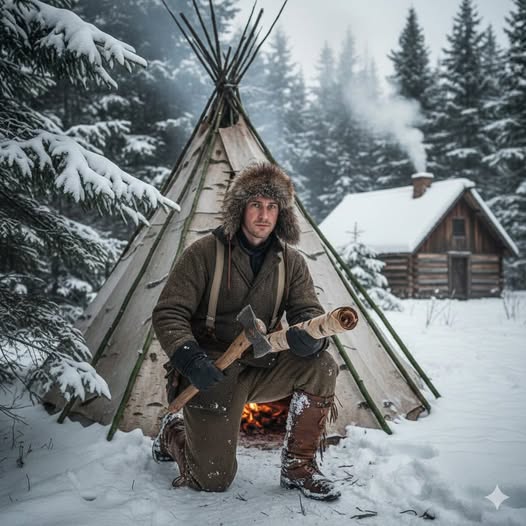
In Kalispell, Montana, doubt hung in the air as heavily as the early November chill. When Jonah Redfeather chose a wooded plot outside town over the security of a traditional log cabin, many locals quietly predicted he wouldn’t make it through winter. In the Flathead Valley, the cold isn’t just uncomfortable—it’s relentless. Temperatures routinely plunge far below zero, and sharp winds sweep down from the Rockies with biting force. To longtime residents, surviving that season without thick timber walls sounded impossible.
Jonah, a 32-year-old former Army Corps of Engineers specialist, responded to the skepticism with calm confidence. While others stocked up on lumber and fiberglass insulation, he gathered flexible saplings, rawhide cord, and heavy canvas. His plan wasn’t a stunt or an act of rebellion—it was rooted in the teachings of his grandmother, Margaret Redfeather, a respected Blackfeet elder. She had always told him that modern buildings often try to overpower nature, while traditional structures are designed to work alongside it. “You don’t battle the wind,” she would say. “You move with it.”
As snow began settling across the valley, neighbors watched him shape his shelter. He planted young trees in a careful circle, bending them into a sturdy dome and weaving them together in a spiral that distributed tension evenly. To some, it resembled a fragile basket. To anyone familiar with structural design, it was a study in strength and efficiency.
His approach centered on airflow and heat retention. The structure hugged the ground, eliminating flat walls that might catch harsh gusts. While the cabins on the ridge stood tall and rigid—absorbing wind and allowing cold to seep into corners—Jonah’s rounded dwelling encouraged air to glide over it. Inside, he dug a shallow pit lined with stones and layered the exterior with bark, reeds, and canvas. The outer shell functioned less like a barrier and more like a living membrane.
By mid-December, winter intensified. Temperatures dipped into the negative teens. In the hillside cabins, fireplaces burned constantly as residents struggled to maintain warmth. Firewood stacks shrank quickly, pipes creaked under stress, and drafts crept in despite careful sealing.
Jonah’s method was different. Rather than feeding a fire all night, he built a modest blaze for about an hour, heating the stones beneath his central pit until they stored enough warmth. He then covered the embers with ash and let the earth do the rest. The heated stones gradually released warmth through the night, while the curved walls reflected it inward. The dome shape prevented heat from rising out of reach.
One bitter morning, when the outside temperature dropped to minus eleven degrees, a skeptical neighbor named Earl Watkins decided to check on him. Noticing no smoke from Jonah’s shelter, Earl feared the worst and trudged through deep snow to investigate.
When the entrance flap lifted, a wave of gentle, humid warmth drifted out. Earl stepped inside, surprised. He checked his pocket thermometer. Outside: minus eleven. Inside: a steady thirty-four degrees—achieved with minimal firewood. Meanwhile, his own cabin, despite constant burning logs, barely hovered above freezing.
“How are you doing this?” Earl asked quietly.
Jonah answered simply: “Design. Insulation. The ground. And respect.”
As winter pressed on, curiosity replaced criticism. Men from the ridge began visiting, asking about the angle of the saplings, the layering technique, and the depth of the pit. Jonah explained that their rigid cabins created pressure points where wind forced heat outward. His structure, by contrast, allowed air to pass smoothly, conserving warmth through shape and balance.
Eventually, a local reporter climbed up to document the story. She asked if it was true that his traditional shelter consistently stayed dozens of degrees warmer than nearby homes. Jonah smiled slightly. “Sometimes even more,” he replied. “It’s not about old versus new. It’s about understanding what works.”
By late February, the sun softened the landscape and icicles began to drip from cabin roofs. Many homeowners faced high heating bills and repair costs from the long season. Jonah, however, simply untied the lashings of his shelter, preparing to return the materials to the land.
He hadn’t conquered winter. He had adapted to it. And in doing so, he reminded his neighbors that resilience often comes not from thicker walls—but from wiser design.