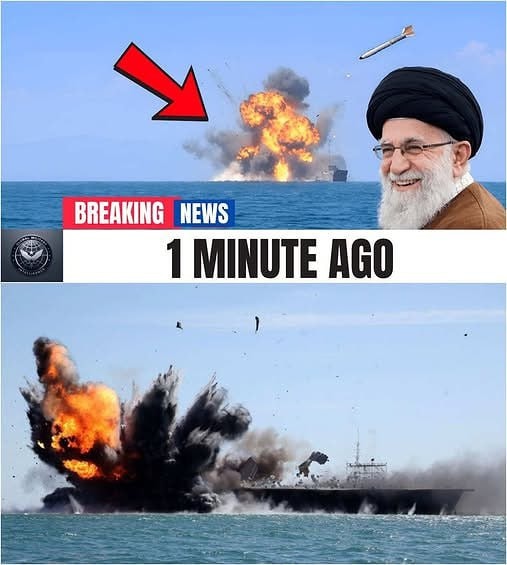
For decades, the Middle East has existed in a fragile equilibrium, where power is measured not only by force but by restraint. Few places embody that tension more than the Strait of Hormuz—a narrow stretch of water where global commerce, military presence, and political rivalry collide. In a brief but explosive thirty-two-minute span, that balance nearly collapsed when a routine U.S. Navy passage escalated into a near-catastrophic confrontation. What unfolded aboard the USS Theodore Roosevelt illustrated just how thin the line is between controlled deterrence and open warfare.
The morning began quietly, the kind of deceptive calm sailors in the Persian Gulf know well. At approximately 7:45 a.m., the Theodore Roosevelt—a nuclear-powered aircraft carrier the size of a small city—entered the Strait. For its crew of nearly 4,700 personnel, the transit demanded alertness but not alarm. The strait, only about twenty-one miles wide at its narrowest point, serves as a vital corridor for global oil shipments. To Iranian military commanders, however, the presence of a U.S. carrier strike group represented more than routine navigation—it was a powerful symbol of foreign military dominance moving through their immediate sphere of influence.
As the strike group advanced, the atmosphere began to change. By mid-morning, the carrier’s electronic warfare systems detected intensified activity from Iranian coastal installations. Radar emissions were no longer passive; American vessels were being actively targeted—an unmistakable escalation that often signals imminent hostilities. Captain James Chen, a veteran commander well-acquainted with the region’s volatility, noted the shift immediately. Harassment by fast patrol boats was expected, but the focused radar tracking suggested something far more deliberate.
The situation sharpened dramatically at 1:52 p.m. Intelligence units monitoring regional communications intercepted encrypted transmissions from an IRGC command hub near Bandar Abbas. Once decoded, the message was stark: “Authorization granted for afternoon delivery.” Within military terminology, such phrasing rarely implies supply movement—it almost always refers to weapons deployment. That realization moved rapidly through command channels. This was no longer posturing. It was a prelude to violence.
At 2:18 p.m., the threat materialized. Iranian coastal missile systems activated along the shoreline, their electronic signatures unmistakably hostile. Captain Chen immediately ordered General Quarters. Throughout the carrier, alarms echoed as sailors rushed to assigned stations. What had moments earlier been a standard transit instantly transformed into a combat scenario. The Roosevelt and its escorts shifted into full defensive posture.
The carrier’s protective screen—composed of advanced warships including multiple Arleigh Burke–class destroyers—tightened around it. These vessels, equipped with the Aegis Combat System, scanned the horizon continuously, searching for launch signatures. Inside the Combat Direction Center, operators monitored streams of data, ready to deploy Rolling Airframe Missiles and activate the Phalanx CIWS, a rapid-fire system designed to neutralize threats at extremely close range.
When Iranian anti-ship missiles were launched from mobile coastal platforms, the response was immediate. Defending a carrier in the confined waters of the Strait leaves almost no margin for delay. Missiles traveling at high subsonic speeds can cross the distance from shore in seconds. The American defense relied on layered systems—electronic interference, decoys, and interceptors working in concert. The air filled with the thunder of countermeasures as the strike group erected a moving barrier of steel and signal disruption around the carrier.
Beyond the physical engagement, a strategic calculation unfolded behind closed doors on both sides. For Iran, striking a nuclear-powered carrier carried enormous risk. Success would have delivered a symbolic blow of historic proportions—but failure would invite a retaliatory response capable of devastating military infrastructure nationwide. The attempt reflected a gamble rooted in misjudgment, underestimating both the integration and redundancy of U.S. naval defenses.
As the engagement reached its peak, the Roosevelt’s air wing launched. F/A-18 Super Hornets roared off the deck, climbing rapidly to establish control of the airspace and identify launch points. The signal was unmistakable: continued aggression would trigger immediate counterstrikes. Faced with failed missile salvos and the presence of American aircraft overhead, Iranian launch activity ceased. The confrontation ended as abruptly as it had begun.
In the aftermath, the Theodore Roosevelt continued through the strait—intact, operational, and resolute. For the crew, the experience left an indelible mark. Those thirty-two minutes represented a glimpse into how swiftly a limited encounter can spiral toward global conflict. Captain Chen’s decisions, and the discipline of the crew, prevented escalation, but the message was clear.
The incident underscored more than a failed attack; it exposed a fundamental miscalculation. Iranian planners underestimated the speed of U.S. intelligence, the cohesion of a carrier strike group, and the readiness of its personnel. As the carrier emerged into the open waters of the Arabian Sea and the crew stood down from battle stations, the immediate danger faded—but the lesson remained.
The Strait of Hormuz is not merely a shipping lane. It is a pressure point where errors are amplified and consequences multiply. In that environment, restraint is as powerful as force—and missteps are measured not only in hardware lost, but in the global repercussions they could unleash.