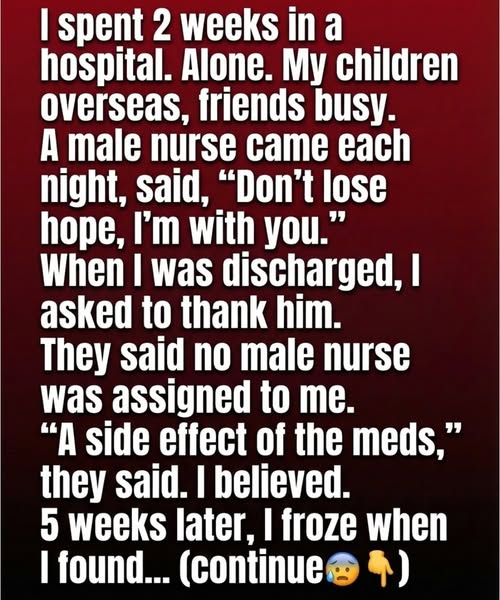
During the two weeks I spent confined to a municipal hospital room—its walls blindingly white and relentlessly clean—silence stopped being empty space and became something far more intimate. It followed me, sat with me, pressed against me. When you are tethered to a hospital bed, the outside world doesn’t merely feel far away; it feels unreachable, like it belongs to another life entirely.
My children were grown, scattered across different cities, wrapped up in careers and responsibilities that kept them hours away. My friends checked in when they could, their messages well-intentioned but brief—small sparks in days otherwise defined by sameness. Life had moved forward for everyone else. Visiting hours came and went, often without a single familiar face appearing. Days blurred together, punctuated only by the steady pulse of monitors, the sharp scent of disinfectant, and the soft shuffle of nurses’ shoes as shifts changed hands.
I told myself this stay was temporary. A pause, not an ending. I repeated quiet reassurances in my head: healing takes time, progress is invisible until it isn’t. But loneliness is most aggressive after dark. When the lights dimmed to that muted nighttime glow and the hallway noise dissolved, my thoughts grew louder. Doubt crept in, asking questions I didn’t know how to answer—whether recovery would truly come, whether I would ever feel whole again.
Still, there was one thing that kept me grounded.
Each night, just before the ward settled into complete stillness, a nurse would step into my room. He moved slowly, intentionally, as though time itself had loosened its grip on him. In a place ruled by schedules and urgency, his calm felt out of place—in the best way. He spoke quietly, his voice steady and low. He didn’t just check my vitals; he straightened blankets with care, as if the act itself mattered.
Before leaving, he always said something simple.
“Get some rest.”
“Keep going.”
“You’re stronger than you realize.”
The words were plain, almost ordinary—but in that isolated room, they carried weight. They reminded me I was seen, not as a patient number or a chart on a screen, but as a person. His visits became the one thing I looked forward to, a gentle reassurance that I hadn’t disappeared into the background of my own life.
When discharge day finally arrived, I felt steadier, though still fragile. As I packed my belongings and prepared to reenter the noise and motion of the world, I knew I couldn’t leave without saying thank you. I stopped at the nurses’ station.
“I’d like to leave a note for the male nurse who checked on me every night,” I said. “He worked late shifts in room 412.”
The staff exchanged uncertain looks. They checked schedules, scanned logs, reviewed assignments. After a few moments, the head nurse met my eyes with a careful expression.
“I’m sorry,” she said gently. “There hasn’t been a male nurse on this floor during your stay. Night shift has been entirely female this month.”
They suggested medication side effects, exhaustion, stress—reasonable explanations. Hallucinations weren’t uncommon, they said. I nodded and thanked them, though unease settled in my chest. Outside, cold winter air filled my lungs as I told myself the mind often creates comfort when it’s pushed too far.
Life slowly resumed. I returned home, rebuilding routines piece by piece. The hospital faded into something dreamlike—blue lights, distant beeps, quiet nights. Weeks later, while unpacking the small bag I had brought with me, my hand brushed against something stiff hidden in an inner pocket.
It was a folded piece of paper.
I opened it carefully. Written in tidy, unfamiliar handwriting were the words I remembered so clearly:
“Don’t lose hope. You’re stronger than you think.”
There was no name. No date. No explanation.
I sat on my bed for a long time, holding that note, replaying those nights in my mind. I searched for logic. Maybe someone else had left it. Maybe I’d written it myself and forgotten. But as I studied the handwriting—steady and unmistakably not mine—I realized the explanation mattered less than the message.
The note still sits on my nightstand. It reminds me that comfort doesn’t always announce itself and that kindness doesn’t require proof. Strength, I learned, isn’t always something we summon alone. Sometimes it arrives quietly, carried by a few well-timed words when the darkness feels overwhelming.
Whether the night nurse was real or imagined no longer matters to me. What matters is what those moments gave me—the will to keep going. Encouragement doesn’t need an identity to change a life. It only needs to arrive when it’s needed most.