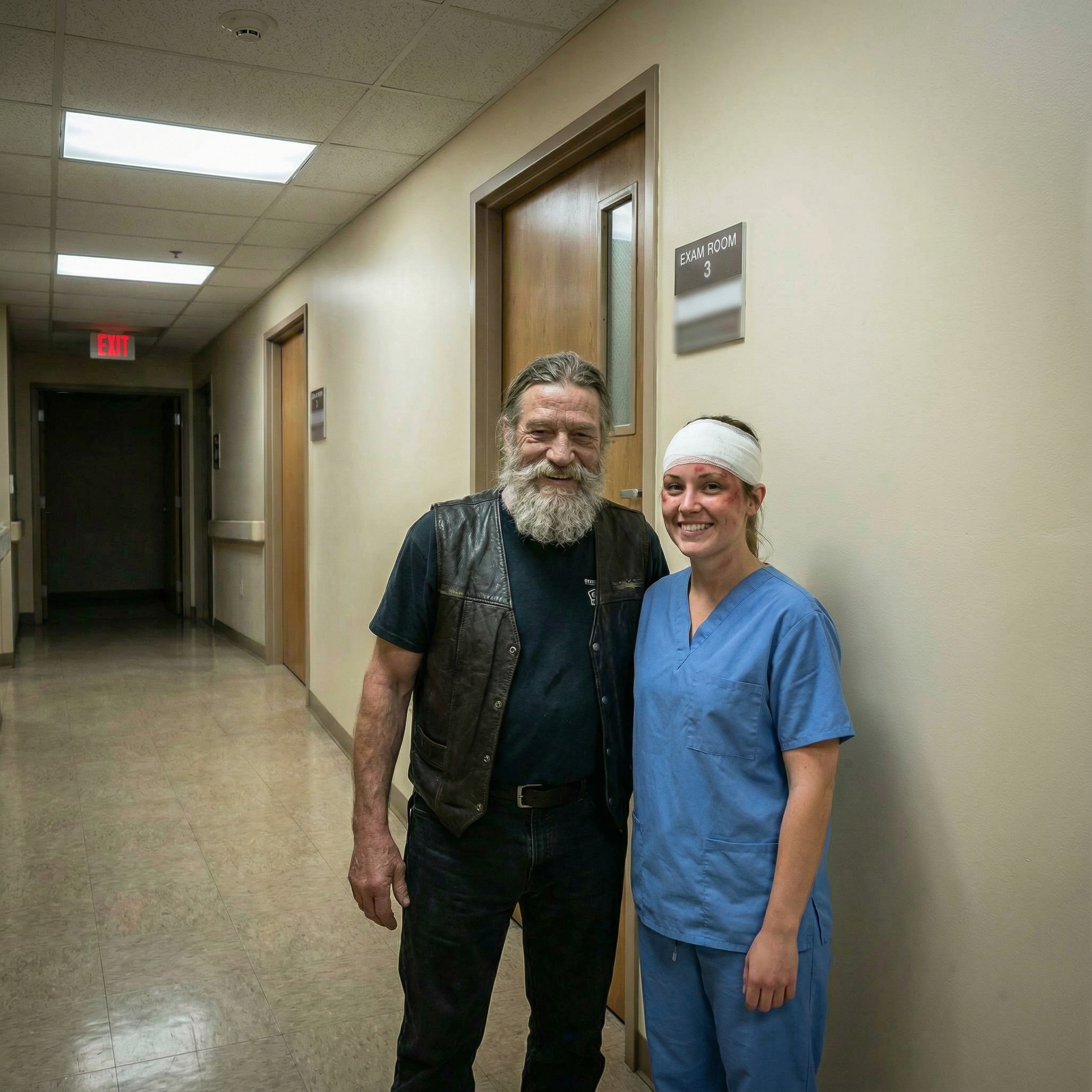
“What are you doing here?” I asked, more than a little alarmed.
“Making sure you get to your car safe,” he said simply.
“You don’t have to do that.”
“I know.”
And yet, he came back. Night after night. For two full weeks, Marcus showed up, always at a respectful distance, never forcing interaction, but always making sure I was safe. He became a silent guardian in a world that suddenly felt threatening. Other nurses noticed and asked who he was. I called him a friend—it felt true enough, though I barely knew him.
Finally, on the fifteenth night, I confronted him.
“Marcus, why are you doing this? Why do you keep coming back?”
He hesitated, uncomfortable, like he’d been hoping I wouldn’t ask. Then, quietly, almost ashamed, he said:
“Because I should’ve been here sooner.”
I felt my heart break at the weight of those words. It wasn’t just about the night of the attack—it was everything he carried silently, the regrets, the things he wished he’d done differently in life. And instead of letting them paralyze him, he acted. He turned that regret into protection, into something tangible, something that saved lives.
Because Marcus didn’t just stop at saving me. His actions created ripples. The man who attacked me was caught. The fear that had lingered in my life—and in Kate’s, another survivor—started to give way to something stronger: hope. Marcus’s vigilance allowed us to begin rebuilding.
Years later, Kate, inspired by that night and the people who stood by her, started a nonprofit helping assault survivors. In its first month alone, thirty women reached out for help—women who thought they were alone. She called me the day she got her first official grant. “I couldn’t have done this without you,” she said. “Without Marcus. You both showed me that surviving isn’t enough—you have to find a way to live.”
We formed an accidental family. Survivors, friends, and heroes, all bound together by courage, by persistence, and by the choice to keep showing up. Dinner together became a ritual—Marcus, me, Kate, her mom Linda, and a handful of others whose lives had intersected in the aftermath of that single terrifying night. Laughter returned. Stories were shared. And the memory of that parking garage, once terrifying, became not only a reminder of fear, but of hope.
Marcus didn’t just save me that night. He stayed. Night after night, week after week, month after month. He gave safety. He gave reassurance. He gave the simple, profound gift of attention. And in doing so, he changed lives beyond what he could have imagined.
Small acts of courage can ripple farther than we see. The heroism isn’t in grand gestures or dramatic rescues—it’s in paying attention when others walk by, in choosing to stay when leaving would be easier, in caring without expecting recognition. That’s what Marcus did. That’s what true courage looks like.
One person showing up consistently can change the course of lives. Who in your life could use your presence, your attention, or your care today?