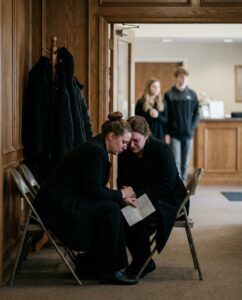
“Twenty-two years,” she said quietly. “He worked in industrial sales. He was with us every week. He came home every weekend.”
Her voice shook.
“Who had him on the weekends?”
I felt my own confusion turning into something heavier.
“I did,” I answered. “He told me his route was Monday through Thursday.”
For several seconds, neither of us knew what else to say.
Two women stood in a funeral home lobby trying to understand how one person had created two completely separate lives.
The funeral director brought us chairs and water.
Instead of arguing, we sat down.
That moment changed everything.
Carol’s name was Carol. Mine was Diane.
I had married Daniel in 1998 at St. Bridget’s Church. We had a marriage license, a home, and a life built over decades.
Carol believed she had married Daniel in 2003 during a beach ceremony. She had always assumed the paperwork had been completed because Daniel told her he had handled it.
Later, we would discover that no legal marriage record existed.
The details were difficult to process.
Daniel had created a schedule that allowed both lives to continue without crossing.
Two phones.
Two addresses.
Two versions of the same man.
He had told Carol that certain holidays were connected to work obligations. For years, she believed his Christmas absences were part of his job.
When she finally realized the truth, she gave a small, broken laugh — the kind of reaction people sometimes have when something hurts too much to fully absorb.
I reached over and held her hand.
Neither of us had created this situation.
Neither of us deserved it.
And the two teenagers sitting nearby certainly did not.
They were simply children who had lost their father.
The funeral continued that afternoon.
Daniel was buried with my service, but Carol and her children sat among the family members.
I invited them because regardless of what Daniel had done, those children were his.
They deserved to say goodbye.
They deserved a place to grieve.
The questions about Daniel’s hidden life began immediately afterward.
Carol had asked one question at the funeral home that changed everything:
“Whose name is on the important documents?”
That question opened months of investigation.
With the help of attorneys and financial professionals, we began uncovering the complicated reality Daniel had left behind.
The life insurance policy through his employer listed Carol as the beneficiary.
The paperwork had been updated years earlier.
The Millbrook home was owned jointly by Daniel and Carol, and records showed money connected to our shared finances had contributed to its purchase.
My own home had been affected by refinancing decisions I had not fully understood at the time.
Financial accounts existed that neither woman knew about.
Retirement benefits, property records, and other documents revealed a pattern of decisions designed to keep two households separate.
Daniel had not simply hidden a relationship.
He had built an entire second financial life.
The situation could have become a long legal battle between two grieving families.
Instead, something unexpected happened.
Carol and I chose communication over conflict.
We both understood the same painful truth: we were not each other’s enemy.
Daniel had made these choices.
We were the people left behind to deal with the consequences.
The legal process was complicated, but we worked through it carefully. Attorneys handled the financial matters, and both families focused on supporting the children who had lost their father.
Over time, Carol and I developed a strange but genuine understanding.
We shared memories of the same person.
Some were good.
Some were painful.
Some were difficult to reconcile.
But we also shared the experience of discovering that the life we believed in was incomplete.
People often assume betrayal stories end with anger and revenge.
Ours did not.
The hardest part was accepting that Daniel had been many things at once: a husband, a father, a provider, and also someone who made deeply dishonest choices.
His actions hurt both families.
But the people affected most were the children who had no role in any of it.
That is why Carol and I made a decision early on:
Whatever happened between the adults, we would not let the children carry the weight of it.
They deserved stability.
They deserved honesty.
And they deserved to know that their father’s mistakes did not define their future.
In the end, Daniel’s greatest secret was not just that he had another family.
It was that two families who had every reason to turn against each other found a way to stand together instead.