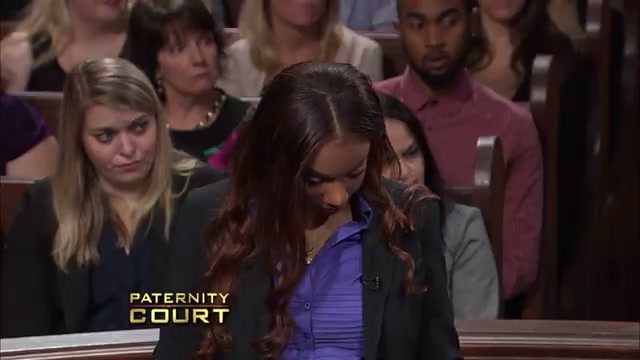
She made it clear from the beginning: she didn’t recognize him as her father.
But the man telling the story had a completely different perspective.
He claimed he had been searching for his daughter for years—holding onto memories, old photos, and even personal items he said he bought before she was born. According to him, he was present during the pregnancy and believed he had every reason to think the child was his. He spoke with conviction, describing details about the timeline, the birth, and even the name he said he had chosen.
To him, this wasn’t a guess. It was something he believed deeply.
Still, belief alone wasn’t enough.
As the hearing progressed, the woman pushed back. She questioned the gaps in his story and pointed out inconsistencies. If he had truly been involved at the beginning, how had she ended up adopted? Why had there been no contact for so many years? And most importantly—why was all of this coming through social media instead of official channels?
Her position stayed consistent: she needed proof, not stories.
The judge stepped in to bring structure to the situation.
Rather than focusing on emotional claims, the courtroom shifted toward facts. Timelines were broken down, locations were questioned, and details were examined carefully. The man presented photographs he believed supported his claim, including images of a pregnant woman and a baby he said was his daughter.
But even that wasn’t enough.
The court made it clear that photos and memories can suggest possibilities—but they cannot confirm identity. Without clear, verifiable evidence, the case remained unresolved.
And that’s where the key moment came in.
The judge emphasized that only scientific testing—specifically DNA analysis—could provide a definitive answer. No amount of confidence, emotional connection, or personal belief could replace objective proof when it comes to something as serious as paternity.
Behind the legal arguments, the emotional weight of the situation was undeniable.
On one side was a man who claimed he had spent years searching, holding onto the idea that he would one day reconnect with his child. On the other side was a woman who had built her entire life without that connection—and was now being asked to reconsider everything based on a stranger’s claim.
It wasn’t just a legal dispute. It was a clash between past and present, belief and evidence, hope and skepticism.
The case also highlights a bigger reality in today’s world—the power of social media to connect people instantly, even in the most personal and sensitive situations. What once might have remained unknown for a lifetime can now surface in seconds through a message or a profile search.
But with that access comes risk.
Information can be incomplete. Stories can be one-sided. And without verification, assumptions can lead to emotional confusion and conflict.
That’s why the court kept returning to one central idea: truth must be proven.
As the hearing moved forward, both sides were left waiting for the same thing—a clear, undeniable answer. Until then, the situation remains suspended between possibility and reality.
So what’s your take?
If you were in this position, would you open the door to someone claiming to be family—or demand proof first? Drop your thoughts below and join the discussion.
FULL VIDEO: