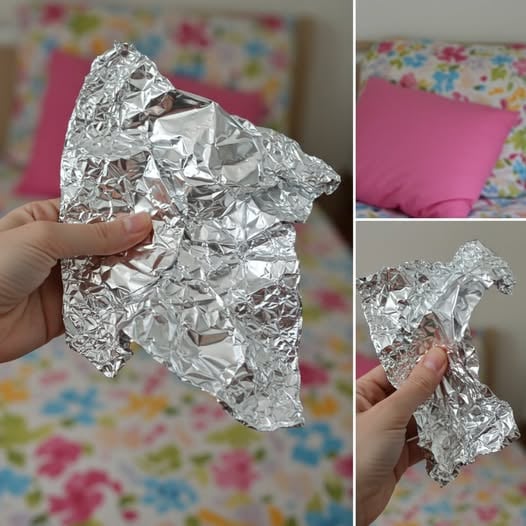
The search for better sleep has pushed modern society into some surprisingly strange territory. From smart mattresses and weighted blankets to sleep apps, herbal supplements, and ambient sound devices, rest has become a full-scale industry. Yet among all the polished, high-tech solutions, one of the oddest trends to surface recently involves an object found in nearly every kitchen: aluminum foil. The idea of sliding a sheet of foil beneath your pillow has exploded online, evolving from an obscure old-fashioned tip into a widely shared sleep “hack.” At first, it sounds absurd—almost comical—but the sheer number of people insisting it works has sparked genuine curiosity.
This unusual habit first gained traction in online wellness spaces where unconventional remedies are often discussed. Users began posting personal stories claiming that placing foil under their pillow noticeably improved their sleep. Some reported waking up feeling clearer and less mentally sluggish, while others said it helped them relax and fall asleep faster. As the trend spread, it took on a symbolic meaning. In bedrooms crowded with smartphones, Wi-Fi signals, and glowing electronics, the foil started being described as a kind of protective layer—a way to block out the invisible chaos of constant connectivity.
Part of the appeal lies in how sleep actually works on a psychological level. For many people, bedtime is no longer a calm transition but a stressful countdown filled with unfinished tasks and racing thoughts. Introducing a quirky ritual—like carefully placing foil under a pillow—can act as a mental reset. The unusual action signals to the brain that the day has ended. This deliberate, physical step shifts attention away from worries and toward a simple task, grounding the mind in the present moment. For those who embrace it, the foil becomes less about metal and more about intention—a personal signal that it’s time to rest.
When science enters the conversation, however, the explanation changes. Sleep researchers and neurologists are clear that aluminum foil itself has no proven effect on sleep quality. Human sleep cycles are regulated by circadian rhythms and hormones such as melatonin, not by household materials placed nearby. Claims that a single sheet of foil can block electronic interference don’t hold up under scrutiny either; effectively shielding against electromagnetic signals would require far more extensive measures. Still, experts aren’t dismissive of the trend altogether—they’re interested in why people feel it works.
The most plausible explanation is the placebo effect, though that term often gets unfairly minimized. Belief alone can have a measurable impact on the body. If someone genuinely expects better sleep, their stress response may decrease, allowing the nervous system to shift into a calmer state. Reduced anxiety means lower stress hormones, which naturally makes falling asleep easier. In that sense, the foil isn’t doing the work—the person’s belief is unlocking the body’s own ability to relax. It’s a powerful reminder of how closely the mind and body are linked.
On a broader level, this trend reflects a collective longing for quiet. Modern life is relentlessly stimulating. Even at night, we remain tethered to devices buzzing, charging, and lighting up the darkness. The foil-under-the-pillow idea feels like a modern folk remedy—a simple attempt to reclaim the bedroom as a place of rest rather than constant connection. Whether it works because of belief or habit, it represents a desire to disconnect from noise and reclaim stillness.
That said, lasting sleep improvement usually comes from more established practices. Consistent bedtimes, a cool and dark room, limited screen exposure, and calming routines remain the most reliable foundations for quality rest. Experts generally agree that trying the foil is harmless, but it shouldn’t replace healthier habits. In some cases, the experiment may even prompt better choices—like moving a phone out of reach or paying closer attention to nighttime routines—which can have a far greater impact than the foil itself.
The popularity of this trend also mirrors how information spreads today. We’re drawn to simple fixes and “secret tricks” that promise fast results. A sheet of foil is far more appealing than cutting caffeine, setting boundaries with screens, or restructuring daily habits. Still, there’s something endearing about the idea. It’s inexpensive, safe, and carries a touch of old-world superstition. It reminds us that humans have always turned to rituals for comfort, especially when life feels overwhelming.
In the end, aluminum foil under the pillow isn’t really about science or superstition—it’s about comfort. It’s about finding small ways to feel safe enough to rest in an overstimulated world. Whether the trend fades or becomes a quirky footnote in sleep folklore, it has already served a purpose by reigniting conversations about rest and well-being. If a simple ritual helps someone slow their thoughts, relax their body, and finally drift into sleep, then the value lies not in the object itself, but in the peace it helps create. And in a world running on exhaustion, that peace is worth more than any gadget.