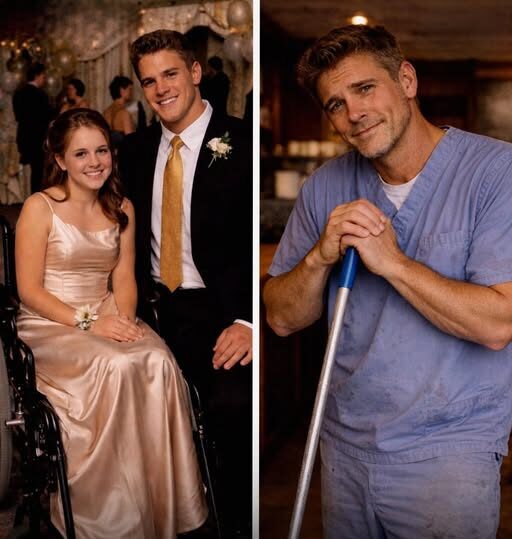
He didn’t treat her differently. He didn’t soften his voice or overthink his words. He simply asked her to dance, as if it were the most natural thing in the world.
When she said she couldn’t, he didn’t argue. Instead, he moved her onto the dance floor—meeting resistance with calm certainty rather than pity.
What happened next wasn’t elaborate. It was simple, human, and quietly powerful.
He didn’t dance around her condition. He included her in the moment as she was. For the first time that night, Emily wasn’t an observer of life happening elsewhere—she was part of it again.
The Quiet Turning Point
The dance didn’t fix what had happened. It didn’t erase pain or uncertainty. But it restored something far more fragile—her sense of belonging.
That single act stayed with her long after prom ended, becoming a quiet reference point in everything that followed.
Recovery was slow. Learning to walk again, adapting to change, and rebuilding independence took years of effort. But Emily moved forward, step by step, refusing to let her world shrink.
Over time, that experience shaped her purpose. She studied design, driven by a simple idea: spaces should not exclude people the way she once felt excluded by circumstance and environment.
Eventually, she built a career—and later, a company—centered on accessibility, inclusion, and thoughtful design.
Thirty Years Later
Life rarely moves in straight lines.
Three decades after that prom night, Emily saw Marcus again by chance in a café. Time had changed them both. He carried his own history of hardship—family responsibilities, missed opportunities, and injuries that never fully healed.
What began as a brief recognition turned into conversation. Then into understanding. Then into something deeper: shared memory, revisited with honesty instead of distance.
Marcus eventually joined Emily’s professional work—not as someone being helped, but as someone contributing from lived experience. His perspective reshaped how her team understood design, shifting it from technical function to human experience.
His presence added something that couldn’t be taught in classrooms: understanding what it means to navigate the world when it wasn’t built for you.
A Full Circle Moment
At the opening of the accessibility center they built together, music played softly in the background.
Marcus turned to Emily and held out his hand.
This time, there was no uncertainty. No need to redefine what the moment meant.
They already knew.
Because what began as a single dance at prom had become something far greater—a reminder that small acts of humanity can echo across decades, shaping lives in ways no one can predict at the time.
If this story resonated with you, share it or leave a thought—sometimes the smallest moments end up changing everything.