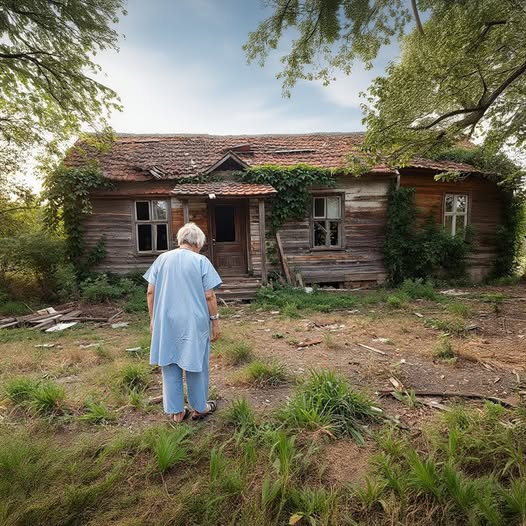
For three decades, Margaret Holloway lived in a place where every sentence she spoke was treated like evidence of illness. At seventy-two, she sat beneath the thin light of a narrow, barred window at Riverside State Psychiatric Hospital, watching October leaves tumble down like secrets no one bothered to read. Around her, the story had already been decided: Margaret was unstable, her recollections were fantasies, and the home she insisted belonged to her was nothing more than a product of delusion.
Her hands—thin, spotted, and threaded with veins—shook as she unfolded a paper she had guarded for thirty years. A legal document, worn at the edges but still readable. At the top, her name was typed in clean, official letters:
Margaret Anne Holloway.
Owner.
They called her confused. Margaret knew the truth. She wasn’t confused—she had been silenced. The fog they accused her of living in hadn’t formed naturally. Someone had created it on purpose.
And on one cold morning, when real mist hung over the hospital grounds and the nurses were distracted by their routine, Margaret did something no one expected.
She left.
Thirty years earlier, Margaret’s life had been simple, orderly, and quietly content. She worked as a librarian in Millbrook, Pennsylvania—a woman who found comfort in neat shelves, quiet hallways, and predictable routines. She lived alone in a two-story Victorian on Hawthorne Lane, a home passed down through her family. It was the kind of house that felt alive: stained-glass windows that caught afternoon sunlight, creaky wooden steps that spoke when you stepped on them, and a kitchen painted in a very specific shade of eggshell blue.
Margaret could have walked through that house blindfolded. She knew every corner, every sound, every shadow.
Then Elaine arrived.
Her sister had always been the opposite of Margaret—dramatic, bold, impatient. Elaine came into town one winter carrying a suitcase, a sharp smile, and a husband Margaret immediately distrusted. She spoke with exaggerated concern, as if she were trying to convince an audience rather than help a sister.
“You’re forgetting things, Maggie,” Elaine would say, voice sweet enough to sting. “You can’t keep living like this. It’s not safe.”
Margaret argued. She resisted. But Elaine moved with a speed and confidence Margaret wasn’t prepared for. Doctors were contacted. Meetings were held. Opinions were formed before Margaret even spoke. Paperwork appeared, and signatures followed.
Then, one evening, Margaret was told she needed a “routine evaluation.”
She never returned to her home.
Inside Riverside, the days blurred together until time stopped feeling real. Everything became pale and repetitive—medication schedules, meal trays, dull television noise, locked doors. Margaret aged while the world outside continued without her. When she tried to tell staff the truth, it was written down as paranoia. When she demanded proof, it was labeled agitation.
Slowly, the world began to treat her silence as confirmation.
Elaine visited less and less, until she stopped altogether. Margaret was told the house had been sold. That the records were gone. That a fire had destroyed important documents. That there was nothing to go back to.
But Margaret never let go of one thing:
The house still existed.
And somewhere inside it, proof still waited.
The spark that ignited everything came from a casual conversation she wasn’t meant to hear. Two young orderlies leaned against a cart one afternoon, speaking carelessly while passing time.
“You know that old Holloway place?” one asked.
The other snorted. “Yeah. Still sitting there empty. Looks like a haunted museum. I can’t believe no one’s torn it down.”
Margaret’s heartbeat changed in that instant.
Empty.
Still standing.
Still there.
That night she didn’t sleep. Her mind, dulled for years by medication and routine, sharpened into something clear and fierce. She began studying everything: shift changes, door patterns, the lazy habits of workers, the moment deliveries arrived and someone always left the service entrance unsecured.
At dawn, she pulled on a thin coat, tucked the deed into her shoe, and walked out.
She traveled like someone who didn’t exist—quiet, unnoticed. A bus ride. Then another. Then miles on foot, her joints aching and her breath burning in the cold air. But she didn’t stop.
When she finally turned onto Hawthorne Lane, her eyes filled before she could stop them.
There it was.
Her Victorian home sat at the end of the road like a faithful animal that had waited too long. The years had been cruel to it. Ivy crawled over the siding. The windows were boarded up. The porch sagged slightly, as if tired from holding its breath.
But it was still hers.
Margaret stepped onto the porch and pressed her hand against the door. The wood felt warped and swollen from decades of weather. She leaned into it, and after a stubborn groan, the door gave way.
Inside, the air was stale and thick with dust. Silence sat heavy in the rooms, like the house had been asleep.
Everything remained, frozen in time.
Her old piano stood in the corner, its keys yellowed with age. The furniture was covered in sheets. The kitchen walls—once eggshell blue—had faded into a dull, ghostlike shade. But Margaret could still remember exactly what it had looked like when the paint was fresh.
She walked through the house slowly, as if it might disappear if she moved too quickly.
Then she headed to the staircase.
Beneath the oak banister was something no one else would know about. When Margaret was a child, she and her father had built a hidden panel there—a secret compartment meant for storing books and personal items.
Her fingers searched for the latch.
The wood didn’t click open. It crumbled.
And behind it wasn’t a childhood hiding place.
It was a narrow concealed room filled with boxes.
Margaret’s breath caught.
These weren’t hospital files or rewritten reports. These were her real documents—the ones that had vanished.
Letters. Evaluations. Legal paperwork.
There were medical opinions from independent doctors Elaine had never shown anyone—doctors who had stated Margaret was mentally capable and showed no signs of the illness Elaine claimed. There were copies of legal petitions Margaret had attempted to file early in her confinement—requests for hearings that had somehow never reached the courts.
At the bottom of the last box was a leather journal.
Margaret opened it, and the handwriting hit her like a slap.
Elaine’s.
Jagged, hurried, nervous.
March 3rd.
I didn’t plan for it to become this permanent. But the house value is climbing, and Margaret refused to sell. She’s stubborn and sentimental. The doctors cost a fortune, but they’re cooperating now. Once she’s admitted, everything becomes easier. I hid the real papers here. I couldn’t destroy them. Maybe guilt is the only thing I still have left.
Margaret lowered herself onto the dusty floor.
Thirty years.
Not an accident. Not a misunderstanding. Not illness.
A theft.
A calculated betrayal disguised as concern.
A loud knock echoed through the house.
Margaret froze.
Another knock followed, heavier this time. A voice called out from the porch.
“Ma’am? This building is condemned. You can’t be inside.”
A city inspector stood outside, likely alerted by a neighbor who had seen movement in the abandoned home.
Margaret rose slowly, her hands gripping the journal and the deed. She opened the door and looked him in the eyes.
“I’m Margaret Holloway,” she said, her voice steady. “And I’m not breaking in. This is my house.”
What followed shook Millbrook.
Once authorities reviewed the documents, everything collapsed into place like a rotten structure finally giving way. The hidden room contained undeniable proof: Elaine’s manipulation, falsified evaluations, suppressed legal filings, and the confession written in her own hand.
Elaine had died years earlier—broke, bitter, and buried under debt. The irony wasn’t lost on anyone.
The state issued public apologies. Riverside Hospital was forced into investigation and restructuring. Margaret received compensation, but when reporters swarmed her porch, she offered them only one sentence that mattered.
“Money can’t return thirty stolen years,” she said. “I wasn’t lost. I was erased.”
Margaret spent the rest of her life as a living symbol of survival. She restored the Victorian home room by room, bringing it back from the dead. She painted the kitchen the same eggshell blue, exactly as it had once been. She returned to the library—not as an employee, but as a volunteer, surrounded by stories she could finally enjoy again.
She never married. She never moved away. She had already lost enough time.
When she passed away at eighty-two, she left the home to the Millbrook Historical Society with one condition:
The hidden room had to remain open.
She wanted the boxes visible. She wanted the truth displayed where no one could bury it again. Because Margaret Holloway knew something most people learn too late:
Truth doesn’t expire.
And sometimes the bravest act isn’t escaping a locked building—
It’s refusing to accept the lies people use to define you.