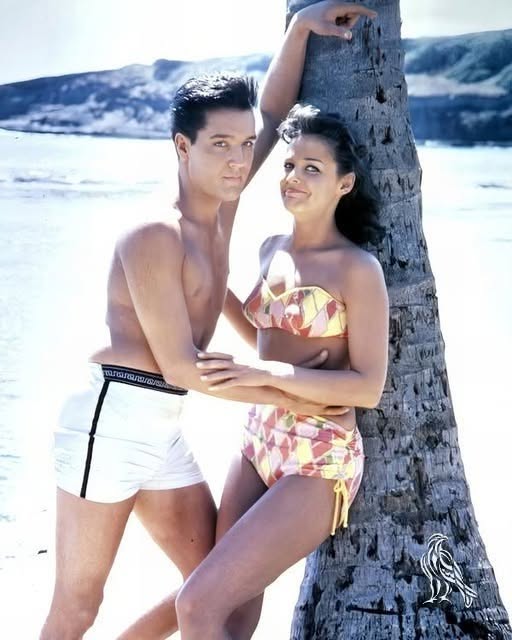
In the film, Elvis plays Chad Gates, a young man returning home to Hawaii after serving in the Army. Unlike some earlier Elvis roles, Chad is not presented as a professional singer. That makes the musical moments feel almost casual. He sings on the beach, in boats, and during romantic scenes, and somehow the relaxed style became part of the movie’s charm.
The soundtrack became just as important as the film itself. Its most famous song, “Can’t Help Falling in Love,” became one of Elvis’s signature recordings and remains closely tied to his legacy. Even many people who have never watched Blue Hawaii know the song instantly.
But behind the sunny image of the movie, there are plenty of interesting details fans still talk about.
One of the most noticeable things about Blue Hawaii is how much real excitement surrounded the production. Elvis was so famous by then that filming in public was not easy. Crowds gathered just to catch a glimpse of him, and the energy around the movie helped turn it into more than just another musical comedy.
The movie also has its share of small continuity mistakes. In some scenes, hand positions, body placement, and background details seem to shift between cuts. These little errors are common in older films, but fans enjoy spotting them because they make the movie feel more human. Instead of ruining the experience, they have become part of its nostalgic appeal.
There was also a major casting change before filming. Juliet Prowse, who had appeared with Elvis in G.I. Blues, was originally connected to the project, but the role eventually went to Joan Blackman. That decision gave the film one of its most memorable pairings. Blackman and Elvis had a natural screen chemistry, and their scenes helped make the romance feel light and believable.
For fans, one of the most iconic parts of the film is the Hawaiian setting. The movie used real island locations, giving viewers a bright, postcard-like version of paradise. Places connected to the film, including Coco Palms Resort, became part of Elvis history. The resort was later badly damaged by Hurricane Iniki in 1992, but it remains strongly associated with the film’s legacy.
Hawaii would continue to hold an important place in Elvis’s life and career. He filmed more than one project there, performed there, and returned to the islands at different points in his life. For many fans, Hawaii represents one of the softer, more relaxed sides of Elvis: away from the stage lights, surrounded by ocean, music, and tropical scenery.
One small but fascinating detail is connected to Elvis’s real military service. His character had recently returned from the Army, and the film gently used that part of Elvis’s public image. By the time Blue Hawaii was released, fans were still very aware of his real-life service, which made the character feel familiar and believable.
The film also helped confirm something Hollywood already suspected: Elvis movies could be hugely profitable even when the plot was simple. Audiences wanted music, romance, scenery, and Elvis himself. Blue Hawaii delivered all of that in a bright, easy-to-watch package.
That success came with a downside. Elvis reportedly wanted to be taken more seriously as an actor, but the popularity of films like Blue Hawaii pushed him deeper into light musical comedies. The formula worked financially, but it limited the kinds of roles he was offered. For fans looking back now, that creates a bittersweet feeling. The movie is joyful on screen, but it also hints at the creative limits Elvis faced behind the scenes.
Still, Blue Hawaii remains beloved because it captures a very specific version of Elvis: young, relaxed, funny, romantic, and surrounded by beautiful music. It may not be his most dramatic film, but it is one of the clearest examples of why audiences could not look away from him.
More than sixty years later, people still watch it for the songs, the scenery, the charm, and the feeling of old Hollywood escapism. The film is not perfect, but maybe that is part of why it has lasted.
It feels warm.
It feels simple.
And above all, it feels unmistakably Elvis.
Which Elvis movie do you think deserves more attention today? Share your favorite below.