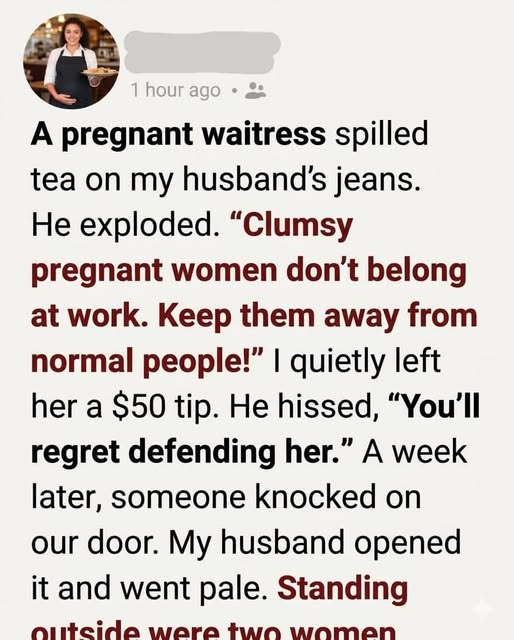
There was something powerful about Evelyn’s silence. She did not scream back. She did not create a scene. She simply absorbed the cruelty with a kind of dignity George clearly did not deserve.
Someone nearby tried to step in and calm the situation, but George dismissed the concern with arrogance. He did not want reason. He wanted control.
Eventually, he stormed out, leaving behind a room full of uncomfortable silence.
The mood inside the restaurant had changed completely. Conversations stayed low. People looked at Evelyn with sympathy, but the damage had already been done.
Before leaving, the witness walked over to Evelyn and offered her a quiet word of support. It was a small gesture, but it mattered. Sometimes, after being treated badly, a person just needs to know that someone saw the truth.
George probably thought the incident ended the moment he walked out.
He was wrong.
A week passed.
Life seemed to return to normal. The restaurant continued serving customers. Evelyn kept working. George likely returned to his office, his meetings, and his polished executive life, believing the ugly scene was already forgotten.
Then came a knock at his front door.
It was a quiet Tuesday evening when George opened the door with the confidence of a man who believed he controlled every room he entered.
That confidence disappeared instantly.
Standing on his porch was Evelyn.
And she was not alone.
Beside her stood Claire Whitman, the CEO of the company where George worked.
In that moment, George’s entire expression changed. The loud, arrogant man from the restaurant was gone. In his place stood someone pale, nervous, and suddenly very aware of the consequences waiting in front of him.
The power he had used against Evelyn in public was useless now.
He invited them inside, but the silence in the house said everything. This was not a friendly visit. This was not a misunderstanding. This was accountability arriving at his own doorstep.
Inside the living room, George tried to explain himself. His words came out clumsy and weak. He wanted to control the story, just like he had tried to control the waitress.
But Claire did not come for excuses.
She already knew what happened.
Evelyn had told her the truth. The incident had been described, confirmed, and brought directly to the one person George could not intimidate.
For years, George had likely believed his professional image protected him. He thought he could act one way in the office and another way in public. He thought cruelty outside the workplace would never touch his career.
But leadership is not only about boardrooms, titles, or expensive suits.
It is about character.
And character shows most clearly in how someone treats people who cannot easily fight back.
George had screamed at a pregnant waitress because he believed she had no power. He thought her position made her safe to disrespect. He assumed the world would move on and that his status would protect him from consequences.
But the world is smaller than people think.
The person someone dismisses today may know someone who matters tomorrow. The worker someone humiliates may have a voice stronger than expected. And the behavior someone thinks is private may reveal exactly who they really are.
Claire’s presence made one thing clear: George’s actions were no longer just a restaurant incident. They were now a reflection of his leadership, his judgment, and his ability to represent the company.
A man who loses control over spilled tea cannot be trusted to lead people with fairness. A man who humiliates a pregnant worker in public cannot pretend to be a principled executive in private.
George’s home, once a symbol of success, suddenly became the place where his image collapsed.
There was no boardroom strategy to save him. No polished speech. No corporate title big enough to cover what he had shown everyone that night.
He had revealed his character.
And now he had to face it.
The lesson was simple but sharp: respect is not optional. It does not depend on someone’s job, income, age, or status. It is the basic line every decent person should know not to cross.
George believed power meant being able to speak down to people.
But real power is shown through self-control, fairness, and basic humanity.
His mistake was not just shouting in a restaurant. His mistake was thinking the person he hurt did not matter.
In the end, the consequences did not come from spilled tea. They came from arrogance, cruelty, and the belief that success gives someone permission to treat others badly.
It does not.
Because sooner or later, people remember how you made them feel. And sometimes, the moment you think is over is the exact moment your real judgment begins.
What would you have done if you saw someone treating a waitress this way? Share your thoughts below and keep reading for more real-life stories about respect, karma, and accountability.