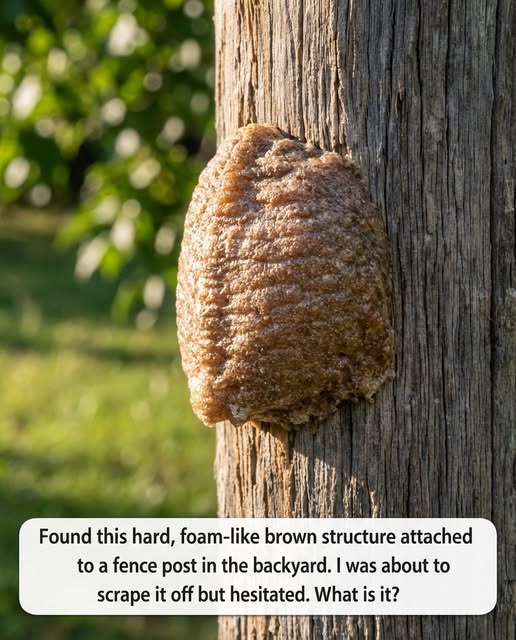
It usually starts as something small and strange—an unfamiliar lump stuck to a fence post, a tree branch, or even the woody stem of a garden shrub. At first glance, it doesn’t look like something natural. It almost resembles a blob of dried construction foam or a patch of hardened mud shaped with unusual precision. Its surface is tan to brown, textured with ridges and grooves, and it feels oddly lightweight yet tough at the same time.
Most people spot it while cleaning up their yard and assume it’s unwanted debris. The instinct is immediate: scrape it off, toss it away, and keep the garden looking neat. But removing it without knowing what it is can destroy one of nature’s most impressive little survival structures.
Because this isn’t fungus, insulation, or leftover dirt.
It’s an ootheca—the protective egg case of a praying mantis.
Nature’s Protective Blueprint
The story of this odd-looking “foam clump” begins months earlier, usually in late summer or early fall. A female praying mantis, preparing to lay her eggs, searches for a secure surface that won’t easily move—something solid like a twig, fence rail, stone wall, or the underside of a wooden beam.
Once she chooses the right spot, she begins a process that feels almost like natural engineering.
As she lays her eggs, she releases a frothy liquid from special glands. With repeated movements, she shapes this secretion into a foamy mass. Within minutes, exposure to air causes the foam to harden into a stiff, papery shell. The result is a durable capsule built specifically to protect developing life inside.
That hardened casing is the ootheca.
It’s designed to survive cold temperatures, heavy rain, and even curious predators. Birds may peck at it. Ice may coat it. Wind may batter it.
And still, it holds.
What’s Hidden Inside?
Although it looks like a single solid lump, the interior is far more complex. The ootheca contains carefully arranged egg chambers separated by thin walls. Depending on the mantis species—such as the native Carolina mantis or the larger Chinese mantis—one ootheca may contain anywhere from 50 eggs to several hundred.
Each egg sits protected in its own small pocket, like a miniature nursery built for survival.
A Silent Winter Watch
Throughout the winter, the ootheca sits motionless, blending into the bark and wood around it. It becomes part of the landscape—easy to overlook unless you know what you’re looking for.
But inside, the embryos remain alive in a dormant state. This pause in development, known as diapause, is nature’s way of ensuring the eggs don’t hatch too early during a random warm spell in the middle of winter.
Even though the outside may freeze, the casing acts as insulation, helping protect the eggs from extreme cold and dehydration.
It’s basically a biological time capsule, waiting for spring.
The Spring Hatch
Once temperatures rise steadily and daylight grows longer, the ootheca becomes active. What once looked like a dead, dry clump suddenly turns into a launch point for new life.
Tiny mantis nymphs begin emerging in clusters, often at nearly the same time. They are incredibly small—sometimes no bigger than a grain of rice—but they already resemble adult mantises. They have the signature folded front legs and the alert, predatory posture that makes mantises so recognizable.
Many hatchlings dangle briefly from fine threads before dropping into nearby plants.
Within a short time, their bodies harden, and they begin hunting almost immediately. They don’t need training. Predatory behavior is instinctive.
A Hidden Benefit for Your Garden
Finding a mantis egg case in your yard is actually a good sign. It means your outdoor environment is healthy enough to support beneficial insect life.
Praying mantises are considered generalist predators, meaning they eat a wide variety of insects rather than focusing on just one species. As they grow, they feed on pests such as aphids, leafhoppers, flies, moths, and even larger insects like grasshoppers. In some regions, they may also prey on invasive species like the spotted lanternfly.
In other words, an ootheca is like a natural pest-control starter pack.
Leaving it undisturbed can reduce the need for chemical sprays and help your garden ecosystem stay balanced.
If You Must Move It
In most cases, the best option is to leave the egg case exactly where it is. However, sometimes it ends up in an inconvenient spot—like on a fence you’re about to paint, a branch you plan to trim, or an area where it might be bumped or crushed.
If relocation is necessary, it can be done carefully.
A safe method is to cut the small branch it’s attached to and move the entire piece. If it’s stuck to a flat surface, gently remove it using a thin blade, being careful not to break or puncture the casing.
Once removed, you can attach it to a sturdier location using a bit of non-toxic glue or by tying it to a branch with string or twine. The key is to keep it elevated off the ground, where moisture, ants, and other predators could damage the eggs.
Try to place it somewhere sheltered, with the ridged side facing outward so hatchlings can emerge easily.
A Small Reminder Hidden in Plain Sight
That strange brown “foam blob” on your fence isn’t clutter—it’s a reminder that nature often hides its most fascinating work in the places we barely notice. What looks like dried debris is actually a carefully designed shelter meant to protect hundreds of future predators waiting for spring.
So the next time you’re cleaning up your yard and you spot one of these odd ridged lumps, pause before scraping it away.
You’re not looking at a mess.
You’re looking at a tiny fortress—one that may soon release the next generation of your garden’s quiet defenders.