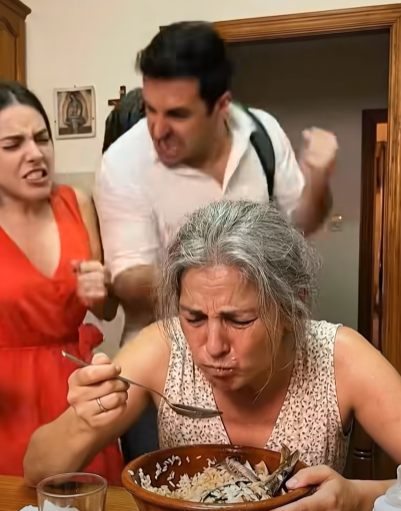
My mother turned, her face pale. For a split second, fear crossed her eyes before she forced a smile.
“You should have told us,” Melissa added, her tone shifting to something defensive. “We would have prepared.”
Prepared.
That word echoed in my head as I walked closer.
“Mom,” I said softly, “why are you cooking?”
She hesitated. Her lips parted slightly, but no words came out.
Melissa answered instead. “She insisted. You know how she is. She doesn’t like sitting still.”
I looked at my mother again. This time, I didn’t look away from the small details—the way she leaned heavily on the counter, the slight shake in her knees, the exhaustion in her eyes.
“Is that true?” I asked gently.
My mother lowered her gaze.
“I… didn’t want to be a burden,” she whispered.
Something inside me tightened.
I turned to Melissa. “What’s going on here?”
Her expression hardened. “What do you mean? I’ve been here every day. I handle everything.”
“Everything?” I repeated, my voice quieter now—but sharper.
I walked to the counter and picked up a pill organizer. Several compartments were still full.
“These weren’t taken.”
“She forgets sometimes,” Melissa replied quickly.
“And the doctor appointments?”
“They rescheduled.”
“And the bruise?”
“She told you—she bumped into something.”
Every answer came too fast. Too practiced.
I exhaled slowly, trying to stay calm.
Then my mother spoke again, her voice barely above a whisper.
“She tries… but she’s busy.”
Busy.
I looked at the takeout container on the table. Half-finished. Expensive.
Then at the nearly empty fridge behind me.
Then back at my mother—who had clearly been trying to manage more than she should.
“I’ve been sending money every month,” I said, my voice steady now. “For her care.”
Melissa crossed her arms. “And I’ve been here, haven’t I?”
“But have you been helping her?”
Silence.
That silence said more than any answer could.
My mother reached for my arm. “Please… don’t argue. I don’t want problems.”
I knelt beside her.
“You’re not the problem,” I said gently.
For the first time since I walked in, her composure broke. Tears filled her eyes.
“I didn’t want you to worry,” she said. “You were working so hard…”
That was it.
That was the moment everything became clear.
This wasn’t just about missed responsibilities. It was about trust. About priorities. About what had quietly been happening while I was thousands of miles away believing everything was okay.
I stood up slowly.
“Mom,” I said, “you’re not cooking tonight.”
I turned off the stove and guided her to a chair.
Then I faced Melissa.
“We need to talk.”
Her posture stiffened. “About what?”
“About what happens next.”
That night, nothing was decided in anger. There were no raised voices, no dramatic exits.
Just truth.
Uncomfortable, unavoidable truth.
Over the next few days, I stayed home. I took my mother to her doctor. I listened—really listened—for the first time in months. I learned what had been happening in the quiet spaces between phone calls.
Some things were misunderstandings.
Others were not.
And some truths changed everything.
I made arrangements for proper care—professional support, regular checkups, and a system that didn’t rely on assumptions.
As for my marriage… that conversation took longer.
Because sometimes, the hardest part isn’t discovering the truth.
It’s deciding what to do with it.
Weeks later, I sat on the porch with my mother as the evening sun settled over the yard. She looked stronger already—still recovering, but no longer carrying everything alone.
“You didn’t have to come back early,” she said softly.
I shook my head.
“Yeah,” I replied. “I did.”
Because sometimes, the moment you think everything is under control…
…is exactly when you need to take a closer look.