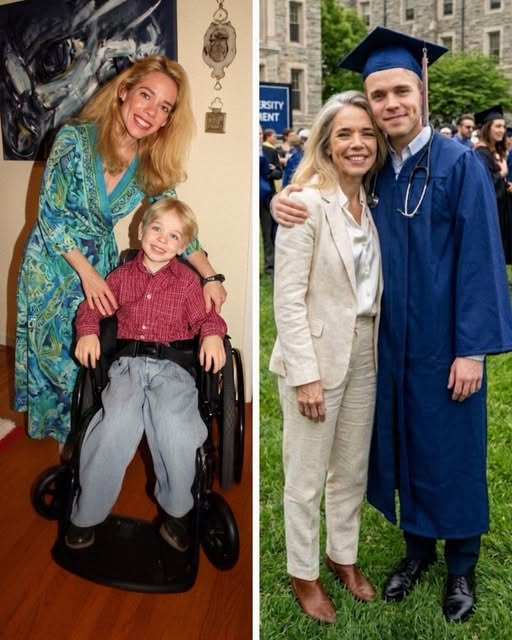
My son accepted his diploma, thanked the dean, and stepped to the microphone.
The applause slowly faded.
He adjusted the microphone and looked across the audience.
His eyes stopped on Warren.
“Father,” he began, “I rehearsed this moment for years.”
The room became perfectly still.
“When I was little, I used to imagine this day differently.”
“I imagined you’d be sitting in the front row because you had helped me get here.”
“I imagined you’d know every surgery I survived.”
“Every brace I wore.”
“Every cast.”
“Every physical therapy session.”
“I imagined you’d know my favorite color, the food I hated, the books I loved, and the reason I decided to become a doctor.”
He paused.
“But then I realized something.”
“You couldn’t know those things.”
“You weren’t there.”
A quiet murmur spread through the audience.
Warren’s smile disappeared.
“You left before I even had a chance to know your face.”
“You didn’t abandon me because of something I did.”
“You abandoned me because of something you were afraid I might never do.”
My hands tightened around the graduation program.
My son continued calmly.
“You saw a wheelchair.”
“My mother saw a child.”
The audience fell silent again.
“One person looked at my diagnosis.”
“The other looked at my future.”
His voice never cracked.
It didn’t need to.
“The difference between those two choices became my entire life.”
He turned toward me.
“My mother worked two jobs while learning medical terms she had never heard before.”
“She slept in hospital chairs.”
“She celebrated every inch I could move.”
“When I managed one step with a walker, she cried harder than I did.”
“When I fell, she picked me up.”
“When I wanted to quit, she reminded me that progress wasn’t measured in miles.”
“It was measured in courage.”
I could barely see through my tears.
Then my son faced the audience once more.
“People keep congratulating me for becoming a doctor.”
“But I think they’ve been congratulating the wrong person.”
He held out his hand toward me.
“Mom…”
“I wouldn’t be standing here if you hadn’t carried me first.”
The audience rose to its feet.
Not because he asked them to.
Because they couldn’t stay seated.
The applause seemed endless.
I covered my face, overwhelmed.
Then came the part no one expected.
My son looked back at Warren.
“When you called me last week, I spent a long time deciding whether to answer.”
“I wasn’t angry anymore.”
“I wasn’t even curious.”
“I simply wondered whether people could really change.”
Warren nodded quickly.
“They can,” he called out.
“I have.”
My son listened quietly.
“I hope that’s true.”
“Because forgiveness doesn’t erase the past.”
“It just refuses to let the past control the future.”
For a moment, I thought that would be the end.
Instead, my son reached into his graduation gown and pulled out a folded envelope.
“I’ve carried this since I was sixteen.”
He unfolded a faded sheet of paper.
“It was the first letter I ever wrote to you.”
“I never mailed it.”
The room held its breath.
“I wrote that I didn’t hate you.”
“I just wanted to know why.”
He looked down at the letter before folding it again.
“I don’t need the answer anymore.”
“I built my life without it.”
Then he smiled gently.
“So today, instead of asking why you left…”
“I want to thank the person who stayed.”
He walked down the steps from the stage.
Not toward Warren.
Toward me.
In front of hundreds of graduates and their families, he wrapped his arms around me.
“You graduated too, Mom,” he whispered.
“You just didn’t get the diploma.”
The applause returned, louder than before.
Even many of the professors were wiping away tears.
Warren remained standing alone.
For the first time, he seemed to understand what he had lost.
Not a successful son.
Twenty-five years of birthdays.
School plays.
Hospital victories.
Christmas mornings.
Conversations.
Memories that could never be recreated.
After the ceremony, families gathered outside for photographs.
Graduates laughed and celebrated with friends.
Warren approached us slowly.
His confidence had disappeared.
“I know I don’t deserve it,” he said quietly, “but could we have dinner sometime?”
My son thought for a long moment.
Finally, he answered.
“Dinner won’t give us twenty-five years.”
“No,” Warren admitted.
“It won’t.”
“But maybe it could give us one evening.”
My son looked at me.
I didn’t speak.
The decision belonged to him.
At last, he nodded once.
“One dinner.”
“Not because you’ve earned it.”
“But because Mom taught me that healing doesn’t always mean restoring what’s broken.”
“Sometimes it means letting go of the weight you’ve been carrying.”
A month later, they met for dinner.
There were awkward silences.
Difficult questions.
Honest apologies.
No miracles.
No instant reunion.
Just two men beginning a conversation that should have started decades earlier.
As we left the restaurant, Warren quietly turned to me.
“I thought having a disabled son would ruin my life.”
He looked across the parking lot, where our son was laughing with friends.
“I was wrong.”
“My fear ruined it.”
I didn’t answer.
Some lessons arrive early enough to change your future.
Others arrive only after you’ve spent years living with the consequences.
Warren had finally learned the difference.
And my son had already become the man his father never believed he could be.