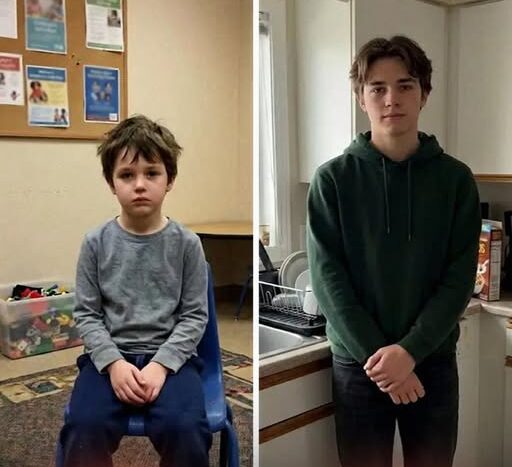
The social worker hesitated before she showed me his file. That pause said more than the paperwork ever could. Most families wanted babies, she explained. Not older children. Especially not children like him.
“People already know of him,” she said carefully.
That should have scared me.
Instead, I asked to meet him.
When he walked into the room, he didn’t smile. He didn’t try to impress me. He just looked at me like he was waiting for disappointment.
“I know how this goes,” he said quietly. “You don’t have to pretend.”
A seven-year-old should never speak like that.
I signed the papers that day.
He didn’t come home as a “possibility.” He came home as my son.
That first night, I tucked him into bed and tried to make the moment feel safe. As I turned to leave, he grabbed my hand.
“If I mess up… do I still get to stay?”
There wasn’t even a pause in my answer.
“Yes,” I told him. “You’re not going anywhere.”
He nodded slowly, like he wasn’t sure promises were real.
Years passed. Life moved forward. But something in Mike never fully relaxed. He lived carefully, as if the world was always one mistake away from changing its mind about him.
Then came his eighteenth birthday.
The next morning, he sat across from me at the kitchen table for a long time before speaking.
“I’m not afraid anymore,” he said. “But I need to tell you what I believed for most of my life.”
What followed didn’t sound like a confession. It sounded like a burden finally being set down.
He believed he was unlucky.
Not in a simple, childish way—but in a deep, consuming way that had shaped everything he did. If something went wrong, even something unrelated to him, he assumed it was his fault.
Then he said the word that made my chest tighten.
“Cursed.”
Somewhere along the way, someone had convinced him that bad things followed him. That people left because of him. That even kindness had a cost.
And he had carried that belief like it was fact.
I realized then how many times I had missed the signs. The unnecessary apologies. The way he hesitated before asking for anything. The quiet way he tried to make himself smaller in every room.
After he left the house that day, I couldn’t sit still. I went back through old memories, trying to connect what I had missed.
Then I went looking for answers.
What I found was worse than I expected.
There had been rumors about him before I adopted him. A story someone had started and others had repeated until it sounded like truth. A label placed on a child who never had the chance to defend himself.
Even worse—it had been published.
When I tracked down the source, I found the person behind it.
She didn’t deny it.
She told me about loss in her own life. About tragedy she couldn’t make sense of. And how, instead of accepting randomness, she had needed something to blame.
So she chose a child.
Not because he caused anything—but because she needed a reason.
By the time I left her house, I knew one thing with absolute clarity.
I had to find my son.
But when I got home, he was gone.
All that was left was a note saying he was sorry, and that leaving was the only way he thought he could protect me from himself.
I didn’t even hesitate. I knew exactly where he would go when the world became too heavy.
The train station.
And there he was.
Sitting alone, watching people leave.
He didn’t look up when I arrived. Like he already expected distance instead of love.
I sat beside him and turned his face gently toward me.
“You’re not a problem that needs solving,” I told him. “And you are not something bad that happened to me.”
His voice cracked when he asked, “But what if it’s true?”
That’s when I said the only truth that mattered.
“You are not the reason my life fell apart,” I said. “You are the reason it came back together.”
For a long moment, he didn’t move.
Then something shifted—not all at once, but enough.
The belief he had carried for years didn’t vanish. But it stopped being the truth.
We went home together.
Quieter. Heavier in some ways. Lighter in others.
Before bed, he asked me about the future for the first time in a long time. College. Work. Life beyond survival.
That was how I knew he was coming back to himself.
At the stairs, he paused.
“Thank you for coming after me,” he said.
I shook my head.
“I was always going to,” I told him.
Because sometimes love isn’t loud.
Sometimes it’s just refusing to let someone disappear alone.