It didn’t stay “any other night” for long.
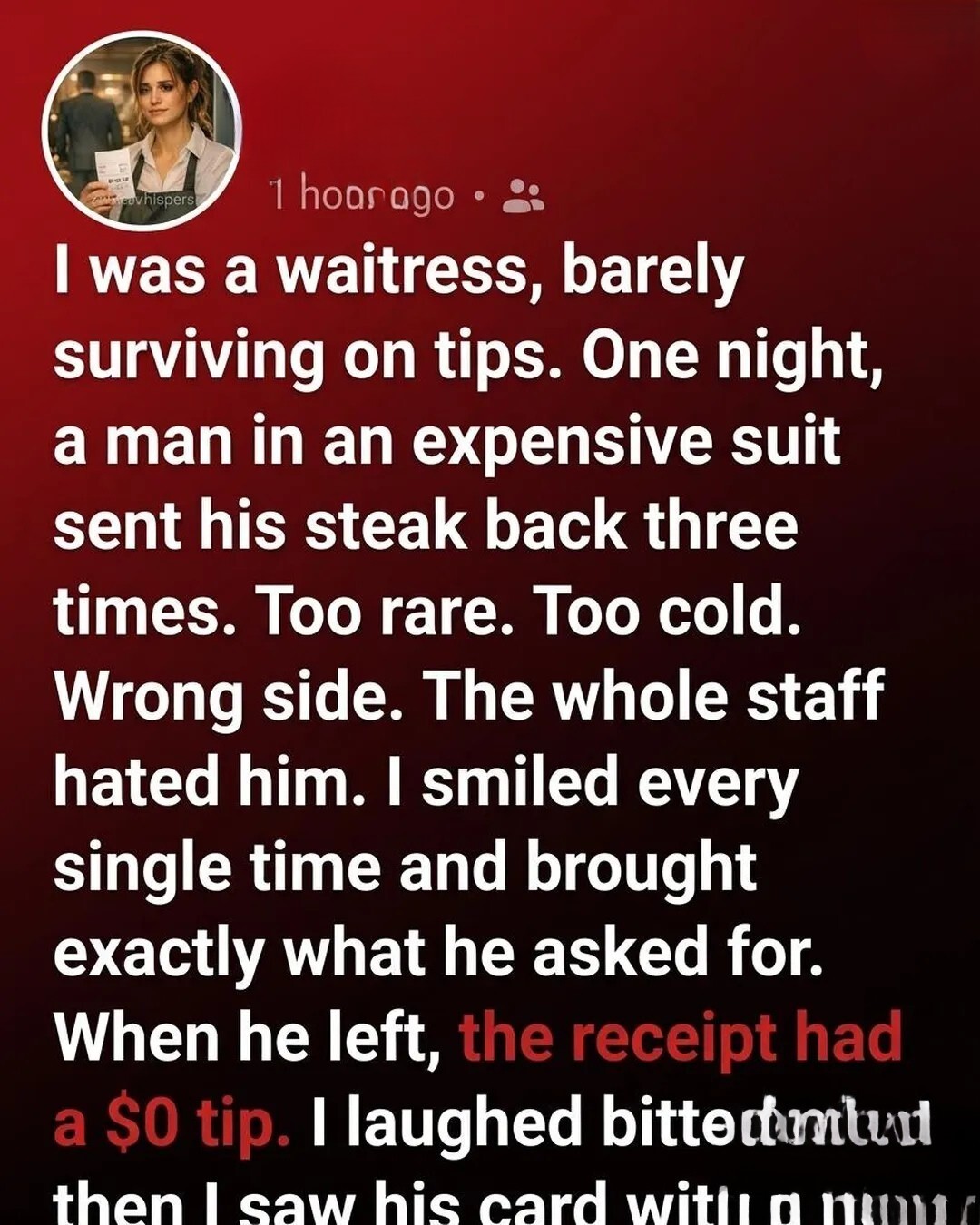
His order was simple enough, but the experience quickly became anything but. The steak went back once. Then again. The seasoning was “off.” The temperature wasn’t quite right. The presentation needed adjusting. Each return meant another apology I didn’t feel responsible for, another trip to the kitchen, another reset of expectations I couldn’t control.
Around me, the restaurant kept moving, but I could feel the pressure building in my chest. Still, I stayed composed. That was the job—steady hands, calm tone, no matter what was happening on the other side of the table.
When he finally finished, he left without a word, signing the check and slipping out into the night like nothing unusual had happened.
Then I saw it.
The tip line was empty.
Not small. Not insulting in a visible way. Just… blank.
For a moment, I just stood there, staring at it. After everything—every adjustment, every apology, every extra mile—it felt like none of it had registered. I remember that sinking feeling clearly, the quiet frustration that only service workers really understand. You learn to take a breath and move on, even when it stings.
I started clearing the table when something caught my attention.
A business card, tucked under a salt shaker.
At first, I assumed it was nothing—advertising, maybe a forgotten item. But the name on the front made me pause. It belonged to a well-known figure in the business world, someone frequently mentioned in industry circles and financial headlines.
I turned it over.
Five words were written on the back:
“You have the right temperament. Call me.”
I just stood there for a moment, unsure whether to laugh or question my sanity. It felt impossible. A prank, maybe. Or something I had misunderstood entirely.
I took the card home anyway.
For two days, it sat untouched on my table while I tried to convince myself to ignore it. But something about it lingered. Not curiosity alone—something deeper. The idea that maybe the night hadn’t been random at all.
Eventually, I called.
What followed wasn’t a joke. It was an interview.
A few days later, I walked into a glass tower downtown, dressed in the only blazer I owned, feeling completely out of place. But the man from Table 14 didn’t look at my clothes. He looked at how I carried myself.
He explained everything simply.
He wasn’t just evaluating service. He was evaluating composure. Patience. The ability to stay steady when everything around you feels designed to push you off balance. In his world, that mattered more than a polished résumé.
By the end of the meeting, I had an offer.
Not a charity offer. A real one. Entry-level operations, better pay than anything I had known, and a chance to build something different.
That moment changed the direction of my life.
Years later, I understand that night differently. What felt like frustration at the time was actually pressure under observation. A test I didn’t know I was taking.
I started from the bottom in that company, learning, adapting, showing up early, staying late, carrying the same discipline I had learned while balancing trays in a crowded restaurant. One step led to another, and slowly, everything shifted.
Today, I lead teams in that same organization.
And sometimes, I think back to Table 14—not with bitterness, but with perspective.
Because what once felt like a bad night turned out to be the moment everything began.
Not every difficult experience is meaningless. Some of them are shaping you for something you can’t yet see.
If this story made you rethink your own turning points, share your thoughts below—and follow for more real-life stories about unexpected opportunities and second chances.