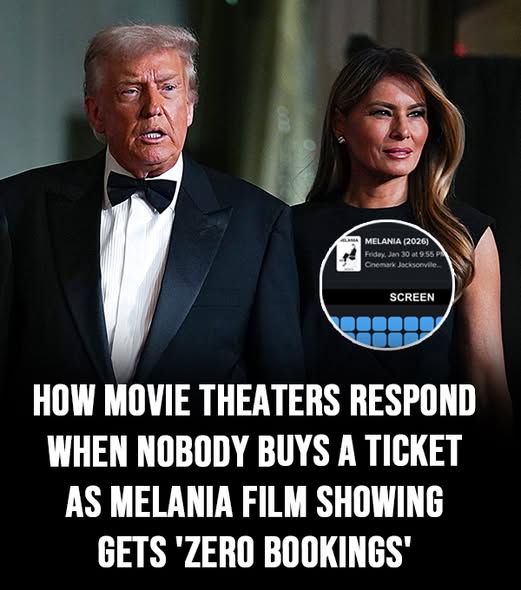
The debut of a documentary titled Melania was intended to serve as a polished portrait of one of the most private figures ever to occupy the role of First Lady. Released in late January 2026, the film promised viewers an unprecedented look into Melania Trump’s life, responsibilities, and personal journey—an experience she described as both “personal” and “remarkable.” Yet when the documentary officially opened in U.S. theaters on January 30, attention quickly shifted away from its glossy premise and toward a far less flattering reality: sparsely populated screenings, reports of unsold showtimes, and mounting questions about whether the project resonated beyond its core audience.
The documentary’s roots trace back to the closing weeks of 2024, just ahead of Donald Trump’s return to the presidency. Amazon reportedly acquired distribution rights for the film in a deal estimated at roughly $40 million, a figure that signaled high expectations for both cultural relevance and commercial reach. Throughout production, Melania Trump positioned the project as an effort to reshape public understanding of her role. In interviews, she emphasized that the film would highlight how demanding her daily life truly was—an aspect she felt had been consistently overlooked. Though initially scheduled for release in late 2025, the premiere was ultimately pushed to January 30, 2026, aligning with the one-year milestone of the administration’s return to Washington.
Donald Trump actively promoted the documentary across social media, calling it essential viewing and insisting ticket sales were booming. However, as opening weekend approached, publicly available seating charts painted a different picture. Screenshots circulated online showed theaters across major U.S. cities with rows of empty seats and, in some cases, entire showings without a single reservation. The contrast between promotional claims and visible attendance sparked online ridicule, with critics framing the rollout as an example of political visibility failing to translate into genuine audience interest.
Behind the scenes, the slow start reportedly prompted a rapid response from politically aligned groups. Entertainment columnist Rob Shuter claimed that Republican organizations in conservative regions were quietly encouraged to purchase blocks of tickets—or underwrite full screenings—to avoid the optics of empty auditoriums. According to sources cited in his reporting, the strategy was less about revenue and more about appearances. Additional claims suggested tickets were being offered at steep discounts or distributed freely through partisan channels, leading some observers to characterize the screenings as symbolic gestures of loyalty rather than standard theatrical events.
The situation has also shed light on how movie theaters handle underperforming releases. Former cinema employees discussing industry practices online noted that when no tickets are sold for a particular showtime, theaters often make cost-saving adjustments. During peak hours, films may still play automatically to empty rooms. For late-night or low-traffic slots, managers may power down projector lamps—an expensive component—until a customer arrives. These so-called “ghost screenings” are not uncommon for films with weak turnout and often become a quiet benefit for staff tasked with cleaning otherwise unused spaces.
Despite the underwhelming attendance reports, the Trump camp has continued to project confidence. On January 25, a private screening was held at the White House, which Melania Trump later described online as a “historic occasion.” In her posts, she framed the documentary as something more enduring than a commercial release—positioning it as a meaningful personal record rather than a box-office endeavor. Supporters echoed that sentiment, viewing the film as a dignified account of her experiences rather than a product meant for mass appeal.
Public response outside that circle has been more reserved. Media analysts suggest that audience fatigue surrounding political personalities may be a key factor. After years of constant coverage involving the Trump family, even a high-budget, Amazon-backed documentary may struggle to attract viewers beyond its most committed supporters. Melania arrives in a media environment defined by sharp polarization, where viewers tend to approach politically adjacent content with either strong loyalty or deep skepticism.
As the documentary enters its first full week of nationwide screenings, its long-term performance remains unclear. While coordinated ticket purchases may temporarily inflate attendance figures, sustained success typically depends on organic interest—something the film has yet to demonstrate convincingly. Whether curiosity, word of mouth, or renewed promotion can reverse its fortunes remains to be seen. For now, Melania stands as a revealing example of the limits of political branding, illustrating that even extensive promotion and high-profile backing cannot always guarantee a full house.