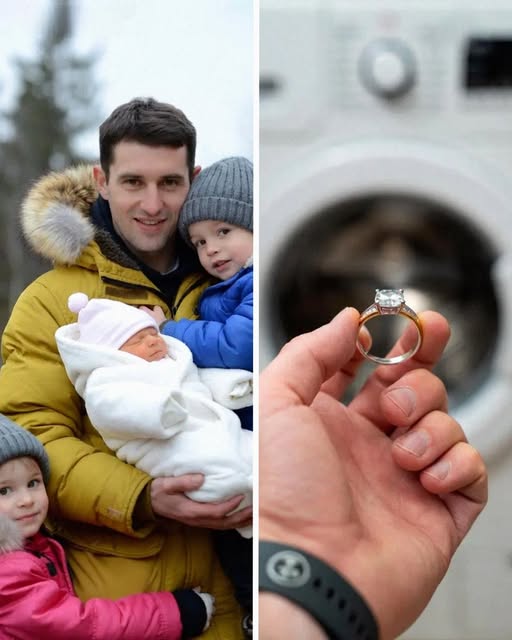
When you’re raising kids alone, hitting “rock bottom” doesn’t happen once — it keeps moving lower. For Graham, a thirty-year-old father juggling life with three children, it struck on a sticky summer afternoon when his old washing machine sputtered, rattled, and finally stopped in the middle of a load. He stared at the tub filled with cloudy water and half-clean clothes, feeling like the universe had just added another problem he couldn’t afford.
Single parent life was already a nonstop balancing act: keeping the lights on, putting food on the table, and trying to give his kids some sense of normal childhood. A broken washer wasn’t a minor inconvenience — it was a disaster.
“Is it broken for real?” little Milo asked quietly, already used to things falling apart.
Graham looked at Nora, Hazel, and Milo and swallowed hard. Buying new was impossible. Even used was a stretch. Still, by the weekend they found themselves at a secondhand shop staring at a scratched machine in the corner with a handwritten sign: “$60 — sold as is.”
It was a risk, but it was their only option.
Hooking it up turned into a noisy family project filled with tangled hoses and kids pretending to help. When Graham finally started the test cycle, the washer began to spin — then came a sharp clanging sound, like metal hitting metal.
Alarmed, he shut it off and reached inside once the water drained. His fingers touched something cool and solid.
In his palm sat a gold band with a small diamond, worn smooth from years of use. Inside the ring were faint engraved words:
To Claire — forever — L.
The room went silent.
To the kids, it felt like finding pirate treasure. To Graham, it felt like temptation.
That ring could pay the electric bill. It could cover groceries. It could ease weeks of stress in one move.
But Nora’s soft voice cut through his thoughts.
“Dad… that was somebody’s love ring, wasn’t it?”
That was all it took.
He nodded slowly. “Yeah. And that means it belongs to someone else.”
Returning it wasn’t easy. The thrift store employee hesitated at first but eventually remembered an elderly woman whose son had donated the washer for her safety. He gave Graham the address — a small home with peeling paint but a garden blooming with care.
When Claire opened the door, suspicion flickered in her eyes — until Graham held out the ring.
She gasped.
Tears streamed down her face as she clutched it to her chest, sinking into a chair.
She told him it had disappeared years earlier, long before her husband Leo passed away. They’d searched everywhere, never thinking it had slipped into the washing machine’s drum. Losing it felt like losing her husband all over again.
“You brought him back to me,” she whispered.
She hugged Graham tightly, thanking him over and over.
He left with cookies in his hands and something lighter in his heart than he’d felt in years.
That night, despite the chaos of kids and laundry piles, he slept peacefully.
Until sirens woke him.
Just after dawn, flashing red and blue lights filled his front yard. Graham rushed to the window in panic — police cars lined the street, blocking his driveway.
Fear surged through him as he ushered the kids into the bedroom and stepped outside.
An officer walked forward, smiling gently.
“Graham? I’m Mark. Claire’s grandson.”
Relief nearly knocked him off his feet.
Mark explained that several family members were officers. When Claire shared what Graham had done — choosing honesty when life was hard — word spread fast.
“We see bad choices every day,” Mark said. “We just wanted to show you that good ones matter too.”
He handed Graham a handwritten note from Claire:
This ring held my life’s love. You returned it when you needed it most. I’ll never forget you. — Claire
The officers let the kids sit in the patrol cars, flip the sirens, and laugh as fear turned into excitement.
When the street finally grew quiet again, Graham taped Claire’s note to the fridge.
It became a daily reminder: life was tough, money was tight — but character was priceless.
That $60 washer didn’t just clean clothes.
It reminded a family who they were.