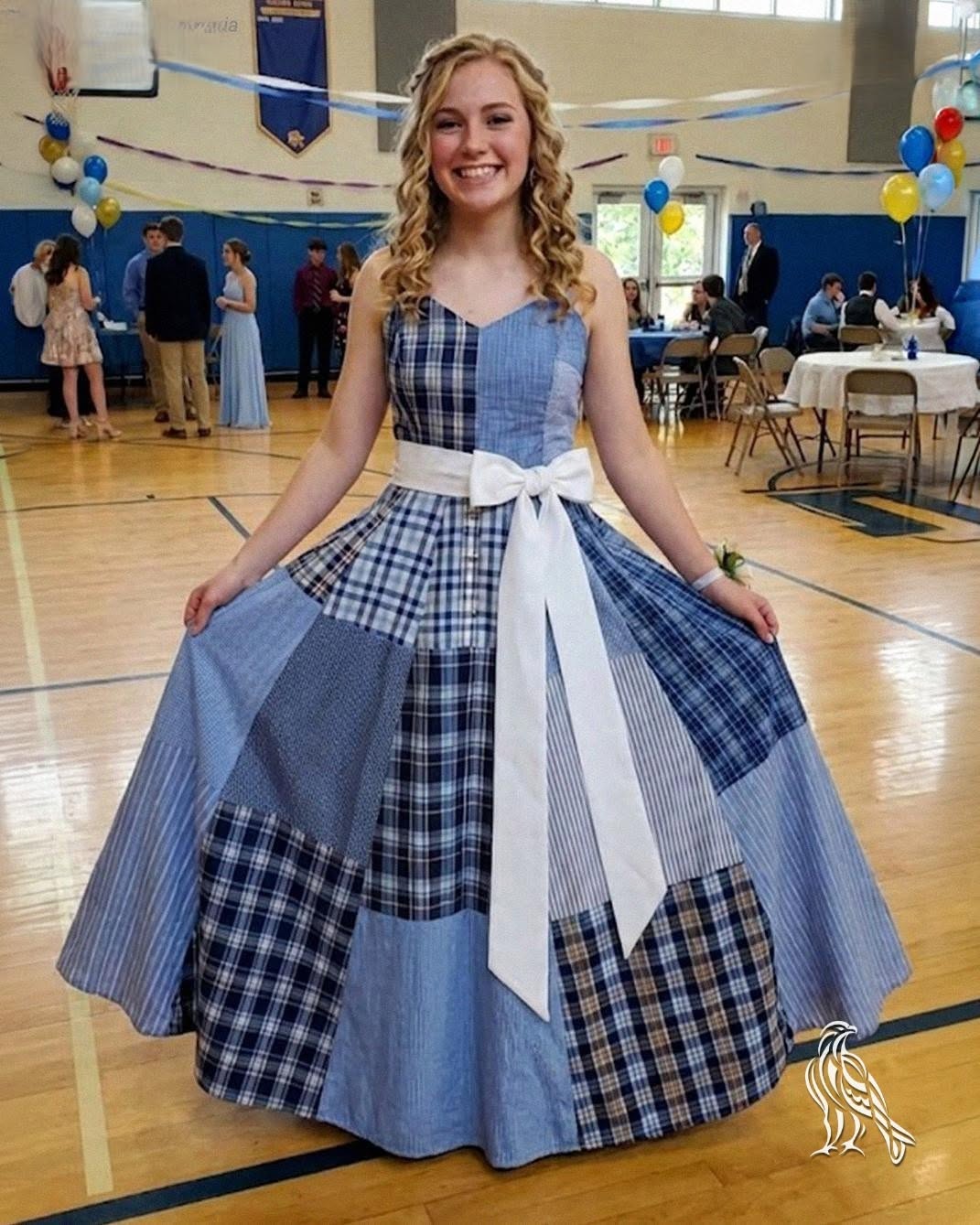
For Maya, it felt like walking into a room full of knives.
She took one step backward.
Then another.
Her eyes burned.
She could already imagine herself running to the bathroom, locking herself in a stall, and calling her aunt to pick her up.
Maybe she had made a mistake.
Maybe this was too personal.
Maybe some memories were meant to stay folded in drawers.
Then someone near the refreshment table said it again, louder this time.
“Seriously, that dress is disgusting.”
Maya’s throat tightened.
She turned toward the door.
She was almost gone.
Almost.
Then the music stopped.
Not faded.
Not lowered.
Stopped.
The sudden silence cut through the room.
Everyone looked toward the stage.
Principal Howard stood there with a microphone in his hand.
He wasn’t smiling.
He wasn’t holding cue cards.
He looked across the ballroom slowly, his face calm but his eyes sharp enough to make half the room straighten in place.
“Before the next song,” he said, “there is something all of you need to know.”
The room went still.
Maya froze near the door.
She didn’t know what was happening.
And then Principal Howard looked directly at her.
“Maya,” he said gently, “please don’t leave.”
The entire ballroom turned.
Every eye landed on her.
Her heart pounded so hard she could feel it in her fingertips.
She wanted to disappear.
But the principal continued.
“Many of you knew Mr. Ramirez,” he said.
A few teachers lowered their heads.
Some students looked confused.
Most of them didn’t know that name.
They had seen him, of course.
But they hadn’t known him.
That was the point.
“Maya’s father worked at this school for eleven years,” Principal Howard said. “He was part of this building long before most of you walked through the doors as freshmen.”
A murmur moved through the room.
“He fixed the lockers you slammed,” the principal continued. “He cleaned the hallways after your pep rallies. He stayed late after basketball games when everyone else went home. He came in early during snowstorms to make sure the sidewalks were safe before the first student arrived.”
Maya’s lips parted.
She had no idea he was going to say any of this.
Principal Howard looked around the ballroom.
“He washed uniforms when teams forgot them. He repaired broken desks teachers needed the next morning. He changed lightbulbs in classrooms nobody wanted to sit in when they were too dim. He opened doors for students carrying too many books. He helped kids find lost phones, lost backpacks, and sometimes the courage to get through a bad day.”
The room had changed.
The laughter was gone.
The girls by the photo booth no longer looked amused.
The boy from the soccer team stared at the floor.
Maya stood completely still, tears already gathering in her eyes.
The principal’s voice grew quieter.
“He did all of this without asking for attention. Without applause. Without anyone calling him important.”
He paused.
“But he was important.”
No one moved.
“He was the kind of man who believed dignity was not found in a title. It was found in how you treated people when no one was watching.”
Maya pressed one hand against her chest.
Her dress suddenly felt heavier.
Not with shame.
With memory.
She remembered her father coming home tired, his hands rough from work, smelling faintly of soap, metal, and cold air.
She remembered him sitting at the kitchen table, rubbing his knees, and still asking about her homework before taking off his boots.
She remembered how he always said, “Work is work, mija. But love is what makes it worth doing.”
Principal Howard turned back toward her.
“Maya’s dress tonight is made from her father’s shirts.”
A soft gasp passed through the ballroom.
Not mocking this time.
Something else.
Something smaller.
Something ashamed.
“She made it herself,” he said. “Not because she couldn’t wear something else. Not because she wanted attention. But because she wanted her father with her tonight.”
Maya’s tears slipped down her cheeks.
“She wanted him to walk into this room with her.”
The room remained silent.
“And some of you laughed.”
Those four words landed harder than any shout could have.
Some of you laughed.
Nobody looked comfortable now.
Not the girls.
Not the boys.
Not the students who had only smiled because everyone else did.
Principal Howard let the silence sit there.
He didn’t rush to fill it.
He let them feel it.
Then he continued.
“I hope all of you remember this moment. Not because I want you to feel embarrassed for one night. But because I want you to understand something you should have learned long before prom.”
His eyes moved across the room.
“Before you mock what someone is wearing, ask yourself what it might mean to them.”
Another pause.
“Before you laugh at someone’s difference, ask yourself what story you don’t know.”
A teacher near the wall wiped her eyes.
“And before you decide someone is beneath you, remember that many of you have walked through clean halls, sat in repaired classrooms, and played on polished courts because a man you barely noticed cared enough to do the work.”
That was when Mrs. Collins, the English teacher, stood.
Then Coach Daniels.
Then two cafeteria workers.
Then a group of basketball players.
One by one, people rose from their chairs.
Teachers.
Students.
Parents.
Athletes.
Kids who had laughed only minutes before.
More than half the room stood.
Then nearly everyone.
The applause started softly.
Then grew.
Maya covered her mouth.
She didn’t know what to do.
For months, she had carried her father’s absence like a stone under her ribs.
At home.
At school.
In the grocery store when she saw his favorite cereal.
In the parking lot when she spotted a truck like his.
And now, for the first time since he died, she felt like other people could see even a small part of what she had lost.
Not perfectly.
Not fully.
But enough.
Principal Howard stepped down from the stage and walked toward her.
He held out the microphone.
“Maya,” he said softly, “you don’t have to say anything. But if you want to, you can.”
Every part of her wanted to say no.
Her hands were shaking.
Her throat hurt.
Her face was wet.
But then she looked down at the dress.
At the blue plaid.
At the gray cotton.
At the navy work shirt.
At the white fabric she had saved because it still felt like him.
And she took the microphone.
The room quieted again.
Maya looked at the students in front of her.
The same students who had laughed.
The same ones who now could barely meet her eyes.
She didn’t give a speech.
She didn’t scold them.
She didn’t try to sound brave.
She simply said what she had come there needing to say.
“My dad promised he would see me go to prom.”
Her voice trembled.
A few people started crying.
“He got sick before that could happen.”
She swallowed hard.
“So I made this dress because I wanted him here.”
She looked down at the sleeves stitched into the skirt.
“He used to tell me that if I walked into a room with love, I’d never walk in alone.”
The room was completely silent.
Maya wiped her cheek.
“I was scared to wear it. But I think he would have liked it.”
Her voice cracked.
“I hope I made him proud.”
That was all.
She lowered the microphone.
For one heartbeat, nobody moved.
Then the applause came again.
Louder than before.
But this time, Maya didn’t feel trapped by it.
She felt held by it.
Not by everyone.
Not completely.
Some people clapped because they were ashamed.
Some because others were clapping.
But some meant it.
And for that night, that was enough.
The girl who had called the dress disgusting stepped forward later with red eyes.
“I’m sorry,” she said.
Maya looked at her for a long moment.
She didn’t say it was okay.
Because it wasn’t.
Instead, she said, “Just don’t do it to someone else.”
The girl nodded.
That was enough too.
The Dance She Almost Missed
When the music finally started again, Maya stayed near the edge of the dance floor.
She wasn’t ready to dance yet.
Then Coach Daniels walked over and held out a hand.
“Your dad used to give me grief for leaving equipment in the wrong closet,” he said. “I probably deserved it.”
Maya laughed through her tears.
“He hated messy storage rooms.”
“He sure did.”
Coach Daniels smiled.
“Would you let an old coach have the first dance?”
Maya hesitated.
Then she nodded.
They stepped onto the dance floor.
The song was slow.
The room watched quietly.
Not with mockery now.
With something closer to respect.
After that, others joined.
Her friends.
A few teachers.
Even some classmates who had never spoken to her much before.
Maya didn’t suddenly become popular.
Life is not that simple.
One speech does not erase years of being overlooked.
One apology does not undo cruelty.
But something had shifted.
The dress was no longer a joke.
It was a story.
And once people understood the story, they could never see it the same way again.
After Prom
That night, after the music ended and the lights came up, Maya didn’t go straight home.
She asked her aunt to drive to the cemetery.
The rain had started softly, tapping against the windshield as they pulled through the narrow road between rows of headstones.
Maya stepped out carefully, lifting the hem of the patchwork dress so it wouldn’t drag through the wet grass.
Her aunt stayed by the car.
Maya walked alone to her father’s grave.
The cemetery was quiet.
The kind of quiet that feels heavy but honest.
She stood in front of the stone and looked down at the dress.
The fabric was damp now.
Her curls were frizzing from the rain.
Her makeup was gone from crying.
But she didn’t feel embarrassed anymore.
“Hi, Dad,” she whispered.
The wind moved gently through the trees.
“I wore it.”
Her voice broke.
“I almost ran away. But I didn’t.”
She knelt in the grass, not caring that her knees got wet.
“Principal Howard told them about you.”
She laughed softly through tears.
“He said you fixed lockers and washed jerseys and stayed late. He made it sound like you were famous.”
Then she touched the blue plaid sewn near her heart.
“But I already knew.”
The rain fell a little harder.
Maya closed her eyes.
“I hope you saw me.”
For the first time all night, she let herself cry without trying to stop.
Not because she was humiliated.
Not because people had laughed.
But because she missed him.
Because she had carried him into that ballroom the only way she could.
Because love had made her brave, even when bravery felt like standing still while everyone stared.
What She Finally Understood
Before that night, Maya thought dignity was something other people gave you.
Respect.
Approval.
A place at the table.
A kind word.
But standing at her father’s grave in a dress made from his old shirts, she understood something different.
Dignity had never been in the job title.
It had never been in the uniform.
It had never been in whether people noticed him walking down the hallway with a mop bucket or toolbox.
Her father had dignity because he lived with love.
Because he worked hard.
Because he helped people who barely remembered to thank him.
Because he came home tired and still made her laugh.
Because he never needed a spotlight to matter.
And she had dignity too.
Not because the room finally clapped.
Not because the principal defended her.
Not because people stood after realizing they were wrong.
She had dignity because she had walked in wearing love.
Even when love looked like old fabric stitched together by trembling hands.
Even when people didn’t understand it.
Even when they laughed.
The Dress Went Home With Her
Maya never wore the dress again.
But she didn’t hide it either.
She hung it carefully in her closet, inside a clear garment bag.
Sometimes, when grief returned suddenly, she opened the closet and touched the sleeve.
The gray cotton.
The blue plaid.
The navy patch.
The pieces of a man who had spent his life quietly holding things together.
A few weeks after prom, the school announced that the maintenance room would be renamed in honor of Luis Ramirez.
Not a huge ceremony.
Not a dramatic event.
Just a plaque near the door.
It read:
Luis Ramirez
For the work seen and unseen.
Maya stood beside Principal Howard when they placed it there.
This time, there was no ballroom.
No music.
No applause that shook the walls.
Just a quiet hallway and a small group of people who finally understood that some of the most important people in a school are the ones others forget to notice.
Maya looked at the plaque and smiled.
Her father had not been invisible.
Not anymore.
The Lesson Everyone Took Home
The story spread through the school, but Maya refused to let it become gossip.
When people asked about the dress, she answered simply.
“It was made from my dad’s shirts.”
And if they asked why, she said:
“Because I wanted him with me.”
That was enough.
The students who had laughed didn’t all become better overnight.
But some changed.
A few started thanking the custodial staff.
A few stopped making jokes so quickly.
A few noticed things they had ignored before.
And maybe that was how change started.
Not with one perfect apology.
Not with one speech.
But with a moment that made people uncomfortable enough to see themselves clearly.
Maya had entered prom afraid that people would only see an odd dress.
By the end of the night, they saw a daughter.
A father.
A story.
A love stitched into every seam.
And maybe, for the first time, they understood that the things people carry are not always obvious.
Sometimes grief looks like silence.
Sometimes courage looks like walking into a room.
Sometimes memory looks like fabric.
And sometimes the strongest person in the ballroom is the girl everyone laughed at before they knew the truth.
Would you have had the courage to wear something so meaningful, even if others didn’t understand it? Share your thoughts below — and pass this story on as a reminder to think before judging what someone carries into the room.