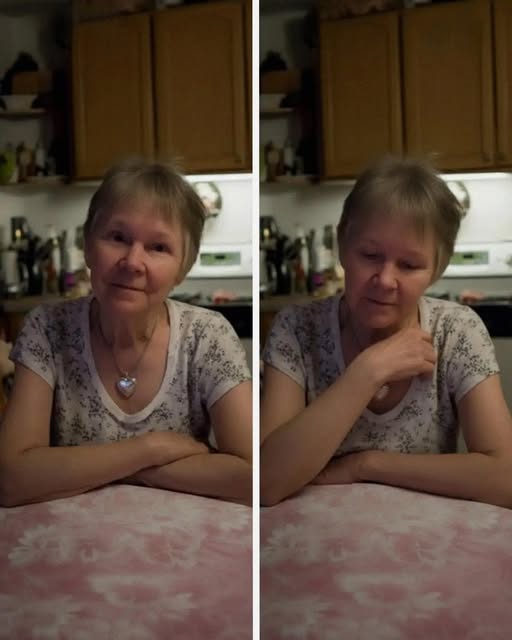
My mother, Nancy, survived by mastering restraint. Her life was shaped by careful choices and quiet endurance, an existence where nothing was wasted and every resource was stretched to its limit. In our home, tea bags were reused until they were nearly colorless, heat came from layered sweaters rather than the thermostat, and every jacket bore evidence of her steady, deliberate repairs. She denied herself nearly every comfort—save for one peculiar exception. A small, gold-colored heart locket she bought for two dollars at a thrift store nearly fifteen years ago. Its shine had faded long ago, yet she wore it constantly, even in hospice, as though it carried meaning far beyond its value.
When I asked her what was inside, she always answered the same way, with a tired smile and gentle dismissal. “It broke a long time ago, Natalie,” she’d say. “I sealed it so it wouldn’t catch on my yarn. There’s nothing in there.” I believed her. My mother had never seemed like someone who carried secrets.
I was wrong.
Three weeks after she died, the locket became something else entirely. My six-year-old daughter, Ruby, was born with significant conductive hearing loss. Sound reaches her world in fragments—through vibration, through movement, through careful observation. She and my mother shared a quiet bond built on shared routines: kneading dough, planting flowers, sitting together without words. After the funeral, Ruby held the locket carefully and said, “Grandma promised this was mine. She used to tap it twice before leaving. Like a signal.”
Later that evening, as I cleaned the locket for her, it slipped from my hands and struck the floor. The noise stopped me cold. It wasn’t hollow. Something inside shifted. Rattled.
Instinct took over. I carried it to the kitchen, armed with acetone and a razor, and worked slowly, dissolving the adhesive my mother had applied years earlier. When it finally opened, a tiny microSD card fell out, along with a narrow strip of paper written in her familiar hand.
“If you’re reading this, Natty, I’m gone. Please be careful. This is important.”
My heart sank. My mother barely trusted modern appliances—why would she hide digital storage inside jewelry? Fear flooded in. Unsure what else to do, I contacted the police.
The next morning, Detective Vasquez arrived. Calm and methodical, she took one look and assured me this was more than a sentimental keepsake. The card was sent to forensic analysts, and I was left waiting, trying to function while everything felt suspended.
While I waited, reality intruded. A letter arrived denying coverage for Ruby’s hearing surgery. The procedure was labeled “nonessential.” Reading it felt cruel. As if my child’s ability to hear her mother speak was optional.
Three days later, I was called to the station. A technician sat across from me, visibly stunned. “This memory card contains a private Bitcoin wallet key,” he explained. “And it dates back to 2010.”
The balance displayed on the screen was staggering. A sum large enough to alter the course of our lives—hidden inches from my mother’s heart for over a decade. Alongside it was a scanned note explaining everything.
Years earlier, my mother had met a homeless veteran named Emmett behind the church. She brought him pie and coffee, not out of charity, but simple kindness. In return, he handed her a card wrapped in a napkin and told her to keep it safe—for her daughter. She didn’t understand what it was, but she understood trust. And so she guarded it, even while living without heat, even while counting every penny, believing one day it would matter.
I went home and stood in the living room, staring at the thermostat. For the first time, I turned it up without guilt. As warm air filled the room, I cried—not from relief alone, but from the realization of how much she had endured in silence so we wouldn’t have to.
The money changed our circumstances, not our values. I paid for Ruby’s surgery. I fixed the roof. I cleared our debts. I filled the fridge with food we no longer had to ration.
The day Ruby’s bandages were removed, the audiologist adjusted the device and softly said, “Listen.” Ruby froze, eyes wide, absorbing sound for the first time with clarity. I leaned in and asked, “Can you hear me?”
She smiled—slowly, brilliantly. “Your voice,” she said. “It feels warm.”
Today, Ruby wears the heart locket daily, polished and sealed once again. She taps it twice every time she leaves the house, just like her grandmother did. The rattle is gone, but the meaning remains.
I think often of the man behind the church, the pie my mother baked, and the years she spent protecting something she barely understood. She taught me that wealth isn’t about accumulation—it’s about sacrifice, foresight, and love expressed quietly.
Ruby can hear birds now. She can hear music. And she can hear stories about the woman who lived humbly, loved fiercely, and left behind a legacy louder than words.