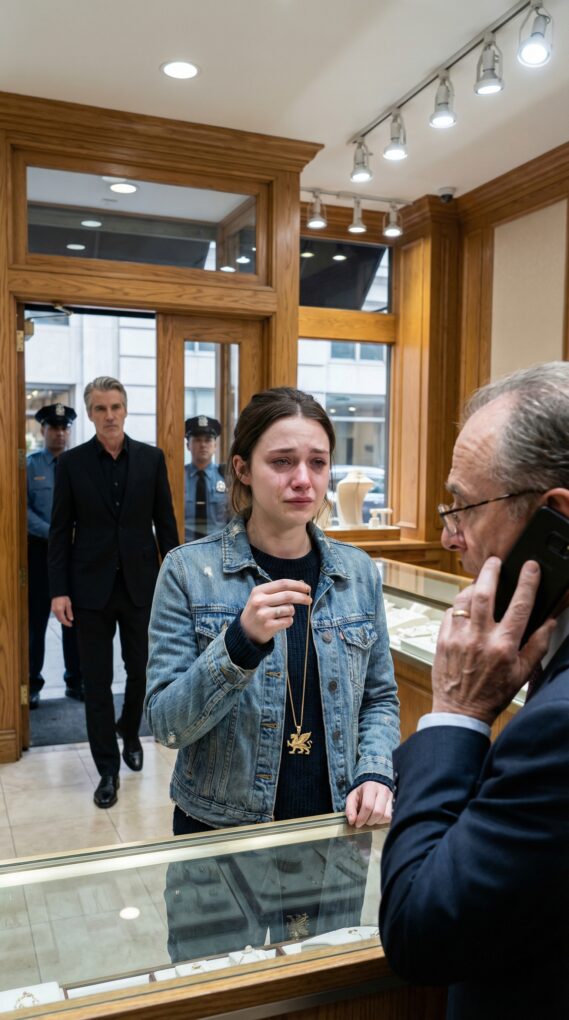
The jewelry shop sat quietly between a pawn store and a closed bakery, easy to miss if you weren’t looking for it. A small bell chimed as I entered. The jeweler behind the counter was older, calm, and professional—until I slid the necklace toward him.
“I’d like to sell this,” I said.
He barely glanced at it. Then his fingers froze around the pendant.
His expression changed instantly. Color drained from his face as he turned the necklace over, studying the back with sudden intensity. The atmosphere in the room felt heavier.
“Where did you get this?” he asked quietly.
“It belonged to my mother,” I replied. “Her name was Diane Carter.”
The man stood so abruptly his chair scraped the floor. He retrieved a magnifying tool from beneath the counter and examined a tiny engraving I’d never noticed before.
“Miss,” he said, his voice unsteady, “someone has been looking for you for a very long time.”
Before I could ask what he meant, a door behind the counter opened. A tall man stepped into the shop, composed and confident, as if he belonged there.
“Alyssa,” he said.
I didn’t recognize him, but he spoke my name like he did.
He introduced himself as Richard Harlan and explained that the pendant was part of a private collection connected to his family—one that disappeared decades ago. My mother, he said, had once worked in his household before abruptly leaving her job and disappearing from their lives.
The jeweler retrieved an old photograph. In it, my mother stood beside a display of jewelry, the same pendant visible around her neck. Seeing it made my stomach drop.
Richard told me that my mother had been quietly blamed for the necklace’s disappearance, though he never believed she took it for personal gain. Instead, he suspected she was protecting someone—or trying to escape a situation she couldn’t safely explain.
Then he said something that unsettled me more than anything else.
“Your divorce wasn’t a coincidence,” he said. “You started asking questions about your mother’s past. Shortly after, everything in your life unraveled.”
I thought of Mark’s strange fixation on the necklace during the divorce—how he’d made sure I took it with me. At the time, I assumed it was spite. Now, I wasn’t so sure.
Richard handed me a simple business card and asked me not to sell the necklace. He believed it held answers my mother wanted me to find—but only when I was ready, and only when I had no other choice.
Before leaving, I looked closely at the back of the pendant. Under the scratches, faint letters appeared: D.C. — 04/18. My mother’s initials. A date I didn’t recognize.
Outside, the rain felt sharper, more real. I walked toward the bus stop with the necklace hidden under my sweater, realizing that the past I’d never questioned might explain far more than my divorce.
Now I’m left with a decision: confront my ex and risk stirring something dangerous—or quietly uncover the truth my mother left behind.
Either way, nothing about my life is as simple as it once seemed.