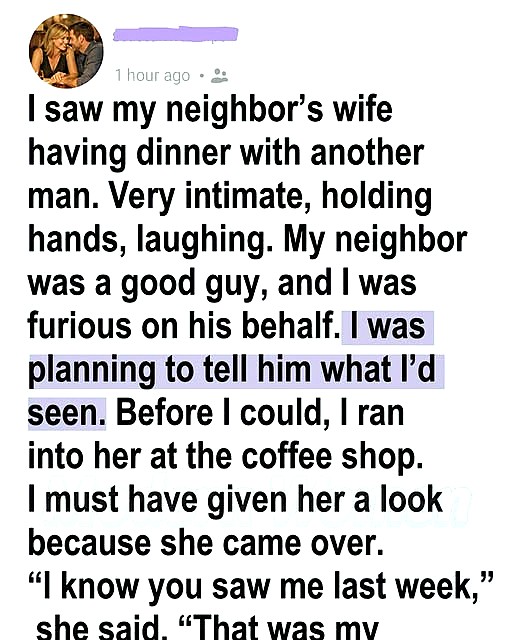
My chest tightened. Had I been caught? Was this confrontation about to escalate?
“That was my brother,” she said softly. “He flew in from overseas.”
Confusion hit me, followed by the sharp sting of embarrassment. But the real shock came next: “I have six months to live. Stage four cancer.”
Everything I’d been carrying—anger, certainty, moral clarity—collapsed instantly. The dinners I had misread, the laughter I had misjudged, suddenly had meaning. Her brother was her anchor, her safe space to be vulnerable, someone she could lean on without shielding Mark from fear.
“I haven’t told my husband yet,” she whispered. “I don’t know how to face him, to take away the future we imagined.”
I apologized on the spot, words tumbling out, heavy with shame. She listened, offered a small, sad smile, and let it go.
A week later, she finally told Mark. I was there—not to speak, not to intervene, just to be present. Sunlight spilled across the living room floor. Mark joked about dinner, complained about work, completely unaware of the revelation about to hit him.
When she spoke, the sound he made wasn’t words. It was raw, broken, human. He held her like letting go wasn’t an option, and I realized how close I had come to destroying that fragile, sacred moment—all because I assumed I knew the truth after seeing only a single page.
I learned something crucial that week:
Sometimes what looks like betrayal is grief in disguise. Intimacy can be survival, not deceit. And the truth isn’t always yours to deliver. The most dangerous thing I carried wasn’t information—it was certainty. Certainty that I understood enough, certainty that I was right, certainty that good intentions guaranteed good outcomes.
They don’t.
Restraint can be the deepest act of compassion. Silence, when chosen wisely, is respect. Judgment can never be undone.
I almost shattered something sacred because I thought I had all the answers. I won’t make that mistake again.
Before rushing to judgment, pause. Listen. Observe. Compassion often begins in restraint, not action.