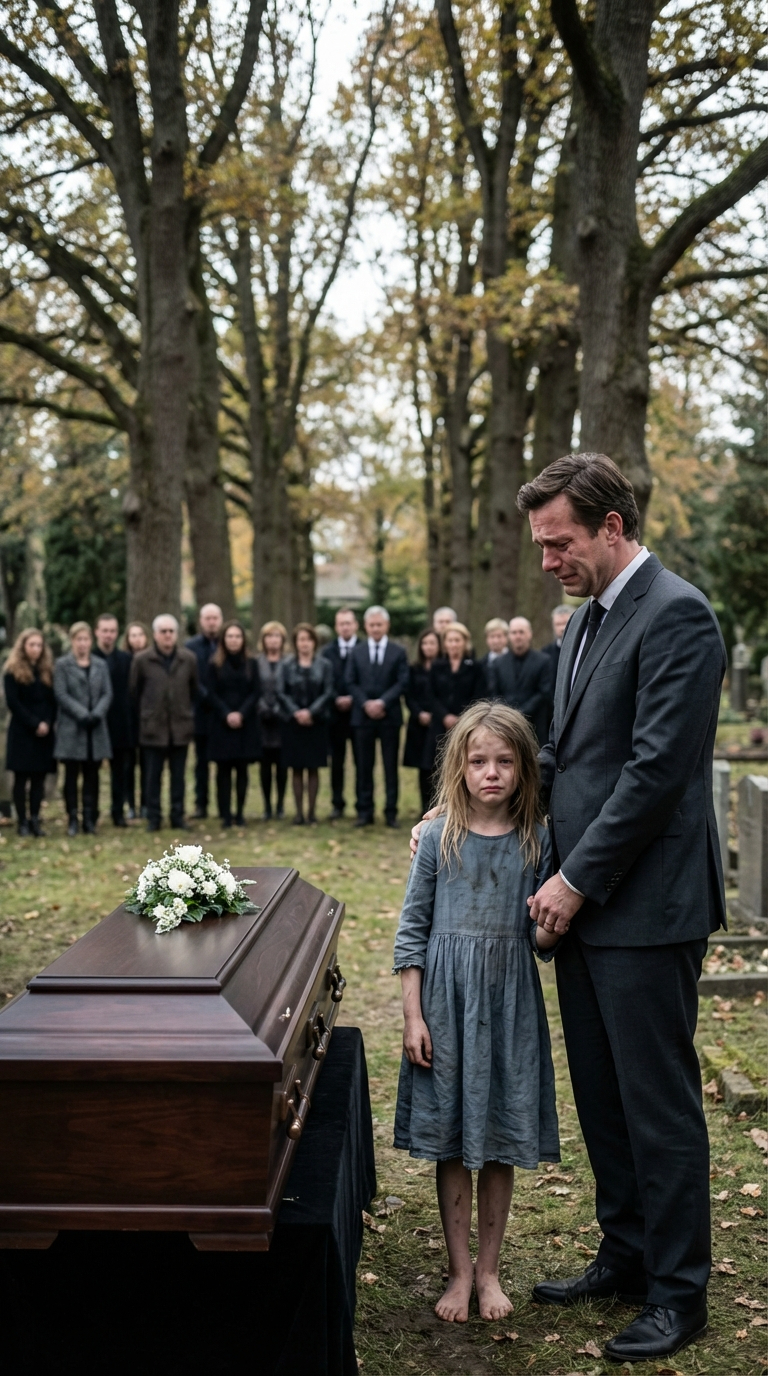
My wife, Eleanor Hayes, had been gone for six days.
According to my family, she had died instantly in a late-night car accident so severe I was advised not to see her body. My sister Madeline handled everything—arrangements, documents, legal matters—while my younger brother Oliver quietly supported her decisions.
“They’re protecting you,” everyone said.
I believed them.
As the officiant raised his hands for the final prayer, the silence became overwhelming.
Then I heard footsteps.
Fast. Uneven. Desperate.
Murmurs rippled through the crowd. Heads turned.
A young girl ran through the rows of gravestones, stumbling as she went. She looked no older than eight, her hair tangled, her jacket far too big. Security tried to intercept her, but she slipped past them and ran straight toward me.
Madeline tightened her grip on my arm. “This shouldn’t be happening,” she whispered sharply.
The girl reached me and clutched my jacket, shaking.
Then she shouted words that froze the entire cemetery.
“Stop! She isn’t gone!”
Everything stopped.
The officiant fell silent. Conversations broke out in hushed disbelief.
I looked down at the child, my heart pounding.
“What are you talking about?” I asked quietly. “Who are you?”
Before she could answer, Madeline stepped forward, her composure cracking. “Remove her,” she ordered. “She’s confused.”
A guard reached for the girl, but she clung tighter.
“I saw her,” the girl cried. “She’s alive. At Ridgeway Care Facility. Room 412.”
The specificity sent a chill through me.
Ridgeway existed. I knew the place.
“Wait,” I said.
My voice wasn’t loud—but it was final.
The guard hesitated, then stepped back.
I knelt in the grass beside her. “What’s your name?”
“Lena,” she whispered. “Lena Brooks.”
“Lena,” I said gently, “my wife was declared deceased.”
“I know,” she replied. “They called her someone else. But a nurse said her name was Eleanor. She said people were paid not to talk.”
I stood slowly and looked at my sister.
“She knows the room number,” I said.
Madeline shook her head. “This is absurd.”
I called Ridgeway on speaker.
After a pause, the receptionist spoke carefully.
“We don’t have an Eleanor Hayes listed. But we do have a patient in room 412—admitted six days ago. Unidentified. Female. Blonde. Mid-forties. Crescent-shaped birthmark on her left shoulder.”
My phone slipped from my hand.
That was Eleanor.
I walked toward the coffin.
“Don’t open it!” Madeline shouted.
I opened it anyway.
Inside was not my wife—but a weighted mannequin dressed in her clothing.
The truth unraveled quickly after that.
Eleanor had discovered financial manipulation within our family trust. Someone intended to remove her quietly, declare her gone, and finish what they started. What no one accounted for was a child who noticed details others ignored.
We found Eleanor alive—injured, sedated, but breathing.
When she said my name, grief turned into something else entirely.
The authorities became involved. The truth came out.
One year later, Lena lives with us. She has stability, safety, and a future.
Eleanor recovered.
We rebuilt our lives—not around wealth or appearances, but honesty.
Because harm doesn’t always arrive as a stranger.
Sometimes, it wears the face of family.
And sometimes, the truth comes from the quietest voice in the room.